Six-year-old Finn came inside the house from the pool and ran dripping wet past me on his way to the kitchen to get a bag of chips. I was sitting in my antiquated deep blue velvety cloth recliner in the den watching TV when he zipped by.
“Every time I come to your home, you’re always sitting in the same chair watching TV,” Finn commented as he raced past me.
“Hey,” I said to his back. “Why do you think I do that?”
He barely turned and said with a tone of dismissal in his voice, “I guess it’s because you’re lazy.” Point taken.
Six years later I continue to hover in my recliner in front of the same TV but with a different new brown leather comfy chair that includes a remote for adjusting my sitting positions. Ah, technology at its finest thanks to the generosity of our best friends Francie and Nekki.
Sometimes I feel I’ve earned my laziness as reparations for the forty-five frantic years I labored with numbers in the work force, at other times I worry I inherited the right to laziness through the hard work of my ancestors whose sacrifices for family shouldn’t be disrespected by my inability to be productive; but today, I cast laziness to the winds, muted the TV, sat in an upright position and committed anew to this project of recapturing images of the people and places that shaped my solitary journey from playing outside on the dusty red dirt roads of a tiny town in rural southeast Texas as a child to living seven decades later inside a middle-class suburban home in South Carolina facing a blank computer screen screaming give me words.
I will be seven and seventy years old this year with a life expectancy of fourteen more according to reputable statistics – a sobering thought to see numbers like these in print. Nothing is available to predict quality of life for those fourteen years, however, but laziness is not recommended by any of the experts on aging I have read.
One of the great bonuses of getting older is the freedom to own your truth, to reclaim the unfiltered mind of the child you were before the onslaught of the certainties from the adults in your rooms created doubts about who you were and what you believed. Today I get a free pass on words with my white hair, arthritic hands and feet, wrinkled sagging skin, watery eyes. Oh, ignore her, they laugh. She is old.
And so, I continue to tell it like I see it as I have done for the past fifteen years. For sure I’m closer to the end of my life than to the beginning, but maybe the words I own will resonate, rejuvenate, even cause us to celebrate our shared humanity which is relevant regardless of age.
Women’s History Month for Pretty and me begins with March Madness every year. While we fall woefully short of being perfect card-carrying lesbians in areas like do it yourself home improvements and/or knowing all the lyrics to Brandi Carlisle’s music – no disrespect to Brandi Carlisle whose songs we do love – we get better marks for being lesbian in two unrelated categories: devotion to our dogs (and now cats), obsession with sports (particularly women’s college basketball and professional tennis).
This first March weekend we kept I-26 hot driving a hundred miles north to Greenville, South Carolina from our home in West Columbia and riding the same hundred miles back on Friday, Saturday and Sunday to watch the University of South Carolina Gamecock Women’s basketball team play in the 2023 Southeastern Conference Tournament. We rode with two of our gay boys’ basketball buddies who cheer with us in our very loud Section 118 of the Colonial Life Arena during the regular season for every home game.
(clockwise) Garner, Brian, Pretty and me
standing in line on beautiful day in Greenville at Bon Secours Wellness Arena
Garner and me with Carolina logo featuring our
Gamecock mascot The General
Garner took this pic of me and ESPN analyst Holly Rowe on College Game Day
(Holly Rowe is the person in pink – Gamecock fans behind me)
Pretty and I love our Gamecockwomen’sbasketball team
the smiling faces of Champions – 2023 SEC tournament
(2022-23 regular season Champions, too with perfect record of 16-0 in the conference)
Photo by DWAYNE MCLEMORE, The State Newspaper
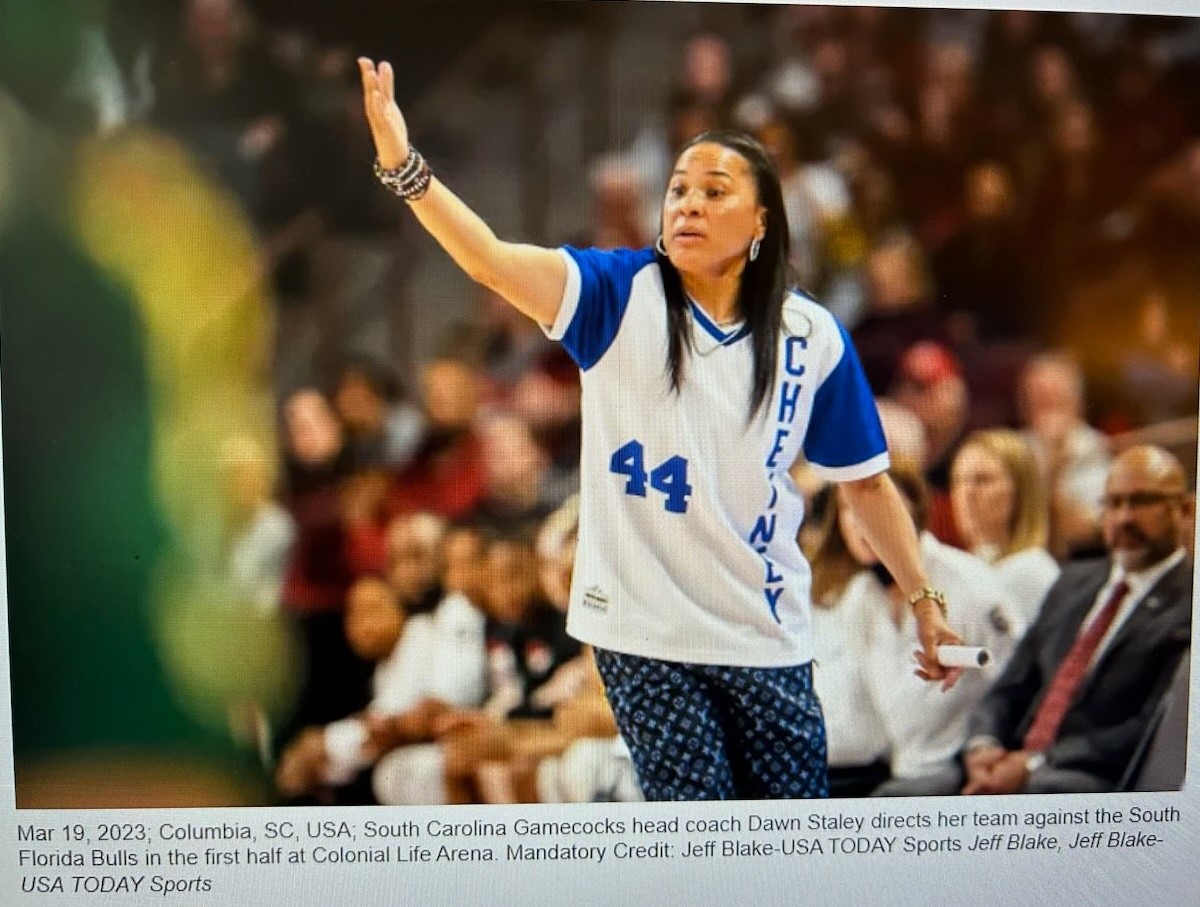
Head Coach Dawn Staley also happy as she cuts the net
photo by DWAYNE MCLEMORE, The State Newspaper
Head Coach Dawn Staley was named SEC Coach of the Year for the sixth time in 2023 as she completes her 15th. season with the University of South Carolina; the 2023 Tournament Championship win marked the seventh SEC title in the past nine seasons. Coach Staley’s Gamecock teams have won National Championships in 2017 and 2022, but the best team may be her current one which has an overall record of 32-0 staying in the #1 spot of the AP Poll every week from the beginning of the year. The 16-0 regular season record for the Gamecock women made them conference champions for the sixth time under Coach Staley. This team is one for the record books, but what is a remarkable team without great players?
The names of seniors Aliyah Boston, Zia Cooke, Brea Beal, Laeticia Amihere, Victaria Saxton, Kiera Fletcher, and Olivia Thompson will leave behind a stellar history for women’s Gamecock basketball not only for their team championships on the basketball court but also individual records that set high standards for the players who come after them. These young women have been inspirational in their dedication to their craft, community, and loyal fans who look forward to following their futures.
Thank you, Coach Staley, for guiding your teams to greatness – it’s been such a fun ride for your fan base which includes Pretty and me. More than that, however, thank you for preparing your players for making our world a better place.
I no longer have to imagine a world without John Lewis as I did when I originally published this piece in July, 2020 – because I have now lived in that world in real time for almost three years. I miss him.
********************
I cannot imagine a world without John Lewis. I knew him first as a Civil Rights activist in the 1960s when I was in college, but I’ve known him longest as a congressman from our neighboring state of Georgia who for the past 33 years fought for social justice issues in the US House of Representatives. When John Lewis spoke, I listened. On July 17, 2020 his voice spoke for a final time as he drew his last breath, but his words will live on for me and countless others across the planet he loved.
Two of my favorite quotes from Congressman Lewis:
“We may not have chosen the time, but the time has chosen us.”
“If you see something that is not right, not fair, not just, you have a moral obligation to do something about it.”
Then, this quote from a 2003 Op Ed by Congressman Lewis in the Boston Globe was particularly meaningful for me: “I’ve heard the reasons for opposing civil marriages for same-sex couples. Cut through the distractions and they stink of the same fear, hatred and intolerance I have known in racism and bigotry.”
From being beaten by police on Bloody Sunday at the Edmund Pettus Bridge in Selma, Alabama in 1965 to observing the creation of a Black Lives Matter Plaza in Washington, D. C. near the White House in June of this year, John Lewis was a presence and driving force for good for more than 50 years. I truly cannot imagine a world without him.
“You must be able and prepared to give until you cannot give any more. We must use our time and our space on this little planet that we call Earth to make a lasting contribution, to leave it a little better than we found it, and now that need is greater than ever before.” (quote provided by Jonathan Capehart in The Washington Post on June 10, 2020)
One of my father’s favorite biblical sayings was “a good name is rather to be chosen than great riches.” (Proverbs 22:1) The name of Congressman John Robert Lewis who died yesterday at the age of 80 will be written in our American history as a good name, perhaps even an “exceptional” one according to remarks by former President Barack Obama as he remembered Lewis today.
I cannot imagine a world without the compassionate leadership of John Lewis, an American patriot. Your journey is over, John – your job was well done. Rest in peace.
************************
John’s job was, indeed, well done. What about ours? Will we leave this little planet we call Earth a little bit better than we found it? That is the challenge we face daily. Onward.
Groundbreaking research is currently being conducted in the medical field on treatment programs including new medicines for dementia and Alzheimer’s disease. In 2011 when I wrote this piece and published it for the first time, Pretty and I had become caregivers for my mother for the previous three years with the goals of keeping her safe and comfortable. We were told her dementia would get progressively worse with no hope for improvement. We saw that prognosis slowly come true. Last week Pretty’s ongoing work on bringing order to the very old boxes in her warehouse revealed a small black box containing my mother’s notebook prepared by the funeral home that took care of her final remains and resting place in 2012. Inside the notebook was her copy of my first book Deep in the Heart: A Memoir of Love and Longing that I gave her in 2007.
****************
August 08, 2011
Last week I visited my mother who is in a Memory Care Unit in a facility in Houston, Texas. She is eighty-three years old and has lived there for two years. She is a short, thin woman with severe scoliosis. Her curved spine makes walking difficult, but she shuffles along with the customary purpose and determination that characterized her entire life. Her silver hair looks much the same as it has for the last thirty years, missing only the rigidity it once had as a result of weekly trips to the beauty parlor and massive amounts of hairspray.
Her skin is extraordinarily free of wrinkles and typically covered with makeup. She wears the identical mismatched colors she wore on my last visit. Black blouse and blue pants. This is atypical for the prim, little woman for whom image was so important throughout her life and is indicative of the effect of her dementia.
My mother is a stubborn woman who wanted to control everyone and everything in her life because she grew up in a home ruled by poverty and loss and had no control over anything. Her father died when she was eleven years old. He left a family of four children and assorted business debts to a wife with no education past the third grade. Life wasn’t easy for the little girl and her three older brothers who were raised by a single mom in a rural east Texas town during the Great Depression.
My mom survived, married her childhood sweetheart, and had a daughter. The great passions of her life, which she shared with my father, were religion and education and me, possibly in that order. She played the piano in Southern Baptist churches for over sixty years. She taught elementary grades in three different Texas public schools for twenty-five years. The heart of the tragedies in her adult life made a complete circle and returned to losses similar to the ones she experienced in her childhood: her mother who fought and lost a battle with depression, two husbands who waged unsuccessful wars against cancer, an invalid brother who progressively demanded more care until his death, and a daughter whose sexual orientation defied the laws of her church. Alas, no grandchildren.
My sense is that my mother prefers the order of her life now to the chaos that confronted her when dementia began to overpower her. She knew she was losing control of everything, and she did not go gently into that good night. Today, she seems more content. At least, that’s my observation during my infrequent visits.
“My daughter lives a thousand miles from me,” she always announces to anyone who will listen. “She can’t stay long. She’s got to get back to work.”
We struggle to find things to talk about when I visit, and that isn’t merely a consequence of her condition. We’ve had a difficult relationship. Our happiest moments now are often the times we spend taking naps. She has a bed with a faded navy blue and white striped bedspread, a dark blue corduroy recliner at the foot of her bed, and one small wooden chair next to her desk. I sleep in the recliner, and she closes her eyes while she stretches out on the bed.
The room is quiet with occasional noises from other residents and staff in the hallway outside her door. They don’t disturb us. She has no interest in the television I thought was so important for her to take when I moved her into this place. I notice it is unplugged. Again.
“Lightning may strike,” she says when I ask her why she refuses to watch the TV in her room. “Besides, I like to watch the shows with the others on the big TV. Sometimes we watch Wheel of Fortune, and sometimes we watch a movie.”
I give up and close my eyes.
“I love this book,” my mother says, startling me awake with her words. I open my eyes to see her sitting across from me. She’s in the small wooden chair with the straight back. I can’t believe she’s holding the copy of my book, Deep in the Heart, which I gave her two years ago. I never saw the book since then in any of my visits, and I assumed she either threw it away or lost it. I was also stunned to see how worn it was. The only other book she had that I’d seen in that condition was The Holy Bible.
“I know all the people in this book,” she continues. “And many of the stories, too.”
“Yes, you do,” I agree. “The book is about our family.”
And, then, for the second time in as many weeks, I hear another reader say my words. My mother reads to me as she rarely did when I was a child. She was always too busy with the tasks of studying when she went to college, preparing for classes when she taught school, cooking, cleaning, ironing, practicing her music for Sunday and choir practice—she couldn’t sit still unless my dad insisted that she stop to catch her breath.
But, today, she reads to me. She laughs at the right moments and makes sure to read “with expression,” as the teacher in her remembers. Occasionally, she turns a page and already knows what the next words are. I’m amazed and moved. I have to fight the tears that could spoil the moment for us. I think of the costs of dishonesty on my part, and denial on hers for sixty-five years. The sense of loss is overwhelming.
The words connect us as she reads. For the first time in a very long while, we’re at ease with each other. Just the two of us in the little room with words that renew a connection severed by a distance not measured in miles. She chooses stories that are not about her or her daughter’s differences. That’s her prerogative, because she’s the reader.
She reads from a place deep within her that has refused to surrender these memories. When she tires, she closes the book and sits back in the chair.
“We’ll read some more later,” she says.
I lean closer to her.
“Yes, we will. It makes me so happy to know you like the book. It took me two years to write these stories, but I’m glad you enjoy them so much.”
“Two years,” she repeats. “You have a wonderful vocabulary.”
You must be logged in to post a comment.