Category: family life

  • readings


    Pardon another interruption from politics and the pandemic – this piece was originally published in August, 2011. For sure not a current event, but in this time of disconnection from family and friends, I needed a reminder of the feelings those up close and personal encounters gave me.

         Dame Daphne du Maurier, the English author and playwright, decries our infatuation with literary public readings by writers, noting that “writers should be read, but neither seen nor heard.” She makes a good point, although I have to admit I love to read my own words aloud.  Maybe it’s because I often read audibly as I write.  Ergo, it makes sense I like to read to other people.  Often my motives are mixed with shameless promotion of my books.  In theory, people will buy more books if the author appears in public to read and sign them.  If you invite me, I will come.

                I was so taken with the sound of my own voice  I made an audio version of my first book, Deep in the Heart—A Memoir of Love and Longing.  My thanks to the three people who actually bought that CD, wherever you are.  Who knew everything in the world is now downloaded from some mysterious cyber-place and that no one buys audio books except the technologically illiterate?  Evidently, I missed that memo.

    I almost missed another one.

    Recently, I was invited to a book club that chose my second book, Not Quite the Same, as their book of the month.  It was the eleventh anniversary celebration for the club.  This diverse group of ten women met monthly for eleven years to discuss a different book chosen by the hostess.  Since I am not a person who likes to belong to groups or attend meetings, I found this record remarkable.  But, if you invite me, I will come.

    That night I had center stage in the intimate living room where the women gathered in the early evening.  The voices buzzed and hummed in the festive atmosphere as food and drinks loosened their day’s tensions.  A few of the younger women sat on the floor, but no one seemed to mind.  This was an informal group with good chemistry and healthy appetites.  The hostess made sure everyone’s wine or iced tea glass was filled.  The highlight of the meal was a fresh coconut cake baked by one of the members, but that was saved for later.  No one objected, and, as the last empty plate was removed, everyone settled in for their monthly literary fix.  I had prepared some thoughts on writers and writing, so I began with those.  Not too original and less than inspirational, but the women responded warmly.

    “What makes writers really write?” asked one.  “I’ve often thought I could write a book, but when it comes down to actually doing it, I don’t have the discipline.  I think I have stories to tell from my teaching experiences.  I really do.  Of course, I have some others that should never be told.”  The other women laughed.  “What should I do?”

    “That’s a great question, and I’d like to give you a simple answer.  I’m afraid I don’t have one, though.  I believe all of us have stories to tell and that storytelling is a primal need.  I’ve seen stones in New Mexico that are hundreds of thousands of years old, and you know what’s on them?  Stories someone wanted to tell.  They’re told in drawings on the rock faces, but they were someone’s disciplined efforts to communicate, and I felt I was there with the storyteller.  I never sat down to write a book.  I wanted to save my stories and the people and places in them.  They became a book because I couldn’t quit writing.  Now, it’s like not being able to turn off a spigot.  When that happens to you, discipline will be the least of your worries.”

    I was the first author to be invited to a club meeting—ever.  It was a fun night, and the highlight was reading my own words.  What could be better?   I had selected three different short sections from my book and read them to the group.  Their rapt attention and total engagement in the process pleased me and indicated my reading was a success. But, the evening didn’t end there.  Each woman, in turn, was asked to give her reflections on my book.  Naturally, with the author sitting in the same living room, they were beyond gracious.  No one cast a stone.

    What I found most incredible that night, however, was listening to my words read by readers.  Several women read sentences, paragraphs, or whole pages of their favorite words.  I never fully understood the power of writing until I heard other people read what I wrote.  My stories were safe.  They would be remembered and told by these women and others like them.  Although I thought the night revolved around me, I was wrong.  They inspired me.  These women treasured words and ideas that created bonds among them.  My words were now a little part of their wealth of knowledge that lived beyond the pages.  I was elated.

    Dame Daphne was in the vicinity, but she missed a key concept.  Allow me to modify her quote: “Readers should read, and writers should listen.”

    *********************

                Last week I visited my mother who is in a Memory Care Unit in a facility in Houston, Texas.  She is eighty-three years old and has lived there for two years.  She is a short, thin woman with severe scoliosis.  Her curved spine makes walking difficult, but she shuffles along with the customary purpose and determination that characterized her entire life.  Her silver hair looks much the same as it has for the last thirty years, missing only the rigidity it once had as a result of weekly trips to the beauty parlor and massive amounts of hairspray.

    Her skin is extraordinarily free of wrinkles and typically covered with makeup.  She wears the identical mismatched colors she wore on my last visit.  Black blouse and blue pants.  This is atypical for the prim, little woman for whom image was so important throughout her life and is indicative of the effect of her dementia.

    My mother is a stubborn woman who wanted to control everyone and everything in her life because she grew up in a home ruled by poverty and loss and had no control over anything.  Her father died when she was eleven years old.  He left a family of four children and assorted business debts to a wife with no education past the third grade.  Life wasn’t easy for the little girl and her three older brothers who were raised by a single mom in a rural east Texas town during the Great Depression.

    My mom survived, married her childhood sweetheart, and had a daughter.  The great passions of her life, which she shared with my father, were religion and education and me, possibly in that order.  She played the piano in Southern Baptist churches for over sixty years.  She taught elementary grades in Texas public schools for twenty-five years.  The heart of the tragedies in her adult life made a complete circle and returned to losses similar to the ones she experienced in her childhood: her mother who fought and lost a battle with depression, two husbands who waged unsuccessful wars against cancer, an invalid brother who progressively demanded more care until his death, and a daughter whose sexual orientation defied the laws of her church.  Alas, no grandchildren.

    My sense is that my mother prefers the order of her life now to the chaos that confronted her when dementia began to overpower her.  She knew she was losing control of everything, and she did not go gently into that good night.  Today, she seems more content.  At least, that’s my observation during my infrequent visits.

    “My daughter lives a thousand miles from me,” she always announces to anyone who will listen.  “She can’t stay long.  She’s got to get back to work.”

    We struggle to find things to talk about when I visit, and that isn’t merely a consequence of her condition.  We’ve had a difficult relationship.  Our happiest moments now are often the times we spend taking naps.  She has a bed with a faded navy blue and white striped bedspread, a dark blue corduroy recliner at the foot of her bed, and one small wooden chair next to her desk.  I sleep in the recliner, and she closes her eyes while she stretches out on the bed.

    The room is quiet with occasional noises from other residents and staff in the hallway outside her door.  They don’t disturb us.  She has no interest in the television I thought was so important for her to take when I moved her into this place.  I notice it is unplugged.  Again.

    “Lightning may strike,” she says when I ask her why she refuses to watch the TV in her room.  “Besides, I like to watch the shows with the others on the big TV.  Sometimes we watch Wheel of Fortune, and sometimes we watch a movie.”

    I give up and close my eyes.

    “I love this book,” my mother says, startling me awake with her words.  I open my eyes to see her sitting across from me.  She’s in the small wooden chair with the straight back.  I can’t believe she’s holding the copy of my book, Deep in the Heart, which I gave her two years ago.  I never saw the book since then in any of my visits, and I assumed she either threw it away or lost it.  I was also stunned to see how worn it was.  The only other book she had that I’d seen in that condition was The Holy Bible.

    “I know all of the people in this book,” she continues.  “And so many of the stories, too.”

    “Yes, you do,” I agree.  “The book is about our family.”

    And, then, for the second time in as many weeks, I hear another reader say my words.  My mother reads to me as she rarely did when I was a child.  She was always too busy with the tasks of studying when she went to college, preparing for classes when she taught school, cooking, cleaning, ironing, practicing her music for Sunday and choir practice—she couldn’t sit still unless my dad insisted that she stop to catch her breath.

    But, today, she reads to me.  She laughs at the right moments and makes sure to read “with expression,” as the teacher in her remembers.  Occasionally, she turns a page and already knows what the next words are.  I’m amazed and moved.  I have to fight the tears that could spoil the moment for us.  I think of the costs of dishonesty on my part, and denial on hers.  The sense of loss is overwhelming.

    The words connect us as she reads.  For the first time in a very long while, we’re at ease with each other.  Just the two of us in the little room with words that renew a connection severed by a distance not measured in miles.  She chooses stories that are not about her or her daughter’s differences.  That’s her prerogative, because she’s the reader.

    She reads from a place deep within her that has refused to surrender these memories.  When she tires, she closes the book and sits back in the chair.

    “We’ll read some more later,” she says.

    I lean closer to her.

    “Yes, we will. It makes me so happy to know you like the book.  It took me two years to write these stories, but I’m glad you enjoy them so much.”

    “Two years,” she repeats.  “You have a wonderful vocabulary.”

    The coconut cake we had for dessert at the book club meeting was deliciously sweet and well worth the wait.  But, the moment with my mother was sweeter, perhaps because the wait had seemed like forever.  Invite me, and I will come, and I will read.  But, I’ll want you to read to me, too.

    *********************

    Stay safe, stay sane and please stay tuned. I have voted. VOTE.
  • what a difference a year makes

    what a difference a year makes


    October, 2019

    two weeks old granddaughter Ella James stares at me 

    December, 2019

    Pretty and I take granddaughter on her first trip up the road

    February, 2020

    Pretty smiles at Baby Ella

    April, 2020

    Ella, her Mama and her Aunt Coco bring me scrumptious birthday cake

    June, 2020

    Summertime at the pool with NanaT

    July, 2020

    and she’s still staring – but standing on her own now

    September, 2020

    walking, trying to use remote for tv in our den

    October 01, 2020

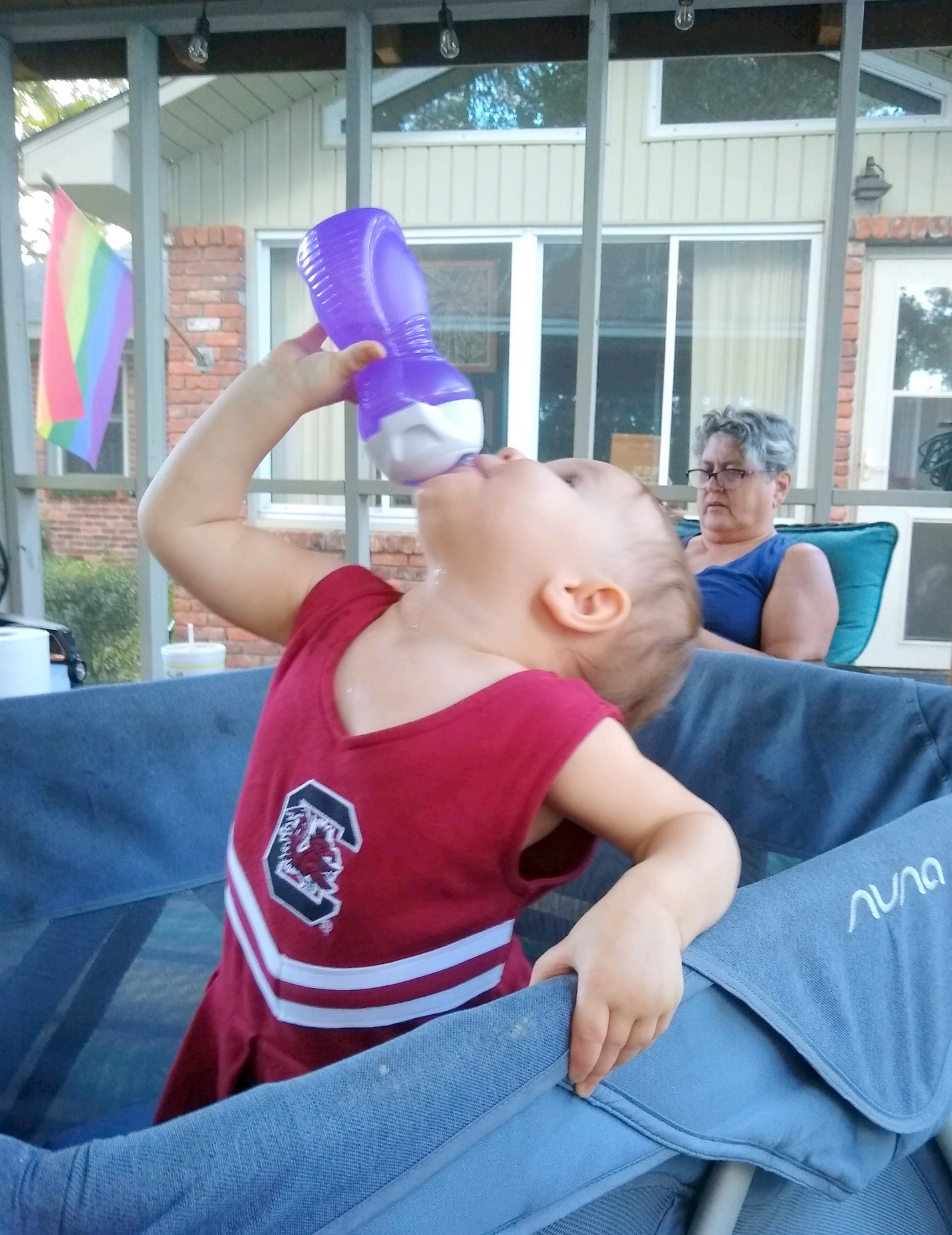
    Happy Birthday, Ella James!

     Toni Morrison said, “you are your best thing” – and for your NanaT and me, as well as so many others whose lives you’ve touched in this brief first year of your life – you are our best thing, too.

    *************************************

    In these incredibly perilous times I implore you to stay safe, stay sane, stay tuned and VOTE.

  • say her name: Breonna Taylor


    The 2020 WNBA season consists of twelve teams living and playing together since July in the IMG Academy in Bradenton, Florida for a shortened 22-game schedule followed by the traditional playoff series that began on September 15th. The bizarre season is notable not only for its Covid restrictions regarding players and personnel living in the Bradenton Bubble without any fan support during their games but also is notable for the players’ dedication of their season to Breonna Taylor, a black woman who was killed in a raid on her apartment in Louisville, Kentucky  March 13th. All the  players have worn Say Her Name Breonna Taylor uniforms in every game, had observations of silence to honor her memory before games, been vocal as a players’ association about police brutality in the systemic racism exemplified by the treatment of black women everywhere.

    Two days ago, a Louisville grand jury failed to indict any of the officers for criminal behavior resulting in the death of Ms. Taylor who was shot five times and received no medical attention for more than 20 minutes after she was struck according to reporting by the NY Times yesterday.

    Prior to last night’s playoff game between the Minnesota Lynx and the Seattle Storm, Lynx player Napheesa Collier read the following statement on behalf of all the players in the league (Jasmine Thomas of the Connecticut Sun read the same statement before their game against the Las Vegas Aces):

    “Our hearts are with Ms. Tamika Palmer. It has been 195 days since her daughter, Breonna Taylor, was killed. One-hundred and 95 days and still today, no one was charged for her death. We strongly support the sentiment expressed by the family of Breonna Taylor. The result is outrageous and offensive. No one needs to live in the commonwealth of Kentucky to understand this case. We won’t stop pressing for full transparency and full and complete justice. There are far too many questions left unanswered.

    “Justice is on the ballot. Please register today and vote on or before Nov. 3.”

    In another voice with a different platform Oprah Magazine explained the remarkable cover of Breonna Taylor for their September, 2020 issue as follows: “For the first time in 20 years, @oprah has given up her O Magazine cover to honor Breonna Taylor. She says, Breonna Taylor. She was just like you. And like everyone who dies unexpectedly, she had plans. Plans for a future filled with responsibility and work and friends and laughter. Imagine if three unidentified men burst into your home while you were sleeping. And your partner fired a gun to protect you. And then mayhem. What I know for sure: We can’t be silent. We have to use whatever megaphone we have to cry for justice. And that is why Breonna Taylor is on the cover of O magazine. I cry for justice in her name…”

    Congressman John Lewis issued a moral imperative for all of us. When we see something is not right, not fair, not just – we have a moral obligation to do something about it. I salute the courage of the players in the WNBA for doing something about the death of Breonna Taylor in their 2020 season, and I thank Oprah for the empathy she has for the family of Breonna Taylor in their unspeakable loss.

    Adding our voices to cry for justice in the name of Breonna Taylor – we are no longer lone voices crying in the wilderness of separation and fear. Together we stand for Breonna Taylor, her family, for justice.

    Say Her Name: Breonna Taylor and plan your vote for November 3rd.

    Stay safe, stay sane and stay tuned.

  • your protection has expired


    I can’t make this up.

    The first words I saw when I opened my laptop last night to read about the passing of Justice Ruth Bader Ginsburg were “your protection has expired.” Granted those words referred to my cyberspace security, but last night they spoke to the inner turmoil I felt at the loss of this “protector” of the rights of the marginalized.

    I fear the country I love, the democracy I cherish, is in more peril today than it was yesterday before the death of a woman who kept her oath to uphold the Constitution of the United States – a warrior who used the power of her dissent as a Supreme Court Justice to work toward promoting a more perfect union for every citizen.

    If there is a heaven somewhere, I hope Congressman John Lewis and Justice Ginsburg are together still trying to create good trouble on behalf of a nation mourning their losses.

    Ruth Bader Ginsburg

    (March 15, 1933 – September 18, 2020)

    I will miss her.

    Stay safe, stay sane and please stay tuned.


  • black women called “Mayor” from sea to shining sea


    A world wide pandemic from an attack by an unseen enemy known as Covid-19,  increasing public protests across the country led by Black Lives Matter against systemic racism in the criminal justice system and other institutions,  police brutality in the murders of George Floyd, Breonna Taylor and Rayshard Brooks; the deaths of two iconie Civil Rights leaders: Congressman John Lewis and Reverend C.T. Vivian – the crises facing the mayors of American cities in 2020 was a perfect storm of despair from the loss of people, jobs, faith in the federal government and too often hope for the future. And yet, a growing number of black women stepped up courageously to meet the challenges of local government leadership..

    “I’m an independent reform candidate. I do not represent the past.” – Mayor Lori Lightfoot

    Indeed, Mayor Lightfoot was elected mayor of Chicago, Illinois in April, 2019 to shine a bright light into the future as she became the first openly gay African American woman ever elected mayor of a major American city.  Chicago is located in the Great Lakes region of the Midwestern United States, the 3rd. largest city in the country according to the 2020 census with a population of over 2.6 million people.

    Two thousand miles west of Chicago on a peninsula between the Pacific Ocean and San Francisco Bay lies the 16th. largest city in the country: San Francisco, California. In July, 2018,  London Breed was elected mayor of that city in a special election to become the first African American woman to serve as mayor of this municipality which has a population of almost 900,000 people. According to Jay Barmann in the San Francisco News Tuesday, September 15, 2020, Mayor Breed said:

    “People are pretty much tired of what we’re living in, as it relates to COVID. I’m tired of talking about it. I’m tired of living in it,” Breed said in her usually candid fashion in a press conference Tuesday. “I’m tired of doing all the things you are tired of doing, because I want to enjoy my life. I want to live. I want to go back to normal.”

    But, she cautioned, we still haven’t turned any corners on the coronavirus, it’s still spreading in the Bay Area, and there’s even been an uptick in hospitalizations in San Francisco in the last week. “We are not out of the woods when it comes to COVID,” she said. (end of quote)

    The driving distance between San Francisco on the West Coast of the US  all the way across the country to the Mid-Atlantic region of the East Coast where the 20th. largest city in the country, Washington, D.C. is located, is a distance of approximately 2,800 miles. DC has a population of more than 720,000 people according to the 2020 census and in the mayoral race in 2014 Muriel Bowser became the first African American woman to be elected mayor of her city. Mayor Bowser brings a refreshing approach to gun control:

    “You have a mayor who hates guns. If it was up to me, we wouldn’t have any handguns in the District of Columbia. I swear to protect the Constitution and what the courts say, but I will do it in the most restrictive way as possible.”

    Ranking 36th. on the list of American cities by population sits Atlanta, Georgia with a population of almost 525,000.  Atlanta is 625 miles south of Washington, D.C., considered to be part of a sub-region of the US known as the Deep South,  and is located among the foothills of the Appalachian mountains. Atlanta Mayor Keisha Lance Bottoms, an African American woman, was elected mayor in 2017. In a speech addressing the Democratic National Convention in August, Mayor Lance Bottoms had these remarks on the importance of voting in the 2020 election:

    “We know how important it is that we elect real servant leaders, leaders like Joe Biden and Kamala Harris—people of honor and integrity, who hold justice close to their hearts and believe that the lives of my four Black children matter. In the words of womanist poet Audre Lorde, “Your silence will not protect you.”

    Finally, I felt compelled to check out black female mayors in other places like, let’s say Atlanta’s neighboring state of South Carolina, my home state for the past fifty years. Tann Vom Hove, senior fellow at City Mayors Research, listed two black female mayors from Hampton County (Francenia Ellis in Furman, pop. 275; Patricia Williams in Brunson, pop. 550), one from Union County (Mary Ferguson Glenn in Carlisle, pop. 450), one from Charleston County (Miriam Green  in Awendaw, pop.1,300), one from Laurens County (Stellarteen Jones in Gray Court, pop. 800),  and one from Calhoun County (Helen Carson-Peterson in St. Matthews, pop. 1,900).

    Through my personal research of watching the 6 o’clock local ABC news last night, I was introduced to Mayor Alfred Mae Drakeford who is the first African American female mayor of Camden, SC in Kershaw County. Camden is 40 miles west of our house, has a population of 7,200 and is full of Revolutionary War history but is better known in our home as one of Pretty’s favorite “antiquing” towns.

    Thank goodness for the black women mayors wherever they are regardless of the size of their cities – may they continue to serve their communities and always strive to preserve the Constitution of the United States against all enemies not only in 2020 but also in years to come.

    America, America, God shed her grace on thee – and crown thy good with sisterhood from sea to shining sea.  Amen.

    Stay safe, stay sane, and please stay tuned.