Category: Lesbian Literary

  • the battle my grandmother lost

    the battle my grandmother lost


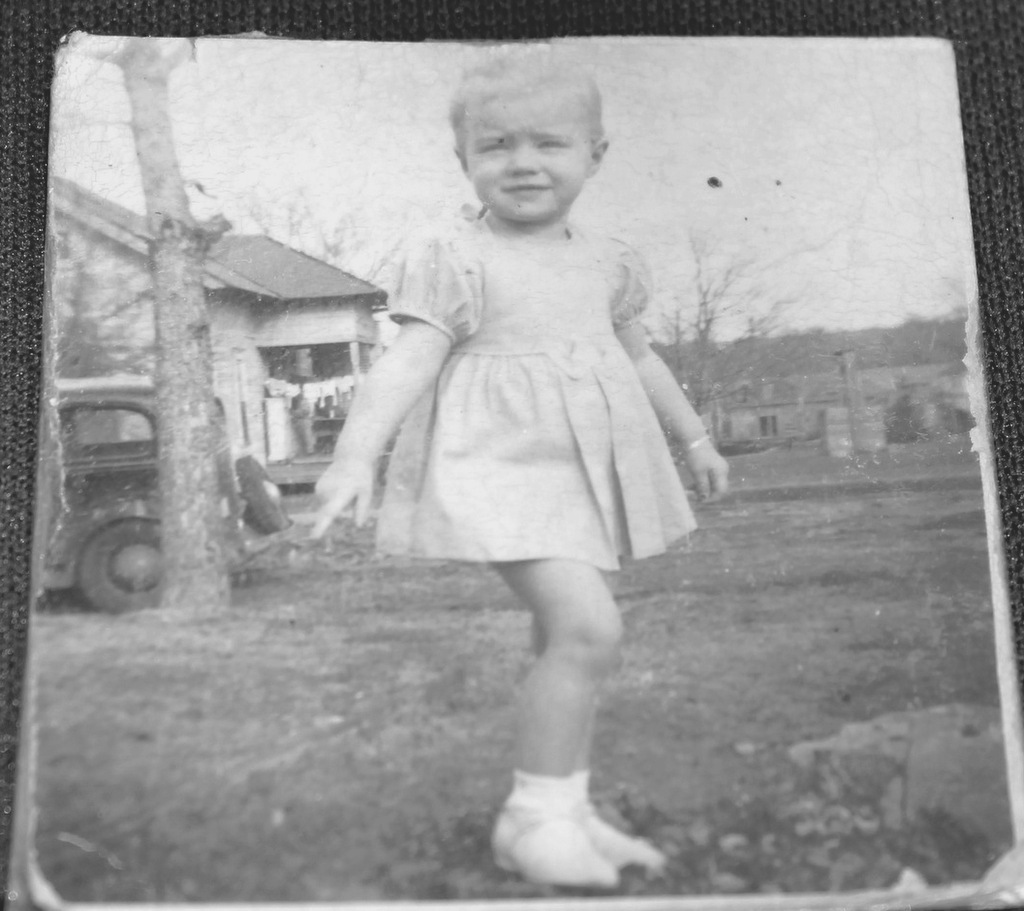
    my early years in my hometown of rural Richards, Texas

    (circa 1949 – when I was three years old)

    (this picture should have been a clue, but my grandmother ignored it)


    a birthday party dress made by my grandmother (circa 1951)

    my grandmother made this dress and a  picture postcard of me

    for her family Easter card in 1949

    Bless her heart. My grandmother tried and tried to reshape my fashions which upon reflection she probably hoped would reshape my life. One of the most dreaded phrases my mother ever spoke to me – the one that made me cringe-was “Your grandmother is making you a new dress and needs you to walk down to her house to try it on. No arguments, no whining, just go.”

    I absolutely hated to stand on her little stool while she endlessly pinned away to make sure  the pattern she bought from a grand clothing store in much bigger town Navasota  fit perfectly on my small body. She pulled, tugged here and there, made me turn around as she measured whatever cloth she had purchased when she bought the pattern. I prayed silently that the aroma I smelled was her pineapple fried pies…the only possible redemption from the hell of being poked and prodded for a new dress I didn’t want to wear.

    My grandmother Betha Day Robinson Morris and I lived within shouting distance of each other in the tiny town (pop. about 500) of Richards until my dad found a new job that took us out of the place I called home when I was 13 years old. Our new home in Brazoria was less than two hours from Richards so we came back every other week for most of my teenage years. Distance did not deter my grandmother from her sewing, however.

    She usually managed to have something for me to try on whenever we visited. I finally surrendered to her passion for sewing because as I grew older I came to understand sewing was an important part of her life, but to this day I dread hearing Pretty say she brought something home for me to try on.

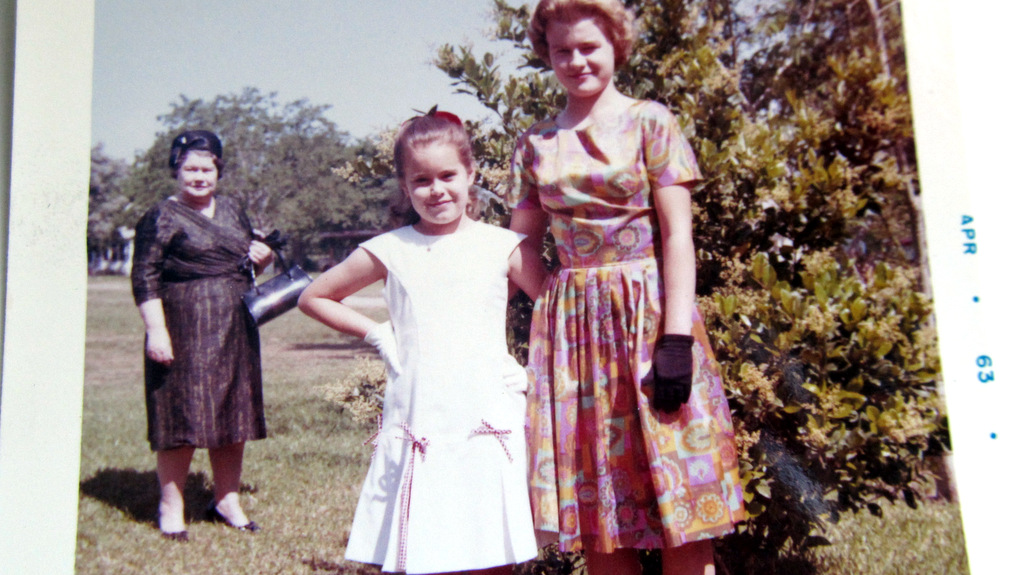
    my grandmother surveys her granddaughters

    before Easter Sunday church services in 1963

    I was 17 years old and wearing a dress my grandmother made for me

    while my younger cousin Melissa modeled her store-bought outfit

    My grandmother continued to sew for me until I was in my twenties. Every Christmas she wrapped a large box in her best wrapping paper and favorite bow saved from the previous Christmas to give to me. I always opened with feigned surprise at the dress she made for me to wear to church and praised her for being able to still find the perfect pattern and material for me even when I wasn’t there to try it on.

    I’ll never forget the last time I opened a gift of clothing she made for me. She had made a pants suit – unbelievable. I could see she was pleased with herself for breaking from the dress tradition she wanted me to wear to making the pants she now understood would forever be my choice of clothes. The year was 1968 – I was 22 years old – my grandmother would have been 55. The pants suit represented a rite of passage for both of us.

    Unfortunately, I never could bring myself to wear the pants suit which was made with a hideous polyester fabric and a horrible bright green and white large zig zag pattern. I couldn’t bring myself to wear it, but I carried it with me around the country wherever I moved for the next 30 years. I would carefully hang it in my closet as a daily reminder of  the love my grandmother gave me for as long as she lived.

    My grandmother Betha was a flawed individual but what I wouldn’t give today to hear my mother say “Sheila Rae, your grandmother is making you a new dress and wants you to try it on. No arguments, no whining, just go.”

    **********************

    Those were the days, my friends – and now we have the opportunities to create new memories for our granddaughters we celebrate not only during the holiday season but also whenever we see them. What will they remember? I wonder.


  • cross over the bridge

    cross over the bridge


    In June, 2015 two separate events captured the attention of not only the United States but also countries on other continents. Yes, indeed. We were part of the good, the bad and the very ugly. I wrote this piece the day after the Supreme Court ruled same-sex marriage was the law of the land,  the day of the funeral for the Reverend Clementa Pinckney who was one of the Emanuel Nine in Charleston, South Carolina.

    *****************************

    Traveling to East Tennessee last week, Pretty and I listened to a collection of Patti Page hits. One of the songs she sang in this album which was recorded at Carnegie Hall in 1997 was Cross Over the Bridge – a song I hadn’t heard since 1954 when Patti originally recorded it –  but one I remembered singing while my mother played the yellow piano keys of the ancient upright piano in our living room in the tiny town of Richards in rural Grimes County, Texas. My mom bought sheet music like some people bought cigarettes back then…she was addicted to it. One of her favorites was Cross Over the Bridge so naturally eight-year-old me learned the lyrics as my mother sang and played which meant I was able to sing along with Patti in the car while Pretty and I rode through the gorgeous vistas of the Upstate of South Carolina toward the incredible views of the mountains in East Tennessee. Mine eyes did see the glory.

    Cross over the bridge, cross over the bridge…Change your reckless way of living, cross over the bridge…Leave your fickle past behind you, and true romance will find you, Brother, cross over the bridge.

    Admittedly this is a love song in the tradition of the 1950s favorite sentiments, but as I was trying to digest and cope with the overwhelming seesaws of emotion I felt yesterday, crossing bridges came to mind.

    Yesterday morning I woke up in a new world…truly a new world for me and my family. The Supreme Court of the United States lifted my status as a citizen. I was no longer “lesser than.” I was a person who mattered. By recognizing the fundamental right to marry for all same-sex couples in every state in the nation, SCOTUS recognized me as a person who was entitled to my own pursuit of happiness with life and liberty guaranteed as a bonus.

    Two years to the day after the favorable ruling in the Edie Windsor case that gave equal federal treatment to the same-sex marriages recognized in twelve states and the District of Columbia at the time, the Supremes crossed a bridge to leave a fickle past of outright discrimination behind all of us and yes, to allow true romance for whoever we love. We crossed a bridge to walk a path toward full equality for the entire LGBTQ community because of the efforts of people who worked at coming out to their parents, friends, co-workers – everyone in their daily lives – to reveal their authentic selves.

    It was a day of rejoicing for Pretty and me in our home; we were beside ourselves with an emotional high as the breaking news unfolded on the television before our eyes. To hear a Gay Men’s Chorus sing our national anthem outside the building in Washington, D.C. where history was being made brought chills and tears to our eyes. We savored the moment together.

    But the celebration was cut short by the next four hours of the television coverage of the funeral of the Reverend Clementa Pinckney, one of the Emanuel Nine slain in his church in Charleston, South Carolina the week before when he was leading a Bible Study group at the church. The celebration of his life was a long one for a man who had lived the relatively short life of only forty-one years. But this man’s life had counted for more than his years.

    He began preaching at the age of thirteen and was a pastor at eighteen years of age. The men and women who reflected on Reverend Pinckney’s life did so with exuberance and humor as they told their personal stories of interacting with him as friends, family and co-workers. The picture that emerged was that of a good man who loved his family, his church and his country with its flawed history of systemic racism. He was a man on a mission to make life better for those who felt they had no voice to speak about their basic needs of food and shelter, their educational opportunities, a flawed criminal justice system. He was a man who cared, he was passionate about making a difference.

    He was murdered by another kind of man who had a reckless way of living and a disregard for the sanctity of human life. He was murdered by a white man who was taught to hate the color black as a skin color in a society too often divided by colors, creeds and labels. We need to change our reckless way of living as a people.

    We need to open our eyes and our hearts to see glimpses of truth, as the old hymn admonishes. Open our eyes that I may see glimpses of truth thou hast for me. And may we not just see the truth, but may we speak and act as though the truth is important because it is. When our eyes are opened, for example, to the pain the Confederate Flag flying on the public state house grounds inflicts on a daily basis to many of our citizens, we must make every effort to take it down. We must speak up and act out. (the flag came down on July 10, 2015)

    President Obama spoke in his eulogy about the grace that each of us has from God, but that none of us earned. Regardless of our concept of God, we know grace is unmerited favor. We live in a country of contrasts and  sometimes conflicts, but for those of us to whom grace has been given, we are compelled to share this bounty with everyone we encounter – whether they agree or disagree with us in our political ideals. This is harder to practice than preach. Reverend Clementa Pinckney both preached and practiced grace  in his life as he crossed another kind of bridge – a bridge we will all cross at some point.

    The tragedy of his untimely crossing took Pretty and me on a roller coaster of emotions as we watched the funeral yesterday. From the euphoria of the Supreme Court ruling early in the morning to the depths of despair as we remembered the losses of the Emanuel Nine during the funeral of Reverend Pinckney to the stirring tribute filled with hope by President Barak Obama that raised our spirits once again to believe in the possibility of grace; we crossed over two bridges in one day that we will never forget. Patti Page had none of this in mind when she sang her love song in 1954, but I’d like to  think my mother would be happy to know her music inspired more than a little girl’s learning to carry a tune.

    **********************

    Nine years later we continue to cross over the bridges of systemic racism that divide us in this country. The murder of George Floyd in May of 2020 ignited marchers in the streets around the world to cross bridges for civil rights with similar passions to those of  John Lewis and the others who crossed the Edmund Pettus Bridge in Selma, Alabama in 1965. I believe the Black Lives Matter movement along with the passing of civil rights icons Congressmen John Lewis and Elijah Cummings were the beginning of the end for a Trump presidency that failed spectacularly to successfully combat an enemy known as Covid 19 in 2020 – an administration committed more to the stock market than  the welfare of its citizens, a presidency that encouraged politics of divisiveness over unity, a political party with ongoing threats to democratic cornerstones. The loss of nearly 300,000 American lives was, and continues to be, a bridge too far of failed leadership that resulted in the contentious removal of a one-term impeached president  by 81 million plus voters in the November election of 2020; 74 million people voted to re-elect him.

    ******************

    And yet here we are in 2024 with 77 million people voting to re-elect a president who has devoted much of his past four years avoiding paying settlements and/or serving prison sentences determined by judges and jurors in courts of law while 76 million people cast their votes for other candidates. The Democrats lost their way and in the process lost the confidence of the American people. It may just be a bridge too far to cross.
  • Dining with Dorothy Allison (April 11, 1949 – November 6, 2024)

    Dining with Dorothy Allison (April 11, 1949 – November 6, 2024)


    Pretty who owned Bluestocking Books, a feminist bookstore in Columbia in 1994, not only loved books but also loved movies. She had co-sponsored Dorothy Allison to do a reading with Women’s Studies at the University of South Carolina on the evening of March 21st. which meant she would miss Tom Hanks’s beautiful acceptance speech for Best Actor in Philadelphia. I didn’t realize that night how important the Oscars were to her because I was enamored by Dorothy Allison’s stories from her award winning book Bastard Out of Carolina that had been published two years earlier.

    At the time I was a financial advisor working with numbers with no thought of writing, but I was mesmerized by this woman who was born in Greenville, South Carolina, in 1949 to a fifteen-year-old mother. Lesbian literary journal Sinister Wisdom recalls Allison’s childhood was marked by poverty, sexual, physical and emotional abuse – themes which became cornerstones of her work. Needless to say following Allison’s talk, I bought her book from Pretty who invited me to go to dinner with a few friends along with Allison.

    My memories of the dinner are unremarkable except that Allison was polite, even cordial but, as Pretty remembered, seemed underwhelmed by our table of local lesbians who were thrilled to be in her presence. Our lives would intersect with hers again twenty-three years later, however.

    In 2017 the University of South Carolina published a collection of oral histories I edited: Southern Perspectives on the Queer Movement, Committed to Home. The back cover included a comment from Dorothy Allison whose storytelling has always been an inspiration to me as a lesbian writer.

    “Thirty years of history retold from the inside is in this anthology. The people who stood up and risked their homes, their families, and their very lives to make the world safer and more just for all of us tell us how they did it, day by day, year by year.”

    Through her books Dorothy Allison told us day by day, year by year of her personal struggles to make the world safer and more just for all. During the Thanksgiving season this year I will be especially thankful for this lesbian activist whose life lifted us to higher ground.

    Dorothy Allison died Wednesday, November 6th., at the age of 75 – her words live on.

    Rest in peace, Dorothy.

  • before the brand came The Red Man

    before the brand came The Red Man


    Teresa and I had purchased the house in Montgomery, Texas, in 2010 so I could be closer to my aging mother who was struggling with dementia in a memory care unit in Houston. Her condition had deteriorated significantly during the past four years of her stay there while the long-term care policy critical to our financial stability neared the end of its benefit period in that blazing hot Texas summer of 2011. My mom needed to move to a less expensive place… I had equal parts of fear and dread at the thought of moving her, but I was in a search and rescue mode for a place closer to our Worsham Street home in Montgomery while my wife Teresa kept a busy schedule in her job managing the mercantile department of the Mast General Store a thousand miles away from me in Columbia, South Carolina.

    I was in the middle of writing my third nonfiction book, desperately seeking a publisher and/or a literary agent who could locate a publisher for me. You have to build a brand, I was told with every rejection. Red’s Rants and Raves (my first blog on WordPress) wasn’t setting the right tone for my “serious” writing. Seriously? Nobody was more critical of human frailty than The Red Man, our rescued Welsh terrier, but I got the hint.

    The premier for my second blog, I‘ll Call It Like I See It, was on August 02, 2011. Nine hundred ninety-nine posts thirteen years later was a number I couldn’t have imagined when I started this amazing ride that began as a solo journey with zero followers. In November of 2011 Shirley Baranowski Cook from my hometown of Richards, Texas became the first email subscriber joined by my cousin Melissa Bech, Worsham Street neighbor Lisa Martin and college roommate Robyn Whyte – all in December of that year. I was no longer alone on the journey.

    The cyberspace universe has been magical for me – my readers who are now loyal subscribers and social media followers have become friends whose comments make me laugh when I need a laugh, inspire me to keep going when I wonder if anyone finds me that horrible word for old women with white hair: irrelevant. I developed an Honor Roll of Friends, but I had so many names I was overwhelmed by the numbers and didn’t dare risk overlooking anyone.

    Just know that I treasure each of you who has made part or all of this journey with me – I hope you know you made the Honor Roll. If you are in doubt, just ask.

    ******************

    P.S. In 2012 I’ll Call It Like I See It: A Lesbian Speaks Out was published. The Red Man was delighted and quick to claim credit for giving me my start.

  • wild woman sisterhood


    Wild Woman Sisterhood – it’s never too late to join an organization whose mission is “to help you embody your authentic nature and live a truly fulfilling life.” Getting closer to my 78th. birthday in April, my thoughts turn to the women I once was – WWS suggests they deserve a little more kindness than I typically have for them.

    Make peace with all the women you once were. Wait a second – you mean, all those women? The young woman in her early twenties whose nightly pilgrimage through the halls of her college dormitory ended in frustration when the soft knock on her beloved’s door woke a surly roommate instead of the woman of her dreams, a roommate who recognized she was, indeed, lost at two o’clock in the morning but on a much different level from her proffered confusion about room numbers.

    Or are you asking me to make peace with the young woman in her late twenties who had crisscrossed the country 3,000 miles one way several times, eventually knocking on a door in a seminary dormitory that finally welcomed her with open arms only to discover the excitement of infidelity + way too much alcohol consumption = a detour in her journey that had no GPS in the 1960s. Make peace with that young woman on a quest to find authenticity before she understood the question – much less had a clue to an answer for herself? Sorry – no flowers for either of those young women in their twenties in the 60s.

    As for the women in her thirties, forgiveness is at least a possibility because they began to openly acknowledge their own truths that belonged to each other; they were no longer two women on a journey plagued by internal battles but one survivor forged by the burning of incense and cooled by the sweetest honey. This woman understood that wandering in the wilderness had always been about her search for authenticity.

    Forty years later the women in my twenties, thirties and decades after ask me to honor, forgive, listen, bless and let them be because they are the bones of the temple I sit in now, the rivers of wisdom leading me toward the sea. If it’s not too late, I’d like to lay flowers at their feet and join a sisterhood of wild women committed to living a truly fulfilling life at any age.

    ********************

    Slava Ukraini. For the women and children of Ukraine who began their third year of resistance last month against enemies determined to wipe democracy from the face of the earth. I’d also like to lay flowers at their feet.