Category: Lesbian Literary

  • The Ides of August – Excerpts from an Essay by Sarah Chayes

    The Ides of August – Excerpts from an Essay by Sarah Chayes


    I know far less about the US departure from Afghanistan than many people do; but I am curious, interested in learning. Last week I posted a column on Afghanistan written by Molly Ivins in October, 2001 as America began what would become our 20 years war that is either winding down or ramping up again in recent days according to your perspective. Today I offer an essay by Sarah Chayes that was written one week ago and revised as events unfold. Fresh, up to the hour perspective from an American writer who is an adoptive Kandahari and a former senior official to the U.S. government. The following are excerpts from her essay The Ides of August. I encourage anyone seeking an informed perspective of the current actions in Afghanistan to take the time to read her entire text at sarahchayes.org/post/the-ides-of-august.

    “I’ve been silent for a while. I’ve been silent about Afghanistan for longer. But too many things are going unsaid.

    I won’t try to evoke the emotions, somehow both swirling and yet leaden: the grief, the anger, the sense of futility. Instead, as so often before, I will use my mind to shield my heart. And in the process, perhaps help you make some sense of what has happened.

    For those of you who don’t know me, here is my background — the perspective from which I write tonight.

    I covered the fall of the Taliban for NPR, making my way into their former capital, Kandahar, in December 2001, a few days after the collapse of their regime. Descending the last great hill into the desert city, I saw a dusty ghost town. Pickup trucks with rocket-launchers strapped to the struts patrolled the streets. People pulled on my militia friends’ sleeves, telling them where to find a Taliban weapons cache, or a last hold-out. But most remained indoors.

    It was Ramadan. A few days later, at the holiday ending the month-long fast, the pent-up joy erupted. Kites took to the air. Horsemen on gorgeous, caparisoned chargers tore across a dusty common in sprint after sprint, with a festive audience cheering them on. This was Kandahar, the Taliban heartland. There was no panicked rush for the airport.

    I reported for a month or so, then passed off to Steve Inskeep, now Morning Edition host. Within another couple of months, I was back, not as a reporter this time, but to try actually to do something. I stayed for a decade. I ran two non-profits in Kandahar, living in an ordinary house and speaking Pashtu, and eventually went to work for two commanders of the international troops, and then the chairman of the Joint Chiefs of Staff. (You can read about that time, and its lessons, in my first two books, The Punishment of Virtue and Thieves of State.)

    From that standpoint — speaking as an American, as an adoptive Kandahari, and as a former senior U.S. government official — here are the key factors I see in today’s climax of a two-decade long fiasco:

    Afghan government corruption, and the U.S. role enabling and reinforcing it. The last speaker of the Afghan parliament, Rahman Rahmani, I recently learned, is a multimillionaire, thanks to monopoly contracts to provide fuel and security to U.S. forces at their main base, Bagram. Is this the type of government people are likely to risk their lives to defend?

    **********

    Americans like to think of ourselves as having valiantly tried to bring democracy to Afghanistan. Afghans, so the narrative goes, just weren’t ready for it, or didn’t care enough about democracy to bother defending it. Or we’ll repeat the cliche that Afghans have always rejected foreign intervention; we’re just the latest in a long line.

    I was there. Afghans did not reject us. They looked to us as exemplars of democracy and the rule of law. They thought that’s what we stood for.

    And what did we stand for? What flourished on our watch? Cronyism, rampant corruption, a Ponzi scheme disguised as a banking system, designed by U.S. finance specialists during the very years that other U.S. finance specialists were incubating the crash of 2008. A government system where billionaires get to write the rules.

    Is that American democracy?

    *******************

    Pakistan. The involvement of that country’s government — in particular its top military brass — in its neighbor’s affairs is the second factor that would determine the fate of the U.S. mission.

    You may have heard that the Taliban first emerged in the early 1990s, in Kandahar. That is incorrect. I conducted dozens of conversations and interviews over the course of years, both with actors in the drama and ordinary people who watched events unfold in Kandahar and in Quetta, Pakistan. All of them said the Taliban first emerged in Pakistan.

    The Taliban were a strategic project of the Pakistani military intelligence agency, the ISI. It even conducted market surveys in the villages around Kandahar, to test the label and the messaging. “Taliban” worked well. The image evoked was of the young students who apprenticed themselves to village religious leaders. They were known as sober, studious, and gentle. These Taliban, according to the ISI messaging, had no interest in government. They just wanted to get the militiamen who infested the city to stop extorting people at every turn in the road.

    Both label and message were lies.

    Within a few years, Usama bin Laden found his home with the Taliban, in their de facto capital, Kandahar, hardly an hour’s drive from Quetta. Then he organized the 9/11 attacks. Then he fled to Pakistan, where we finally found him, living in a safe house in Abbottabad, practically on the grounds of the Pakistani military academy. Even knowing what I knew, I was shocked. I never expected the ISI to be that brazen.

    **********************

    Hamid Karzai. During my conversations in the early 2000s about the Pakistani government’s role in the Taliban’s initial rise, I learned this breathtaking fact: Hamid Karzai, the U.S. choice to pilot Afghanistan after we ousted their regime, was in fact the go-between who negotiated those very Taliban’s initial entry into Afghanistan in 1994.

    I spent months probing the stories. I spoke to servants in the Karzai household. I spoke to a former Mujahideen commander, Mullah Naqib, who admitted to being persuaded by the label and the message Karzai was peddling. The old commander also admitted he was at his wits’ end at the misbehavior of his own men. I spoke with his chief lieutenant, who disagreed with his tribal elder and commander, and took his own men off to neighboring Helmand Province to keep fighting. I heard that Karzai’s own father broke with him over his support for this ISI project. Members of Karzai’s household and Quetta neighbors told me about Karzai’s frequent meetings with armed Taliban at his house there, in the months leading up to their seizure of power.

    And lo. Karzai abruptly emerges from this vortex, at the head of a “coordinating committee” that will negotiate the Taliban’s return to power? Again?

    ***************

    Self-Delusion. How many times did you read stories about the Afghan security forces’ steady progress? How often, over the past two decades, did you hear some U.S. official proclaim that the Taliban’s eye-catching attacks in urban settings were signs of their “desperation” and their “inability to control territory?” How many heart-warming accounts did you hear about all the good we were doing, especially for women and girls?

    Who were we deluding? Ourselves?

    What else are we deluding ourselves about?

    One final point. I hold U.S. civilian leadership, across four administrations, largely responsible for today’s outcome. Military commanders certainly participated in the self-delusion. I can and did find fault with generals I worked for or observed. But the U.S. military is subject to civilian control. And the two primary problems identified above — corruption and Pakistan — are civilian issues. They are not problems men and women in uniform can solve. But faced with calls to do so, no top civilian decision-maker was willing to take either of these problems on. The political risk, for them, was too high.

    Today, as many of those officials enjoy their retirement, who is suffering the cost?”

    ******************

    Stay safe, stay sane, please get vaccinated and please stay tuned.

  • it’s been so long since I’ve had pancakes I forgot the syrup

    it’s been so long since I’ve had pancakes I forgot the syrup


    So this morning I took three of the remaining nine frozen buttermilk pancakes from the freezer, removed the plastic wrap, carefully placed them apart on a microwave safe plate, heated them on high for 1 minute 40 sec, removed, took them to my tray table in front of my recliner in the den and began to eat as I watched tennis replays from last night’s matches at the Western and Southern Open.

    The pancakes were supposed to be my reward for more than five months of pancake abstinence in my personally designed program for changing old eating patterns that included three Eggo buttermilk pancakes for breakfast for as long as I could remember. I mean I could have done a commercial for these frozen pancakes for years. I fought a battle every day to just eat three of them – true love.

    But today I was disappointed in how bland they tasted. Seriously, what had happened to my favorite breakfast delicacy?

    I stared at my plate.

    No syrup, I thought. I had forgotten to follow the most important ritual of opening the pantry door every morning to get the bottle of syrup to place on my tray table while the pancakes were in the microwave. Sweet Suffering Jesus, as the Derry Girl mother would have said if she’d forgotten the syrup for pancakes.

    Also, I forgot the pancakes should be nuked in a small stack – not carefully separated like first, second and third base on a baseball field. Sigh.

    My reward lacked the punch I hoped it would pack.

    I think I’ll try again tomorrow morning. I do still have six in the freezer, and disappointing rewards should be given a second chance.

    ***********

    Stay safe, stay sane, please get vaccinated and please stay tuned.

  • Afghanistan: US Having Two Debates by Molly Ivins (October 17, 2001)

    Afghanistan: US Having Two Debates by Molly Ivins (October 17, 2001)


    As the twenty-year anniversary of 09/11 approaches and as the US makes a chaotic messy devastating departure from Afghanistan, I struggle to connect two events I’ve witnessed with my own eyes. Maya Angelou’s poem On the Pulse of Morning offered a poet’s interpretation of these events for me and led me past the rock to the river and the tree.

    Molly Ivins, on the other hand, was an American newspaper columnist (August 30, 1944 – January 31, 2007) who witnessed 09/11 and had this to say about the beginning of the war in Afghanistan on October 17, 2001. Excerpts of her column are printed here by permission of Creative Commons.

    Afghanistan is to nation-building what Afghanistan is to war — pretty much the last place on earth you’d choose, if you had any choice at all. I point this out not to oppose the idea, about which I think we have no choice, but to underline that the task is hard, long and incredibly complicated. President Bush has said that from the beginning, but it cannot be said too often.

    There are some signs of what could become a dangerous division in what has been an unusually unified America since this crisis began, and they have to do with a class difference in information. To oversimplify, those who are getting their information from the Internet and/or a broad range of publications are having conversations with one another that are radically different from those heard on many radio talk shows.

    This is more than the simplistic jingoism that is a constant in American life; this is simplistic jingoism with a dangerously short attention span. The “let’s nuke ’em” crowd is still looking for a short, simple solution, and there just isn’t one. More stark evidence of this is the poll of Pakistanis just released by Newsweek, and the numbers need to be read carefully: While 51 percent support their government’s cooperation with the U.S. during the crisis, 83 percent are sympathetic to the Taliban, and almost half believe Israel was behind the attacks on the World Trade Center and the Pentagon. Fortunately for us, bin Laden and the Taliban are taking care of that theory. I think one of the few mistakes the Bush administration has made so far in this was to criticize the networks for putting on bin Laden — we want everybody to hear him claim credit for those attacks.

    While some of us search for the answer to the question, “Why do they hate us?” the voices on radio talk shows are answering, “Who cares? Nuke ’em.” Those inclined to think that’s not a bad plan might keep in mind the already-classic lead by Barry Bearak of The New York Times: ‘If there are Americans clamoring to bomb Afghanistan back to the Stone Age, they ought to know that this nation does not have far to go. This is a post-apocalyptic place of felled cities, parched land and downtrodden people…’”

    The task in Afghanistan for the past twenty years has indeed been hard, long and incredibly complicated. Our exit is proving to be difficult, dangerous, disastrous – I wonder what Molly Ivins would have to say on the subject. Hm.

    President Biden promised to bring the remaining American troops (approximately 3,500) home from Afghanistan while campaigning for President in 2020, and he kept that promise – but the promise lacked an informed plan to insure the safety of the troops, their Afghan allies, and a whole host of other folks who needed rescuing from the control of the Taliban so he sent 6,000 more US troops back to Afghanistan last week.

    *********************

    Stay safe, stay sane, please get vaccinated and stay tuned.

  • when maya angelou speaks, I listen

    when maya angelou speaks, I listen


    On the Pulse of Morning

    Maya Angelou – 1928-2014

    A Rock, A River, A Tree
    Hosts to species long since departed,
    Marked the mastodon,
    The dinosaur, who left dried tokens
    Of their sojourn here
    On our planet floor,
    Any broad alarm of their hastening doom
    Is lost in the gloom of dust and ages.

    But today, the Rock cries out to us, clearly, forcefully,
    Come, you may stand upon my
    Back and face your distant destiny,
    But seek no haven in my shadow.
    I will give you no hiding place down here.

    You, created only a little lower than
    The angels, have crouched too long in
    The bruising darkness
    Have lain too long
    Face down in ignorance.
    Your mouths spilling words

    Armed for slaughter.
    The Rock cries out to us today, you may stand upon me,
    But do not hide your face.

    Across the wall of the world,
    A River sings a beautiful song. It says,
    Come, rest here by my side.

    Each of you, a bordered country,
    Delicate and strangely made proud,
    Yet thrusting perpetually under siege.
    Your armed struggles for profit
    Have left collars of waste upon
    My shore, currents of debris upon my breast.
    Yet today I call you to my riverside,
    If you will study war no more. Come,
    Clad in peace, and I will sing the songs
    The Creator gave to me when I and the
    Tree and the rock were one.
    Before cynicism was a bloody sear across your
    Brow and when you yet knew you still
    Knew nothing.
    The River sang and sings on.

    There is a true yearning to respond to
    The singing River and the wise Rock.
    So say the Asian, the Hispanic, the Jew
    The African, the Native American, the Sioux,
    The Catholic, the Muslim, the French, the Greek
    The Irish, the Rabbi, the Priest, the Sheik,
    The Gay, the Straight, the Preacher,
    The privileged, the homeless, the Teacher.
    They hear. They all hear
    The speaking of the Tree.

    They hear the first and last of every Tree
    Speak to humankind today. Come to me, here beside the River.
    Plant yourself beside the River.

    Each of you, descendant of some passed
    On traveller, has been paid for.
    You, who gave me my first name, you,
    Pawnee, Apache, Seneca, you
    Cherokee Nation, who rested with me, then
    Forced on bloody feet,
    Left me to the employment of
    Other seekers—desperate for gain,
    Starving for gold.
    You, the Turk, the Arab, the Swede, the German, the Eskimo, the Scot,
    You the Ashanti, the Yoruba, the Kru, bought,
    Sold, stolen, arriving on the nightmare
    Praying for a dream.
    Here, root yourselves beside me.
    I am that Tree planted by the River,
    Which will not be moved.
    I, the Rock, I the River, I the Tree
    I am yours—your passages have been paid.
    Lift up your faces, you have a piercing need
    For this bright morning dawning for you.
    History, despite its wrenching pain
    Cannot be unlived, but if faced
    With courage, need not be lived again.

    Lift up your eyes upon
    This day breaking for you.
    Give birth again
    To the dream.

    Women, children, men,
    Take it into the palms of your hands,
    Mold it into the shape of your most
    Private need. Sculpt it into
    The image of your most public self.
    Lift up your hearts
    Each new hour holds new chances
    For a new beginning.
    Do not be wedded forever
    To fear, yoked eternally
    To brutishness.

    The horizon leans forward,
    Offering you space to place new steps of change.
    Here, on the pulse of this fine day
    You may have the courage
    To look up and out and upon me, the
    Rock, the River, the Tree, your country.
    No less to Midas than the mendicant.
    No less to you now than the mastodon then.

    Here, on the pulse of this new day
    You may have the grace to look up and out
    And into your sister’s eyes, and into
    Your brother’s face, your country
    And say simply
    Very simply
    With hope—
    Good morning.

    (poets.org/poem/pulse-morning)

    The words and wisdom of Maya Angelou remain a constant presence in my life. I turn to her often when I need inspiration for my writing. Today I felt her words didn’t need any commentary from me.

    Stay safe, stay sane, please get vaccinated and stay tuned.

  • Answer: 300 Million Dollars a Day (from the archives)

    Answer: 300 Million Dollars a Day (from the archives)


    On October 27, 2011 I published the following post. I’m no foreign policy expert or even wonk, but I am devastated by the disastrous unraveling of order – the chaos that is Afghanistan as the United States leaves a country it first sent troops to in October, 2001.

    Answer: 300 Million Dollars a Day

    Question:  How much does the United States spend on the War in Afghanistan?

    Sigh.   If only I’d been watching Jeopardy instead of 60 Minutes last night.   If only The Good Wife hadn’t moved to Sunday nights for the new fall season in 2011.   If only the football game on CBS had ended on time so I wouldn’t have gotten started watching 60 Minutes because I wanted to know when The Good Wife would actually be coming on later.   If only I’d remembered my New Year’s Resolution to avoid TV news shows at all costs.  

    But no, I wasn’t watching Jeopardy.  Instead,  I got hooked on a segment of the  60 Minutes  Sunday evening news program commemorating the anniversary of the ten-year War in Afghanistan and an interview with the two men responsible for its, ahem, conclusion.   As if. 

    So the interview goes by swimmingly with numbers rolling off the tongues of men who look stern and tired and unhappy to be where they are, including the interviewer.   Number of American lives lost so far?   1,800.   One thousand eight hundred men and women no longer with us or their families and friends.   1,800.   Gone.  Immense, immeasurable, staggering loss.

    Number of dollars spent so far?   Half a trillion.   I don’t even know how many zeroes to put in half a trillion.   I’ll call it a gazillion and I’ll break it down into smaller numbers so we can all relate to it.   Let’s see.   That would be about two billion dollars a week or 300 million dollars a day.   Oh, okay.   That’s easier to understand.   If we put this in Powerball lottery terms, we’re spending 20 Powerball lotteries of 15 million dollars each on a daily basis in a country that hates us on a war that will never be over and wonder why we have an uncontrollable federal deficit.   Seriously.   As my daddy used to say, the inmates are running the asylum.

    Oh, and the two men responsible for bringing this war to a successful conclusion?    The same team that helped to end the insurgency in Iraq.   I kid you not.

    I will not watch TV news shows.   I will not watch TV news shows.   I will not watch TV news shows.   Maybe if I don’t watch them, the news will vanish Without a Trace, which is what I prefer to watch along with The Good Wife.

    *********************

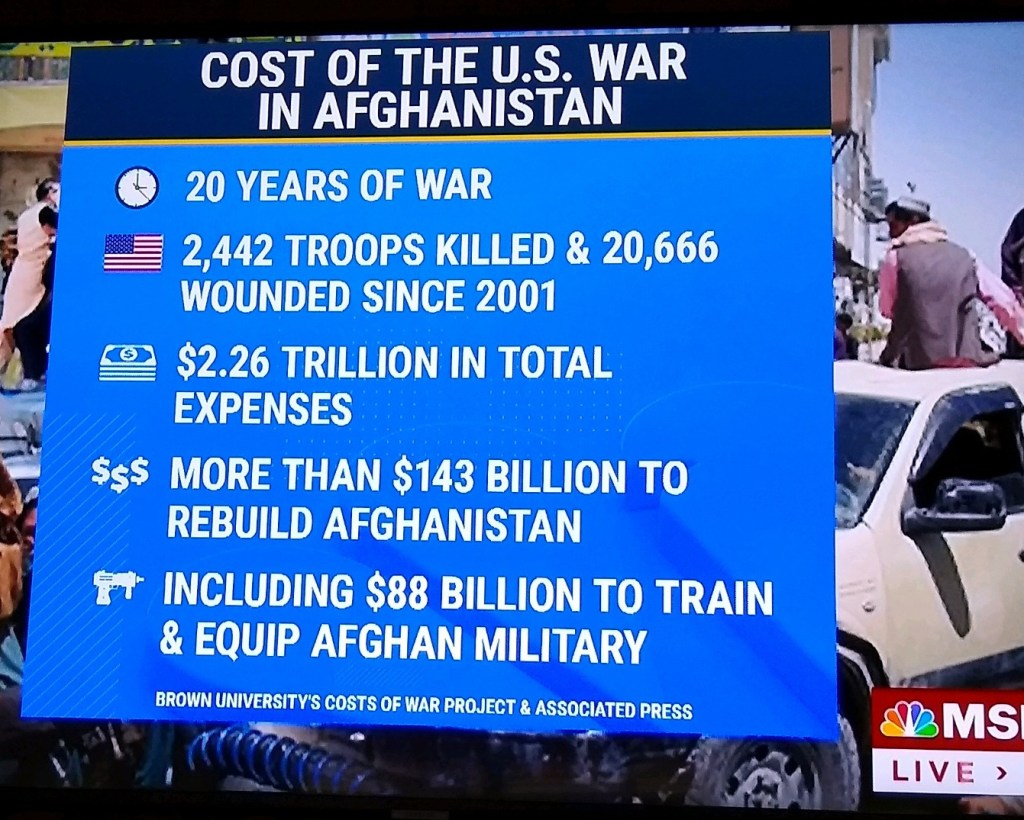
    IMG_20210816_093722329

    Screen shot today of US stats – not including the costs by NATO allies, most especially Germany and the UK, Canadian involvement until 2013, and the immeasurable loss of lives and property by the civilian population of Afghanistan in the past 20 years.

    And guess what? We made a pact with the Devil who has regained control of a country he never left…and never will.

    I remember another 20 year war from 1955 – 1975 in a faraway place known as Vietnam. I know, I know. No comparison, says Secretary of State Blinken. But I vaguely remember helicopters landing and taking off from rooftops to rescue people then like the images I saw today in Kabul. God help the women and children of Afghanistan.

    I will not watch TV news shows. I will not watch TV news shows. I will not watch TV news shows. Somebody stop me.

    *********************

    Stay safe, stay sane, get vaccinated please and stay tuned.