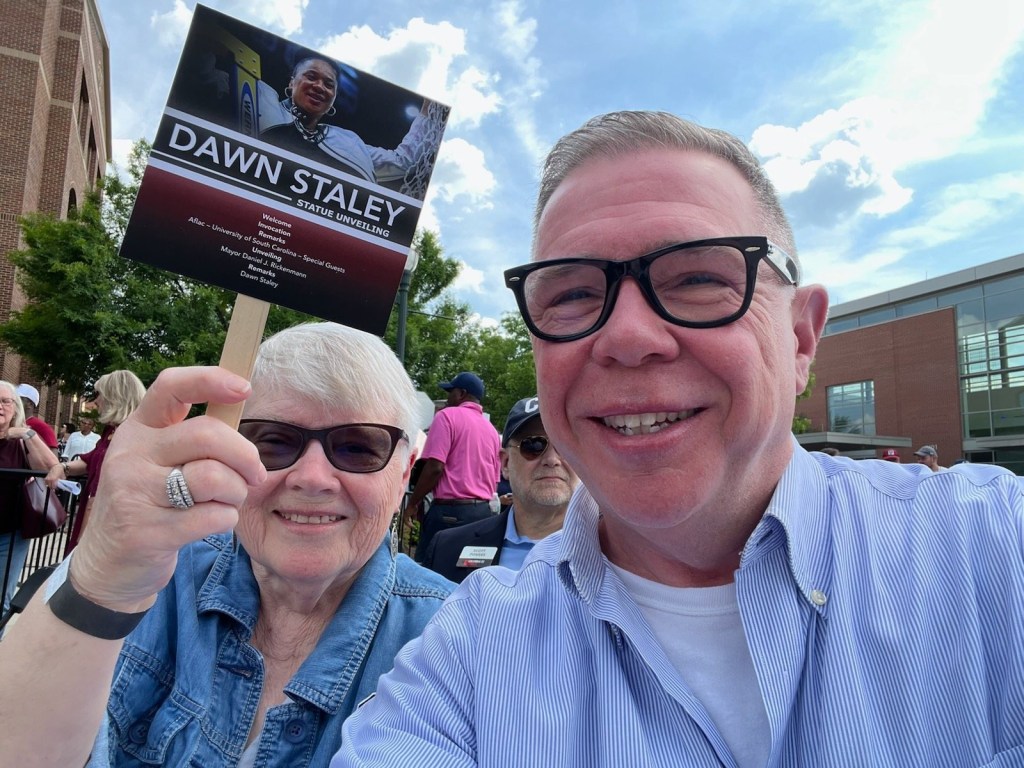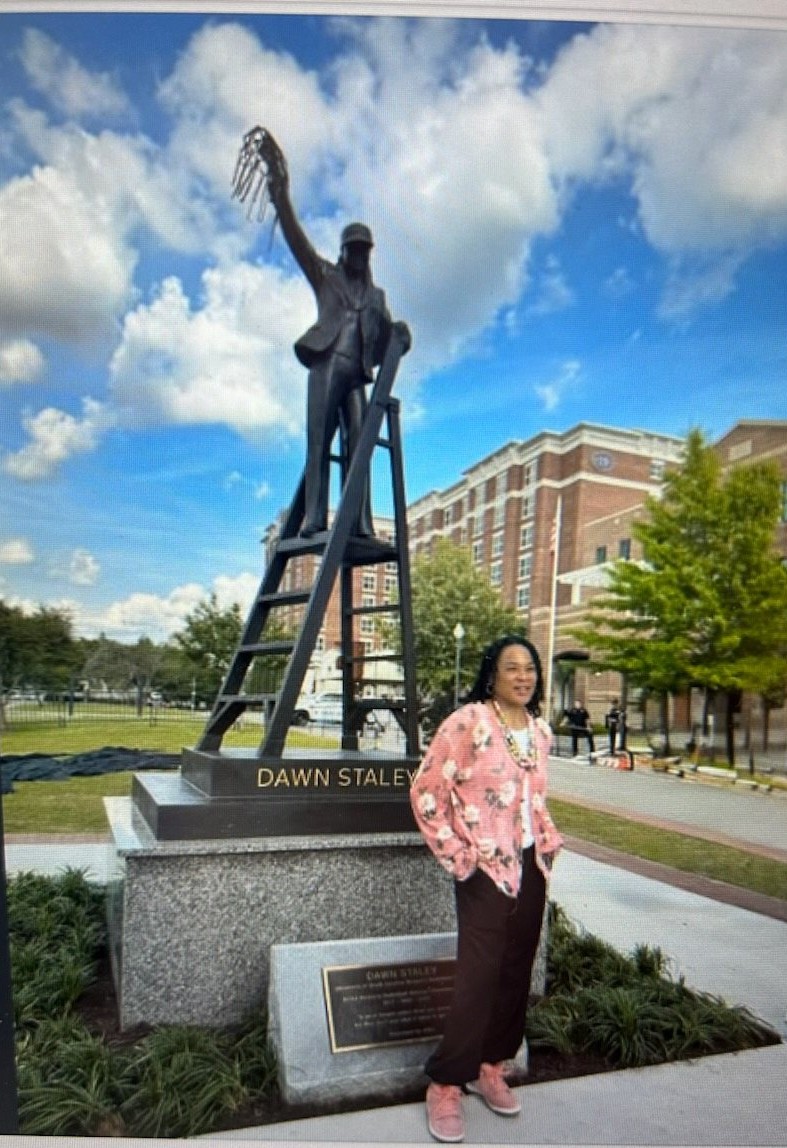
My cell phone rang which interrupted pre-nap reveries, and I was happy to talk to my friend, Garner, who was one of my best basketball buddies ever. He invited me to go with him to the unveiling of the Dawn Staley Statue here in Columbia at 4 o’clock that afternoon. I couldn’t accept fast enough! The day was an unexpected treat.
After lunch this past Wednesday, I settled into my large recliner for an afternoon of the Madrid Open tennis tournament, a tournament played on my favorite surface of red clay. I had fed Charly and Carl and looked forward to a helping of tennis mixed with my long afternoon snooze. Not so fast, my friend. The call from Garner changed that.
the order of the unveiling
my buddy Garner and me at the statue reveal
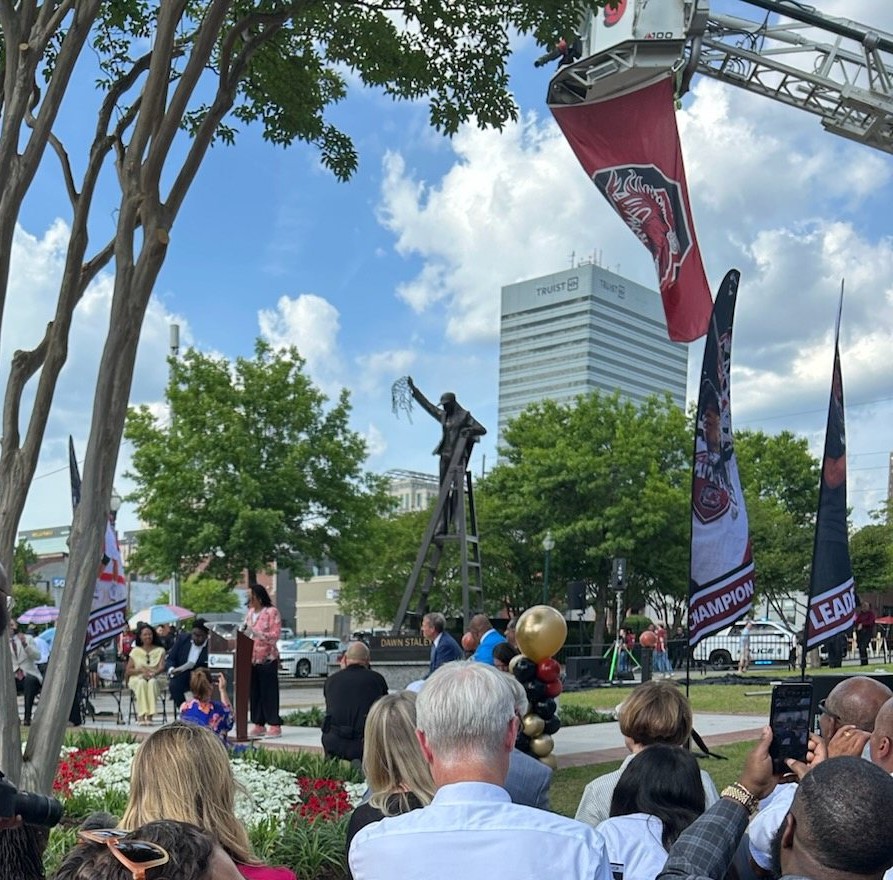
Coach Staley’s words seemed to reveal more than the bronze statue behind her.
“I agreed to the statue not for me, but for the girl who will walk by one day and wonder who I was,” Staley said. “Maybe she’ll look me up. She’ll see that I did some things in basketball of course, but I hope she sees much more. “I hope she sees that I was a champion for equity and equality. That, in my own way, I pushed for change. That I stood proudly in the space God called me to inhabit, not as someone perfect or extraordinary, but as a regular girl who used her gifts to open doors so other girls wouldn’t have to knock as hard.”
Indeed, her statue stands as a symbol of resistance, resilience, and representation. Only 6 percent of statues in the United States depict women, according to UW-La Crosse art professor Sierra Rooney, and even fewer depict Black women. (Curtis Rowser III, BET News, May 01, 2025)
Thanks, Coach, for three national championships, seven Final Fours, and nine SEC championships. We have been starved to have a top tier team at the University of South Carolina – you have put us on everyone’s radar now. More than that, thank you for what you give to this community, to your basketball “fams” and followers, to all who support you in your efforts to give a voice to the voiceless in an unwavering commitment to equality for all.
Although NCAA women’s basketball takes center court in our home during the month of March every year, Pretty and I also welcome an annual springtime celebration of Women’s History in March. Basketball bracketology should be discussed by experts, and neither Pretty nor I qualify. We were, however, both teachers at one point in our lives and did learn how to develop a lesson plan.
My plan today features a civics lesson Americans have either forgotten and/or not been taught, so think of this as a brief refresher course that is not sanctioned by anyone and won’t require a registration fee. Hang on to your recliners, my friends. This is high drama. The United States government is structured with three separate but interdependent branches: the legislative (Congress), the executive (President and Cabinet), and the judicial (Supreme Court and federal courts), each with specific powers and responsibilities. Being a contrarian, let’s work backwards as we consider three women who have been leaders in each equal branch under the Constitution.
Judge Ketanji Brown Jackson’s parents, Johnny and Ellery Brown, had a front row seat at their 51 year old daughter’s confirmation proceedings to be appointed the first Black woman to the United States Supreme Court during the Senate Judiciary Committee’s public hearings in April, 2022. Their faces remained noncommittal, even stoic, when their daughter’s faith, views on pornography, questions of character were attacked by the Republican Senators in the room.
The confirmation hearings that began with President Joe Biden’s nomination of Judge Jackson had a zoo-like quality with the zookeeper a/k/a Chairman Dick Durbin doing his best to maintain order – decorum was out the window. Johnny and Ellery Brown had undoubtedly seen worse behavior as natives of Miami growing up in the Jim Crow South but as public school teachers in Washington, D.C., they had also seen the impact of the Civil Rights Movement of the 1960s which gave their children more opportunities for success. Judge Jackson was born on September 14, 1970, in Washington, D.C. She was confirmed to the Supreme Court by the Senate with a 53-47 vote on April 07, 2022, and was sworn in on June 30th. of that year.
When Judge Jackson was 27 years old in 1997, a woman named Madeleine Albright, who then President Bill Clinton had nominated to become the first female Secretary of State, went through her own Senate confirmation hearings in an atmosphere much less combative than the circus Judge Jackson was forced to endure. Republican Senator Jesse Helms who chaired the Senate Foreign Relations Committee led then United Nations Ambassador Albright through the process that ended in a unanimous Senate vote to confirm. Wow. Those were the days.
Madeleine Albright was born on May 15, 1937, in Prague, Czechoslovakia (now the Czech Republic). In 1939 the Nazi occupation forced her family to become refugees in England, but they returned home after World War II; only to flee again when the communist coup occurred. Her father Josef Korbel had been a member of the Czechoslovakian diplomatic service and sentenced to death by the communist regime. The second time her family fled Madeleine and her mother Anna took a ship to Ellis Island in November, 1948; Josef joined them later. They eventually settled in Denver, Colorado, where Josef accepted a position at the University of Denver. These European immigrants had found a home.
Madeleine Albright’s storied career represents to me the best of America. To be “the first” woman in any field, to be known as a woman who “tells it like it is,” to successfully navigate the political land mines of our nation’s Capitol to serve our country in an ever changing world – these are accomplishments we celebrate; but to achieve as an outsider, a refugee, merited our highest honors including the Presidential Medal of Freedom bestowed by President Barack Obama in 2012.
Madeleine Albright died on March 23, 2022, following a long battle with cancer. The first woman ever called Madam Secretary of State left us as the first Black woman battled for her position on the Supreme Court in a contentious, even embarrassing at times, public hearing while her parents, husband, daughters, brother and the American people watched. The coincidental timing was remarkable to me.
Nancy Pelosi was born on March 26, 1940, andserved as the 52nd. Speaker of the House of Representatives, having made history in 2007 when she was elected the first woman to serve as Speaker. She made history again in January, 2019, when she regained her position second-in-line to the presidency – the first person to do so in more than six decades.
Pelosi was the chief architect of generation-defining legislation under two Democratic administrations, including the Affordable Care Act and the American Rescue Plan. She led House Democrats for 20 years and previously served as House Democratic Whip. In 2013, she was inducted into the National Women’s Hall of Fame at a ceremony in Seneca Falls, the birthplace of the American women’s rights movement. In 2024, she was awarded by President Biden the Presidential Medal of Freedom, the nation’s highest civilian honor.
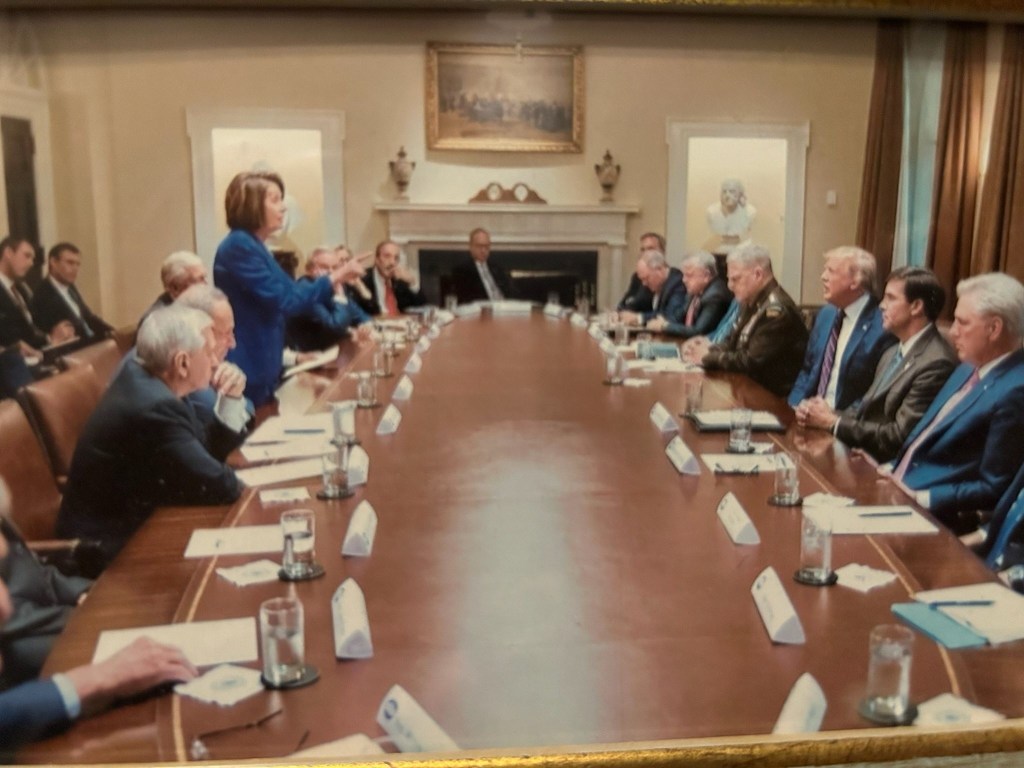
Pelosi has represented San Francisco in Congress for 37 years, currently serving as Speaker Emerita of the House and as the Representative for California’s 11th. Congressional District, but it is one picture of her during Trump’s first presidential term that occupies a place of honor in my office as the recipient of the Sheila R. Morris Calling It Like She Sees It Award.
Speaker Pelosi at a cabinet meeting during the first Trump administration
I had a vision of hope for the future when I heard Judge Jackson’s answers to the questions posed three years ago during her confirmation process, a glimmer of hope for equality and fairness for my granddaughters. I felt that same spirit of hope in the legacy Madeleine Albright left, her persistence in pursuing freedom for all nations from the position of an immigrant in this country, the world peace she strived for. Jackson. Albright. Pelosi. I salute all three of these warrior women during Women’s History Month for their shared destiny of becoming a “first” in the judicial, executive, and legislative branches of government in the United States of America – three women who broke not only glass ceilings in government but also understood that real power belongs to those willing to serve for a greater good.
Congressman John Lewis, civil rights activist and politician, passed away on July 17, 2020, after a brief battle with Stage IV pancreatic cancer. He was eighty years old. The next day then United States Senator Kamala Harris (D-CA) issued the following statement:
Congressman John Lewis was an American hero—a giant, whose shoulders upon many of us stand. Throughout his life, he showed unending courage, generosity, and love for our country.
As the son of sharecroppers in Alabama, John Lewis’ courage and vision placed him at the forefront of the civil rights movement. As the youngest speaker at the 1963 March on Washington, John Lewis knew the importance of bringing people together for an America that lives up to its ideals of liberty and equality for all.
It was an honor to once again join Congressman Lewis this year in Selma, Alabama in March for what would be his final walk across the Edmund Pettus Bridge, where just 55 years ago, Lewis was among those beaten by state troopers as they bravely marched from Selma to Montgomery for the right to vote. I was moved by his words: ‘On this bridge, some of us gave a little blood to help redeem the soul of America. Our country is a better country. We are a better people, but we have still a distance to travel to go before we get there.’
We are grateful that John Lewis never lost sight of how great our country can be. He carried the baton of progress and justice to the very end. It now falls on us to pick it up and march on. We must never give up, never give in, and keep the faith.
I will always cherish the quiet conversations we shared together when he inspired me to fight for the ideals of our beloved country. My prayers are with John Lewis’ family, loved ones, and the nation as we grieve this tremendous loss.
For me, Black History Month would be incomplete without remembering the courage of John Lewis in the Civil Rights Movement on Bloody Sunday at the Edmund Pettus Bridge in Selma, Alabama. I have stood on that bridge, heard the voices of the oppressors and the oppressed as they sang from the pages of a distorted hymnal written in blood through the centuries.
so many children to play with, and Daddy was superintendent
The little girl’s first grade class with teacher Mrs. Lucille Leewho gave us the gift of reading. She taught first and second grade in one room.
The little girl’s daddy was the superintendent of two schools: the one in the little two-story red brick schoolhouse where she went to school and the one across main street in Richards in the quarters where the Black children attended. One independent school district. Separate but not very equal. Integration came slowly to mostly overlooked rural southeast Texas.
Annual Easter Egg Hunt for grades 1 – 4
We walked up the dirt road to our house past my grandfather’s barn across the road from our garage while other teachers hid eggs around the school grounds. Then we turned around and ran back to hunt for the eggs. Ray Wood, a blonde-headed kid in my class, always found the maximum – most of the eggs were gone by the time I made it back. I was never known for speed.
my Uncle Charlie (mother’s brother)graduated from Richards school circa 1941
not sure why, but my Uncle Charlie hadthe number 12 written on him?
Mama’s oldest brother Marion (glasses and tie)
graduated from Richards school circa 1939
Aunt Lucille, Uncle Ray and Glenn a/k/a Daddy
My grandparents had limited education when they were growing up in large families working on farms. They could read, write, and do arithmetic – but I’m not sure where they learned. My mother and her three older brothers; my dad, his older sister, and brother all attended school in Richards, Texas at the same red brick schoolhouse I attended through the seventh grade. Our time at the school spanned from the 1920s – 1950s. All seven of them graduated before WWII ended. If legacies were given, I had one.
the entire Richards School Grades 1 – 8 plus 4 years of high school
the bell signaled the start of school in the morning
I counted four uncles, one aunt, and several cousins in this picture. I also knew many teachers and recognized kids whose names I can’t remember, but this was a typical rural Texas school in the 1930s and 1940s before World War II.
Thank you to my cyberspace followers for taking this nostalgic journey once upon a time in a faraway place that will always be deep in my heart. I’ll close with these two last photos that speak volumes about the little girl in the photos and stories.
Fourteen years of publishing with more than a thousand posts, the possibility of duplicate themes looms large. One of my favorite topics is the holiday celebrating the life of Dr. Martin Luther King, Jr. – I’ve written twenty-three posts in which Dr. King was featured, and I feel a sense of responsibility toward preserving his legacy, especially on the day we set aside to honor him in my country.This post was originally published on September 23, 2014.
South Carolina Pride was this past weekend in the state capitol of Columbia. I took 163 digital images over the weekend and posted my favorites on social media. I am a believer in the old adage “a picture is worth a thousand words,” and these pictures are images of hope, faith, love and joy – plus the occasional unsmiling prophecy pretenders. I love the pictures, but I can’t resist the thousand words, give or take a few.
When I look at these images, I hear the voices of America singing. I hear the cries of Paul Revere on his midnight ride and the loud sounds of argument, even heated debate as the Founding Fathers (yes, Virginia – there were no mothers present) drafted the Constitution of the United States with a Bill of Rights guaranteeing individual liberties.
I hear the sounds of slaves who could not speak to their masters, and I hear the whispers of abolitionists who spirited those slaves away in the darkness. I hear the cries of the wounded, dying Confederate and Union soldiers as the artillery fired around them on the fields at Vicksburg and Gettysburg; I hear the cannon fired in Charleston Harbor at Fort Sumter.
I hear the choruses of the suffragettes who held a convention in Seneca, New York, and marched because they dared to dream women had the right to vote – which they hoped would lead to greater equality, but then I hear the roll call of states that refused to ratify an Equal Rights Amendment which attempted to level the playing field for “the weaker sex” in the 1970s.
I hear the singing of the marchers in Selma and Birmingham in the 1960s as they walked to overcome their harsh treatment. I hear the voices of angry rappers today in Fullerton, Missouri, over the endless struggles for fair treatment in a country where equality is, too often, lip-synced.
I hear the voices of the drag queens at Stonewall in 1969 as they refused to be treated inhumanely and stand firm against the oppression of the gay community. I hear the sounds of pleas by children who are thrown out of their homes and into the streets when their family confronts their sexuality. I hear the sounds of comfort and support from people who respond with love to these children in distress…
I wish I had the gift of Dr. Martin Luther King, Jr. to describe my feelings as I rode on the Pioneers Float Saturday, but since I don’t, I’ll borrow his words from his last speech on April 3, 1968, in Memphis, Tennessee – the day before he was assassinated:
“Well, I don’t know what will happen now. We’ve got some difficult days ahead. But it doesn’t matter with me now. Because I’ve been to the mountaintop. And I don’t mind. Like any man I would like to live a long life. Longevity has its place. But I’m not concerned about that now…God’s allowed me to go up to the mountain. And I’ve looked over. And I’ve seen the promised land. I may not get there with you. But I want you to know today that we, as a people, will get to the promised land. And I’m happy, today, I’m not worried about anything. I’m not fearing any man.”
**********************
Dr. King carried me to the mountaintop with him more than once through his words, deeds, dreams, faith, hope and love – his unfailing commitment to peaceful change. Regardless of how I feel today on his special day in 2025, I know I’ve been to the mountaintop and seen the promised land. I hope you have, too.
You must be logged in to post a comment.