Category: racism

  • CELEBRATE International Women’s Day!


    Invest in Women — Accelerate Progress

    (theme for 2024)

    In South Carolina where Pretty and I live, 54% of the population are women, but not one woman sits on the South Carolina Supreme Court; we are the only state in the nation without a female justice. Only six state senators out of 46 are women, 20 out of 124 House members are women. These statistics indicate we rank 48th. of 50 states in women’s legislative representation according to the Center for American Women and Politics.

    Do the math: only 15% of the lawmakers making our laws in this state on reproductive rights, on health care for women and children, on domestic violence, on gun control, on climate change, on school safety, on police brutality against people of color, on issues affecting marginalized populations in the state, on banning books that promote inclusiveness and social justice – on these and all other laws in our state affecting every citizen – only 15% of those lawmakers are women.

    The voting odds are stacked against women, and history is not on our side, either. Women’s groups have been talking about underrepresentation in our state for nearly forty years. One of the true pioneers for women’s rights in South Carolina, Barbara Moxon, began a group called Advocates for Women on Boards and Commissions in 1988. I was the treasurer for that organization which developed extensive publicity on the need for more women political appointees while also providing aid and encouragement for female members to apply for appointments. We had limited successes in our efforts.

    The consequences of the 2024 election in November will have a generational effect not only on the nation but also on our state. Bravery, courage, dogged persistence, and financial support will be mandatory for any woman who puts herself forward in the political climate of these challenging times, but I am thrilled that a woman who has been my close friend for a very long time has answered the call for a change in leadership by campaigning for a Senate seat in South Carolina District 10.

    This woman has spunk, and I have always admired spunk combined with proven leadership qualities. I will have more to say about her in the days to come during her campaign, but for today as part of your celebration of International Women’s Day, please go to her website; get to know her better, and invest in a woman who will accelerate progress for all. http://www.franciekleckley.com.

    You tell it, Sister Girl.

    Onward.

  • the Orangeburg Massacre: yet another people’s struggle against oppression

    the Orangeburg Massacre: yet another people’s struggle against oppression


    In 2006, Cleveland Sellers’ twenty-two year old son Bakari was elected to the South Carolina Legislature, making him the youngest African American elected official in the country. Speaking with emotion at a SC State memorial service to honor those lost in the Orangeburg massacre, Bakari Sellers said, “We join here today in our own memorial to remember three dead and 27 injured in yet another massacre that marked yet another people’s struggle against oppression. These men who died here were not martyrs to a dream but soldiers to a cause.”

    The Orangeburg Massacre occurred on the night of February 8, 1968, when a civil rights protest at South Carolina State University (SC State) turned deadly after South Carolina highway patrolmen opened fire on about 200 unarmed black student protestors. Three young men were shot and killed, and 28 people were wounded. The event became known as the Orangeburg Massacre and is one of the most violent episodes of the civil rights movement, yet it remains one of the least recognized.

    The above excerpts from HISTORY.com editors on February 07, 2022, related to an event known in South Carolina history as the Orangeburg Massacre which took place on February 08, 1968. I remembered the year, but I didn’t remember the Orangeburg Massacre when I moved to South Carolina in 1974.

    I was in my first year of a “real” job in February, 1968, working for one of the Big 8 CPA firms when the Orangeburg Massacre occurred. While I sat in my cubicle on the 17th. floor of the Bank of the Southwest building in Houston, Texas, I didn’t realize history was being made by students my age at historically black South Carolina State University in the small town of Orangeburg, South Carolina, more than a thousand miles from where I sat.

    Imagine being a black student at SC State, going to a bowling alley with friends on February 05, 1968, only to be turned away by owner Harry Floyd who claimed his All-Star Bowling Triangle bowling alley was exempt from the Civil Rights Act of 1964 since his bowling alley was private property. Whites Only, the sign said.

    Students from SC State and nearby Claflin University began nonviolent protests that lasted for two nights, but on the third night their nonviolence took an extremely violent turn when South Carolina highway patrolmen opened fire on about two hundred unarmed black student protestors. Three young black men were killed with another twenty-eight protestors wounded.

    The three students who were shot and killed by the police were: Freshman Sammy Hammond was shot in the back; 17-year-old high school student Delano Middleton, whose mother worked at SC State was shot seven times; and 18-year-old Henry Smith was shot three times. (History.com)

    Among the wounded that night was a young civil rights activist named Cleveland Sellers, Jr., who was born in neighboring Denmark, South Carolina, a town with a population under 2,000 when he was born in 1944; he had returned to his home state in 1967 to pursue a teaching career following years of activism in the Civil Rights Movement which put him on the government’s radar as a militant. On the night of the Orangeburg Massacre Cleve Sellers was shot in the arm, taken into custody at a local hospital and charged with inciting a riot on the campus. Two years later in September, 1970, a South Carolina judge allowed the state to convict him of rioting at the bowling alley. Sellers was sentenced to one year of hard labor but released after seven months. He was the only protestor prosecuted – nine police officers were charged with shooting at the protestors…all were acquitted.

    Harry K. Floyd, Sr., owned and operated the All-Star Triangle Bowling Alley until his death in 2002 at which time his son Harry K. Floyd, Jr., took over. The Floyd family closed the bowling alley in 2007 due to “financial difficulties” according to wikipedia. The site remains on the National Register of Historic Places and has supposedly been bought by a nonprofit in 2020 with the goal of turning it into a memorial for the Civil Rights Movement in Orangeburg called the National Center for Justice.

    February 08, 2024, marked fifty-six years since the Orangeburg Massacre, and I felt Black History month was an opportunity to remember, to honor the personal sacrifices made by ordinary citizens who refused to yield to discrimination based on their race. Cleveland Sellers, Jr., went on to serve his native South Carolina by becoming the director of the African American Studies Program at the University of South Carolina, by becoming the 8th. president of Voorhees College in Denmark, and by raising his youngest of three children, Bakari, to follow in his footsteps as an activist who honored the Orangeburg Massacre.
  • say it plain, say it loud

    say it plain, say it loud


    Benjamin Mays was the child of former slaves,. He was born on an isolated cotton farm near Ninety Six, South Carolina in 1894. His parents were sharecroppers. The darkest years of Jim Crow segregation were just descending on the South; humiliation, mob violence and lynching by whites were common threats for African Americans. Mays learned at an early age the searing lessons of racial inferiority. He had a vivid memory of being stopped with his father by a group of armed, white men on horseback. “I remember starting to cry,” Mays wrote. “They cursed my father, drew their guns and made him salute, made him take off his hat and bow down to them several times. Then they rode away. I was not yet five years old, but I have never forgotten them.”2 (American RadioWorks: A Century of Great African American Speeches)

    In 1940 following a fascinating journey from this inauspicious beginning Mays became the President of Morehouse College, a respected black school for men in Atlanta; Martin Luther King, Jr. was a Morehouse graduate in 1948 and considered Mays to be his “spiritual mentor and intellectual father.” On April 9, 1968 five days following the assassination of King, Mays delivered his eulogy in an open-air memorial service on the Morehouse campus where a crowd estimated at over 150,000 people attended.

    As we celebrate the actual birthday of Martin Luther King, Jr. (January 15, 1929) with a federal holiday in the United States in 2024, the words of the Mays eulogy still speak plain and loud.

    God called the grandson of a slave on his father’s side, and the grandson of a man born during the Civil War on his mother’s side, and said to him, ‘Martin Luther, speak to America about war and peace. Speak to America about social justice and racial discrimination. Speak to America about its obligation to the war. And speak to America about nonviolence.

    Let it be thoroughly understood that our deceased brother did not embrace nonviolence out of fear or cowardice. Moral courage was one of his noblest virtues. As Mahatma Gandhi challenged the British Empire without a sword and won, Martin Luther King Jr. challenged the interracial injustice of his country without a gun. And he had faith to believe that he would win the battle for social justice. I make bold to assert that it took more courage for Martin Luther to practice nonviolence than it took his assassin to fire the fatal shot. The assassin is a coward. He committed his dastardly deed and fled. When Martin Luther disobeyed an unjust law, he accepted the consequences of his actions. He never ran away and he never begged for mercy. He returned to the Birmingham jail to serve his time...

    Morehouse will never be the same, because Martin Luther came by here. And the nation and the world will be indebted to him for centuries to come… 

     I close by saying to you what Martin Luther King Jr. believed. If physical death was the price he had to pay to rid America of prejudice and injustice, nothing could be more redemptive. And, to paraphrase the words of the immortal John Fitzgerald Kennedy, permit me to say that Martin Luther King Jr.’s unfinished work on earth must truly be our own.”

    Say it plain; say it loud. America remains indebted to Martin Luther King, Jr. on what would have been his 95th. birthday in a new century, and his unfinished work on earth must truly be our own. We have much to do.

    Onward.

  • Barbie, Beyonce, Taylor? Yeah, but my vote goes to Ruby and Shaye for 2023 women of the year

    Barbie, Beyonce, Taylor? Yeah, but my vote goes to Ruby and Shaye for 2023 women of the year


    I’ve gone through a tough time this last year with political current events under the Republican control of the House of Representatives where they were more obsessed with finding and keeping a Speaker than confronting America’s dilemmas at home and abroad in 2023. The refugees at our borders desperately seeking safety and security while citizens in Texas, New Mexico, Arizona, and California struggle under the weight of thousands of immigrants crossing their southern borders every day; blocking international aid packages for the people of Ukraine and Israel who are waging desperate wars to protect democracies against terrorism; embracing the Big Lie of the 2020 presidential election – the People’s House no longer represents the majority of the people in this country. They do, however, manage to scare me to death.

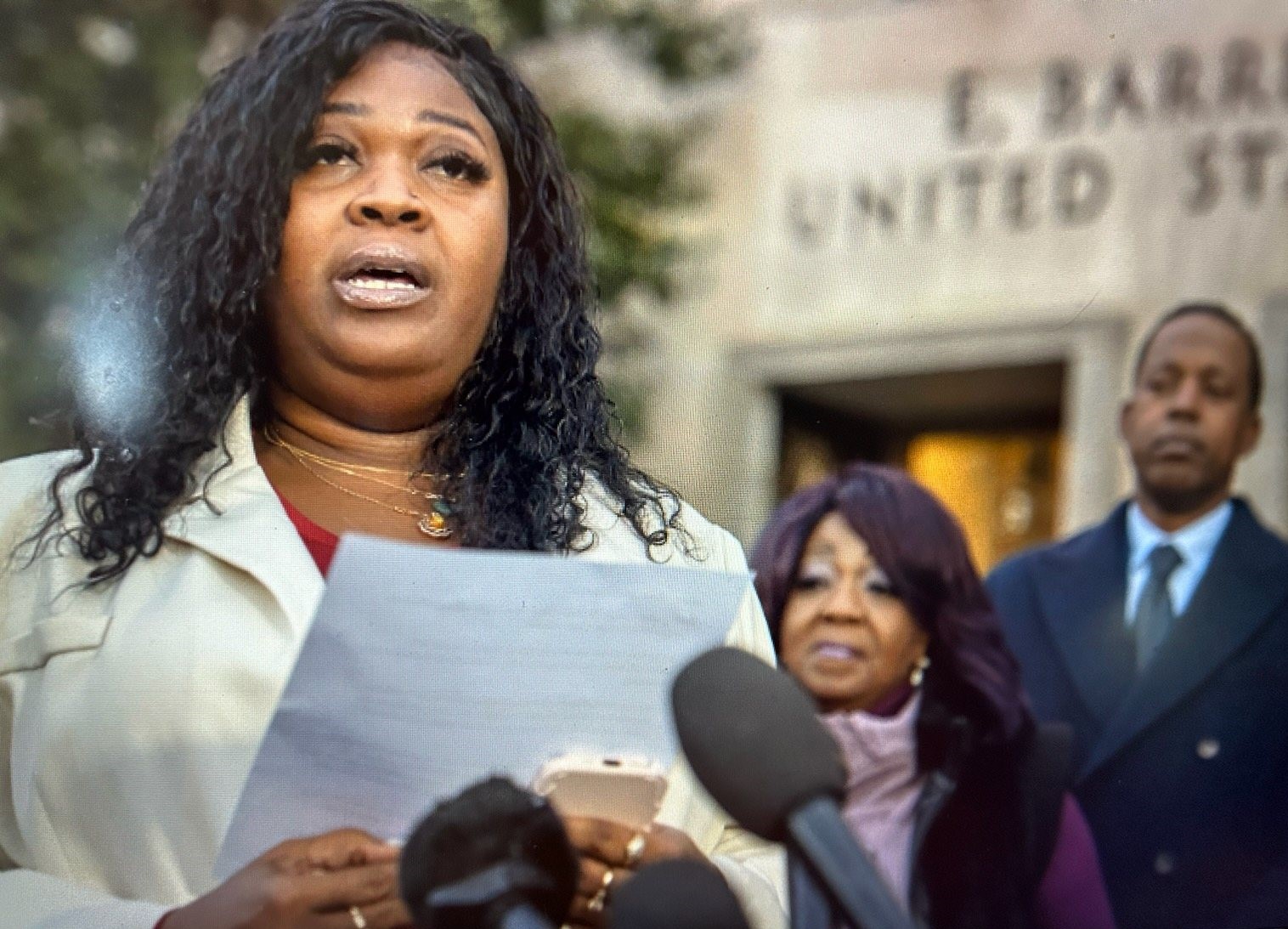
    I’ve had several moments of hope in the past year but no personal giddiness until a jury in New York awarded $148 million to Shaye Moss and her mother Ruby Freeman on December 15, 2023 in a decision against former New York City Mayor Rudy Guiliani for his targeted destruction of their lives through defamation of their characters following their service as election workers in Georgia for the 2020 election. Joy to the world, I thought in keeping with the season, accountability reigns. These courageous Black women have persistently sought justice for the loss of their identities for the past three years, and a jury of their peers rewarded these sacrifices in a tangible manner.

    CNN December 20, 2023

            Shaye Moss speaks while her mother Ruby Freeman listens

                      ************

    But Giuliani refuses to keep his mouth shut about the two women who defeated him. All is still not calm nor particularly bright in the former mayor’s mind.

    “On the heels of winning a $148 million defamation judgment Friday against Rudy Giuliani, former Georgia election workers Ruby Freeman and Shaye Moss have again sued the former New York City mayor seeking to “permanent bar” him from making additional defamatory comments about them…

    In a 134-page complaint filed Monday, attorneys for the two women wrote that Giuliani “continues to spread the very same lies for which he has already been held liable,” citing comments made last week to ABC News’ Terry Moran outside of court, in which Giuliani insisted that Freeman and Moss were “changing votes.”

    The two women asked the court to prevent Giuliani from “making or publishing … further statements repeating any and all false claims that plaintiffs engaged in election fraud, illegal activity, or misconduct of any kind during or related to the 2020 presidential election.”  (ABC News, Lucien Bruggeman, December 18, 2023)

                   *************

    I congratulate the Barbie financial empire creators, Beyonce and Taylor Swift for their amazing accomplishments and recognitions in 2023 – feminist has returned to favor in a world that needs a woman’s touch. But remember Shaye Moss and her mother Ruby Freeman, too, for their historic win against a man who picked the wrong battle and lost.

    Deck the halls with boughs of holly, fa la la la la, fa la la la. ‘Tis the season to be jolly, fa la la la la, la la la la. I’m in the mood to deck a few halls.

  • the truth tellers

    the truth tellers


    At a press conference following her loss in the finals at Wimbledon in 2019, Serena Williams was questioned about why she lost. Although she tried to say her opponent played a brilliant match, the members of the press wouldn’t let it go. They asked her if she thought her lack of match play during the year had hurt her, whether her role as a mother took too much time away from her tennis, and finally someone said they wondered if she spent too much time supporting equal rights or other political issues. Serena’s quick response to that question was “The day I stop supporting equality is the day I die.”

    I can identify with her answer because I believe my actions to support equality and social justice are two of the dominant forces of my life, but alas, I lack the tennis skills that give Serena Williams a universally recognized platform. Writing has been my platform for supporting equal rights during the past seventeen years; it has been the curtain call for the third act of my life – my love affair with words: collecting, rearranging, caressing them to make sense of an ever-changing world. Flannery O’Connor said I write because I don’t know what I think until I read what I write. I get that because I can start with a feeling, but sometimes my thoughts trail along behind my words that come from a mysterious place yet to be revealed.

    This poster given to me by my friend Linda many years ago hangs in my office today with words from author Anne Lamott to writers about why they write. “It is as if the right words, the true words, are already inside of them, and they just want to help them get out.” The true words I release, however, are not necessarily everyone’s truth. I have learned over the years that truth is not an absolute for every person but rather a fluid concept capable of manipulating minds at odds with what I believe truth to be. For example, remember Kelly Anne Conway’s remarkable explanation of “alternative facts.” Those two words took America on a roller coast ride of a reality show called Believe It or Not DC Style for the past eight years, and unbelievably created a deep wedge that pit family members, friends, co-workers, even institutions against each other with no sign of relief in next year’s political environment.

    Truth telling may be a lost art, truth tellers may bend with the winds, but fundamental values of equality and social justice must not be either lost or warped. As Serena said, the day I stop supporting equality is the day I die.

    And I ain’t ready to go yet. Onward.

    ********************

    For the children.