As we turned into the driveway this morning from running errands that included taking Carl to the vet over the river and to the city for evaluation and annual shots by 9 a.m., then driving completely in the opposite direction from the vet to my eye doctor to pick up a pair of eyeglasses being repaired but breaking the heavy traffic with a quick stop at the Rush’s drive thru for our daily fix of iced tea. When I saw the large Ukrainian flag we fly at the edge of our carport, I said oh my goodness. Those poor Ukrainian people are having such a horrible life; I see the images every day of their losses. I continuously worry so much about the children.
When Pretty came to a stop at the carport, she turned to me and said you are so negative. You always see the worst in everything anymore.
To which I replied, maybe because I am getting old.
May Sarton (1912 – 1995) was a Belgian-American novelist, poet, and memoirist who wrote in her journal At Seventy published in 1984: “What I want to convey is that, in spite of the baffling state of the world around us – war in the Falklands and in the Middle East, poverty, recession, racism at home – it is still possible for one human being, with imagination and will, to move mountains. The danger is that we become so overwhelmed by the negative that we cannot act.”
What I want to convey to Pretty is that, in spite of the baffling state of the world around us – war in Ukraine and in the Middle East, poverty, inflation, racism at home, a former president of the United States surrendering today for defying the laws set forth by our founders in the Constitution – it is still possible for one human being, with imagination and will, to move mountains. The danger is that we become so overwhelmed by the negative that we cannot act.
I believe that in the past six years I have become more overwhelmed by the negative than I realized so from this day forward I promise to project positivity for the sake of my family, friends, and followers.
Hm. I hope I haven’t chosen a bad day to make that pledge. TV news off.
***********
P.S. The eyeglasses weren’t ready – the woman told me she had been on vacation so the lens had arrived but they hadn’t been placed in a frame. They will call me. But not to end on a negative note, the woman at the Rush’s drive-thru was the friendliest person ever. Seriously, the…friendliest…person…ever.
By Nancy Pelosi, House speaker emerita (msnbc.com)
On this day [July 19, 1848] 175 years ago, in the small town of Seneca Falls, New York, a group of visionary women shook the world.
With their Declaration of Sentiments, they not only echoed but improved upon our founding charter — boldly asserting that “all men and women are created equal” and rallying women to “demand the equal station to which they are entitled.”
Imagine the courage that it took for those women at that time. Some had left home without their husband’s or father’s permission, and spoke openly about issues of discrimination and disenfranchisement and domestic violence.
The groundbreaking convention in Seneca Falls further energized what was a burgeoning women’s rights movement in America. And since then, generations of fearless women marching, mobilizing and demanding full equality for all have carried forth their torch.
Today, we stand on the shoulders of our courageous foremothers. Because they took a stand, at last we have a seat at the table.
For their audacity in blazing a path for progress, our nation owes a debt to Elizabeth Cady Stanton, Lucretia Mott, Martha Wright, Mary Ann M’Clintock, Jane Hunt, Alice Paul, Susan B. Anthony, Sojourner Truth and countless heroines of history, including those who were enslaved, abused or marginalized.
More than seven decades later, women won the right to vote with the 19th Amendment, although it would take many more decades before Black women could fully exercise this freedom everywhere. The Equal Pay Act of 1963 and the Lilly Ledbetter Fair Pay Act of 2009 are both pieces of an ongoing effort to close the gender pay gap. In the 1990s, Congress secured expanded access to family and medical leave, as well as strong protections in the Violence Against Women Act.
Meanwhile, our coalition has only grown broader and stronger as we have fought for the rights and protections of transgender women and nonbinary Americans.
All this progress has made possible a woman as vice president, a woman as speaker — and someday soon, a woman as president.
Today, we stand on the shoulders of our courageous foremothers. Because they took a stand, at last we have a seat at the table.
Yet outrageously, our centuries-long march toward gender justice was abruptly halted last summer when the Republican supermajority on the Supreme Court took a wrecking ball to women’s health freedom.
The monstrous decision overturningRoe v. Waderipped away long-held rights — and unleashed a flood of draconian policies denying access to the full spectrum of reproductive care, even in life-threatening circumstances.
For the first time in our history, girls growing up today have less reproductive freedom than their mothers. Democrats will not rest until the rights of Roe are restored for all.
At the same time, women still face too many barriers in the workplace.
Gender justice starts with finally achieving equal pay for equal work. And we must ease the burden of caregiving that falls disproportionately on women by investing in the expanded child tax credit, universal child care, paid family and medical leave, home health care services and more.
This is the imperative, ongoing work of the Biden-Harris administration and Democrats in the Congress — and we are committed to finishing the job.
The story of America has always been one of ever-expanding freedoms, from abolishing the scourge of slavery, which was strongly supported at Seneca Falls, to ensuring all women and people of color are able to vote, to securing reproductive freedom, to achieving marriage equality.
These victories were made possible by everyday Americans participating in the highest form of patriotism: outside mobilization. This is the indelible legacy of Seneca Falls, stirring generations of women not to wait but to work for change.
So, on this momentous 175th anniversary, let us renew our pledge to continue the work of Seneca Falls. Because all of America’s mothers, wives, sisters and daughters must be able to enjoy the liberties and opportunities that they deserve.
When women succeed, America succeeds.
Nancy Pelosi
Speaker emerita Nancy Pelosi has represented San Francisco in Congress for more than 36 years. She served as the 52nd speaker of the U.S. House of Representatives, from 2007 to 2011 and from 2019 to 2023.
“Pass Grandpa Schlinke the fried chicken, Sheila Rae,” my grandmother Dude said as I was about to take a drumstick from the platter in front of me. “You know he always gets the first piece.”
How could anyone forget, I thought. I picked up the platter and gave it to my great-grandfather, who sat like a king at the head of our dining room table. He looked imperious as he sat there in his starched white shirt and black trousers held up by dark suspenders. His face was inscrutable as he searched the platter for his favorite pieces. He found the two best ones with white meat, the breast and the pulley bone, and picked them up with his fingers.He placed them ceremoniously on his plate. With something of a grunt, he passed the meat to my Grandma Schlinke, who was seated on his right.
And so, the order was established. Every dish went first to Grandpa Schlinke, and then made its way from him to the rest of us. Uncle Toby, my mother’s brother who lived with us, sat next to Grandma Schlinke. Then came Daddy, who sat at the foot of the table at the opposite end from Grandpa. Mama sat next to him, and I sat in the middle between her and Dude, my mother’s mother. Dude had to be next to Grandpa so she could jump up to get him more sweet tea or homemade rolls. He had a healthy appetite.
Grandpa and Grandma Schlinke were my grandmother’s parents. They lived in Houston with my Uncle Otto, who was their youngest son. Once each summer they came to Richards which they considered way out in the country to stay with us for a few days. Everything changed when they visited. For one thing, we ate every meal in the dining room, which we rarely used. For another, I slept on a pallet on the floor because we really didn’t have enough beds for everyone. It was okay, but I was usually happy to see them leave.
They were mysterious to me. I first believed part of the enigma was they didn’t speak English well. They had spoken German until their thirteen children brought English home from the public schools. As I got to know them better, I decided they weren’t big talkers in any language.
Every morning after breakfast, Grandpa Schlinke would order me to bring him the newspaper, which he would take to a rocking chair on the front porch. There he would sit and read and rock. Always dressed in the same white shirt and black pants with suspenders. And bare feet. One of the few comments he directed toward me was to caution me about shoes. “Shoes are the tools of the devil,” he pronounced.
I tried very hard to like this crusty old man because he was Dude’s father. I loved her so much I knew I should love him, too. She was always thrilled to have her parents visit and wanted everything to be just right for them. I felt I should try to entertain him, since Daddy and Dude were at work, and Mama was gone to college in Huntsville, where she was working on her degree. Uncle Toby was forever listening to his “Back to the Bible” broadcast on the radio and working crossword puzzles. Grandma Schlinke constantly cleaned or cooked. She would sweep the kitchen several times a day. Who knew why?
At any rate, that left me to sit with Grandpa Schlinke on the front porch while he rocked. “What are you reading today, Grandpa?” I asked one morning. “The news of the day,” he replied. “Anything in particular?” I persisted. Being eight years old, and trying to play the genial hostess for this gruff ninety-something-year-old man was challenging.
He paused in his reading and stared into the space in front of him. His eyes were small for his big German face with a nose like Pinocchio. A slight breeze blew the few tufts of his white hair as he rocked. I tried to follow his gaze. The crape myrtles directly in the center of our vision were a brilliant hot pink and in full bloom. The grass was perfectly manicured and emerald, green. Across the dirt road was Anna and Tom Owen Smith’s neat white frame house that looked very much like ours. Nothing stirring there. Beyond their house we had in our sights the roof of the general store where Dude worked. I heard a bee humming in some verbenas near where we sat. There were no other sounds. It was going to be a long day for me with this old man.
“I was in jail once,” Grandpa Schlinke said from out of the blue. “The sheriff came to my house and arrested me and took me to the county jail.” He stared some more. My mind snapped to attention. This was a news flash. My first thought was, did Mama know? She wouldn’t have liked to think that her grandfather had ever been in jail. I knew that without a doubt. That was the wrong image of our family, for sure. Surely, Dude must have known. Maybe she had even been there when the sheriff came to take away her father. How old had she been? My mind was racing with a million questions. I had to be careful, though. This was a situation requiring great diplomacy to elicit valuable information. I walked on eggshells.
“What did you do?” I asked. I was trying to keep excitement out of my voice so that Grandpa would continue. He sat and looked upward to the blue sky, apparently for direction. “I had eleven living children of my own, and then my brother died. He left two more, Arnold and Amelia. I promised him I would take care of them for him. So now we had thirteen children on our farm. There was no money and the cotton crop was very poor.”
He stopped. I waited. No one got arrested for having thirteen children and a bad cotton crop, did they? Surely not. Grandpa turned in the rocker to look squarely at me. He looked right through me with those beady eyes and spoke again. “I had a neighbor named Neville Johnson who told me we could make a lot of money in a new business that wasn’t hard to learn. Neville had capital to get started. So, we made a partnership. Neville and me. Partners. Sealed with a handshake and our word.”
Grandpa paused, gazing again at the crape myrtles. Finally, he turned and looked down at me. He seemed to have reached a momentous decision. I held my breath. “We built a still and made moonshine whiskey in the back of my farm. We made good money for a few months. I was getting caught up on paying my bills. My children were eating regularly. Life was better.” His eyes grew moist. “One night Neville Johnson didn’t come to the still. Instead, the sheriff came that night and busted up everything we had. He arrested me and took me to jail. The deputies threatened me with guns and called me a kraut-head. The booming business was over.”
I nodded encouragement and waited expectantly for more of the story. Grandpa calmly picked up his paper and resumed reading. Apparently he was finished. A few questions would be left unanswered.
I asked Dude about this episode later, and she said she knew. Of course, everyone knew. He had come back from jail after a few months. Her brothers had planted the cotton while he was away. The moonshine money had kept them fed and clothed until the next cotton crop was sold. That was all you could say about it, she implied.
I never took up the matter again with Grandpa Schlinke, but somehow the story made him seem real to me. Maybe the reason he didn’t talk a lot was he was too busy with his memories of people who were no longer there. Like Neville Johnson.
*******************
The blossoms of the crape myrtle tree in our front yard will soon be ablaze with the bright pink signature color I love most – perhaps because pink was the color of the ones in the yard at my grandmother’s house in Richards, Texas. Crape myrtles love the summer heat in South Carolina as they did the brutal Texas heat seven decades ago; today I was reminded of this story my great-grandfather shared with me when I was a child while we sat on a small front porch one summer looking at nothing but pink blossoms and his memories.
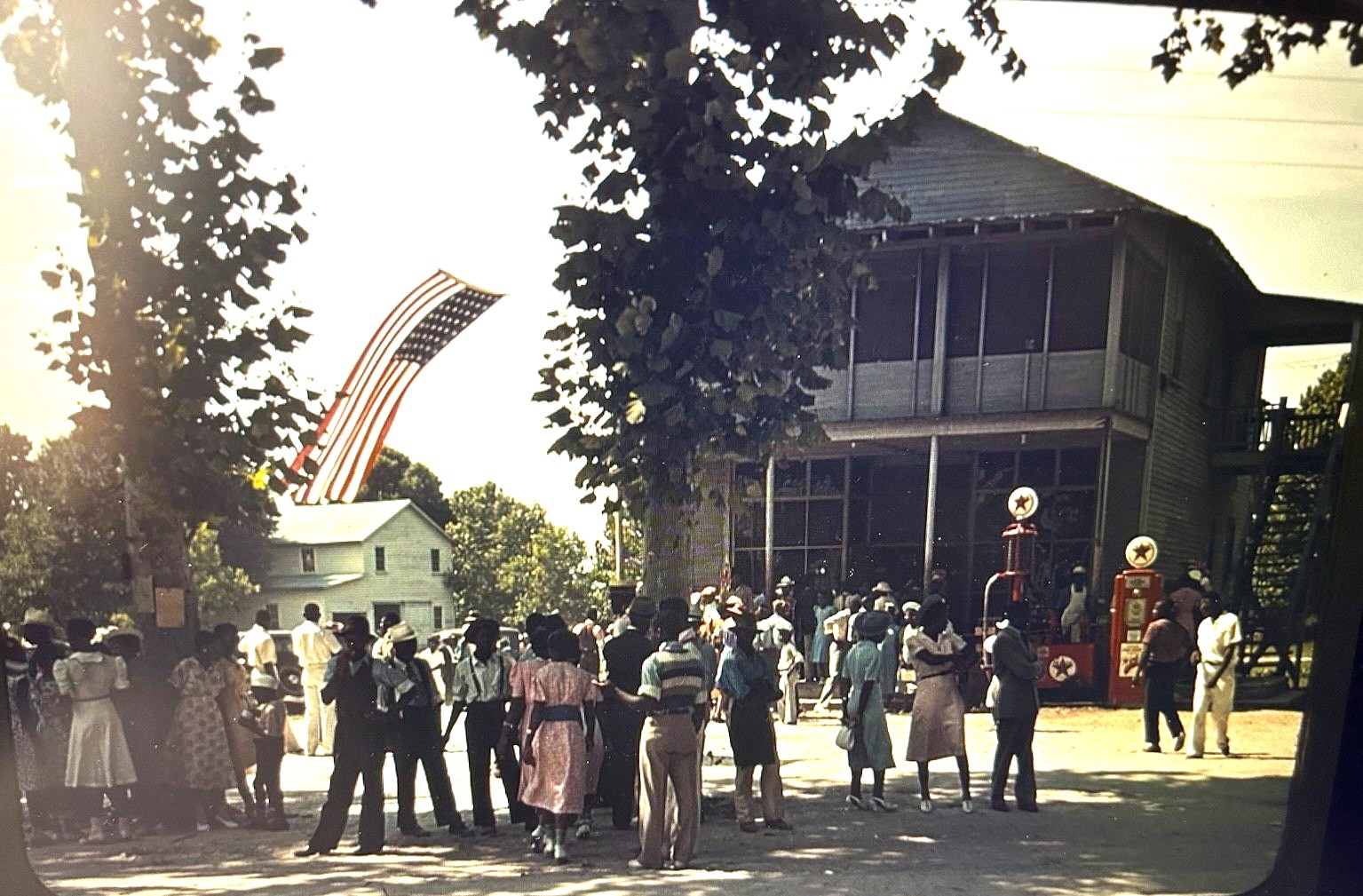
4th of July Celebration at Texaco Station on St. Helena Island, SC in 1939
photographer Wolcott – Library of Congress
Their ancestors from places now known as Spain, France, England, Central and West Africa among others were enslaved laborers on St. Helena Island, South Carolina alongside Indigenous Americans from the early sixteenth century through the signing of the Declaration of Independence on July 4, 1776 through a Civil War begun in cannon fire on Fort Sumter, South Carolina a hundred nautical miles north of their island in 1861 when Union forces set up occupation on St. Helena and freed all slaves working on plantations.
The Declaration of Independence celebrated that 4th. of July at the Texaco filling station on St. Helena in 1939 is the same one we celebrate in 2023 for the hope, the promises that begin with the words “We hold these truths to be self-evident, that all men are created equal, that they are endowed by their Creator with certain unalienable Rights, that among these are Life, Liberty and the pursuit of Happiness.”
The poet Maya Angelou said when she gets up every morning, she doesn’t think those people in the past are gone and forgotten, but when she gets up, she says everybody come with me.
A thirty-eight year old man accused of murdering five neighbors in Cleveland, Texas was captured in a smaller Texas town called Cut and Shoot that was less than 20 miles from where the crime happened after a massive four day manhunt by a collection of law enforcement organizations.The man lived next door to the victims which included two women aged 21 and 31 respectively, a 25 year old woman and her 9 year old son, and an 18 year old young man. According to the 9 year old’s father, the neighbor walked into their home armed with an AR-15 rifle and began shooting after an altercation between them over a crying baby in his home and the neighbor’s shooting practice in the next door yard.
According to data published by Caroline Covington on July 28, 2022 in the Texas Tribune, Texans purchased more than 1.6 million guns in 2021 which was about 1 gun for every 14 adults in the state. Concurrently in 2021 the Texas legislature passed new laws allowing the open carry of handguns without a license to carry those guns under certain conditions per information provided by the Texas State Law Library. The Wild, Wild West of Hollywood westerns in the 1940s and 50s had returned to those thrilling days of yesteryear but the guns of the 21st. century were more powerful, more accessible, able to kill innocent people much quicker than the ones used in the 1952 Gary Cooper film High Noon.
When Pretty and I had a second home on Worsham Street in Montgomery, Texas from 2010 – 2014 we drove through Cut and Shoot whenever we made one of our countless thousand mile trips between South Carolina and Texas. During that time we used the Cut and Shoot post office as a sign we were almost to Conroe which meant we were less than an hour from Worsham Street. Even our dogs sensed the two day drive south and west was nearing the end when we slowed for the small town speed limit and stopped for several red lights there.
Now the name Cut and Shoot is infamous as the town where the Cleveland mass shooter was captured. The little town that got its name from a fight between two (who’s suprised?) religious groups, the home of ostensibly the only person with any claim to fame (professional heavyweight boxer Roy Harris) would achieve notoriety as the place where a middle-aged man with an AR-15 who killed five of his younger neighbors in Cleveland was found hiding in a closet in a house there.
I really don’t care if the people killed and/or the killer were shades of black, brown, white, or mix-ish; what I do care about is that somebody somewhere had an AR-15 rifle and a temper. Everyone has a temper to some degree – even our fifteen month old granddaughter Molly gets mad when she hears the word No, and she feels free to act out by throwing whatever is in her hand to the ground as hard as she can.
But not everyone has an AR-15 rifle, and in my opinion not everyone should.









 I'll Call It Like I See It
You must be logged in to post a comment.