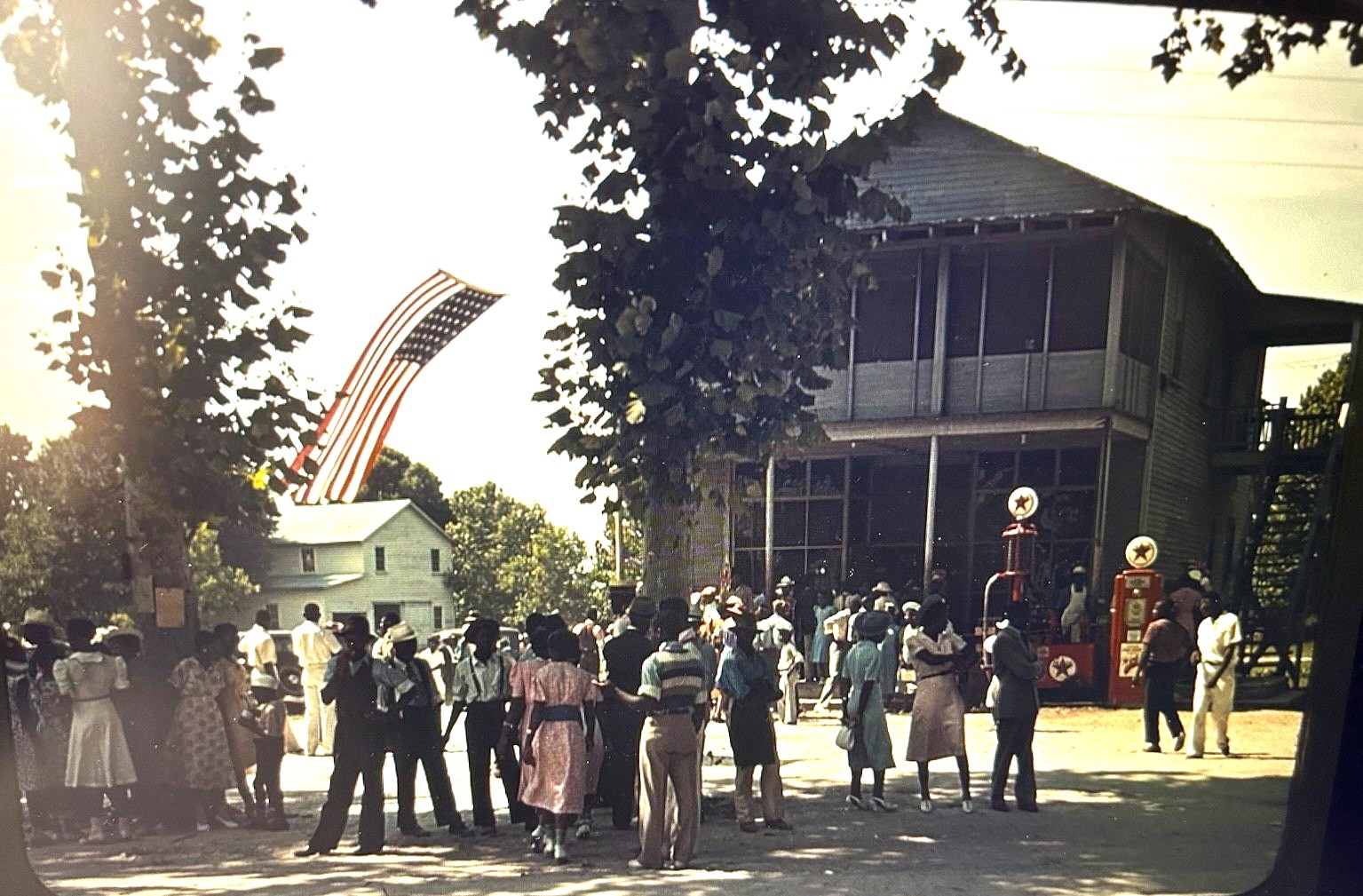
4th of July Celebration at Texaco Station on St. Helena Island, SC in 1939
photographer Wolcott – Library of Congress
Their ancestors from places now known as Spain, France, England, Central and West Africa among others were enslaved laborers on St. Helena Island, South Carolina alongside Indigenous Americans from the early sixteenth century through the signing of the Declaration of Independence on July 4, 1776 through a Civil War begun in cannon fire on Fort Sumter, South Carolina a hundred nautical miles north of their island in 1861 when Union forces set up occupation on St. Helena and freed all slaves working on plantations.
The Declaration of Independence celebrated that 4th. of July at the Texaco filling station on St. Helena in 1939 is the same one we celebrate in 2023 for the hope, the promises that begin with the words “We hold these truths to be self-evident, that all men are created equal, that they are endowed by their Creator with certain unalienable Rights, that among these are Life, Liberty and the pursuit of Happiness.”
The poet Maya Angelou said when she gets up every morning, she doesn’t think those people in the past are gone and forgotten, but when she gets up, she says everybody come with me.
In the middle of losing my job at Geneva Construction and starting a totally new position at Blaney Baptist Church in Elgin, a crisis developed with my family in Texas. My dad who was my best friend my entire life, my biggest booster in every possible way, was diagnosed with colon cancer in August of 1974; and the prognosis wasn’t good. He had several surgeries, radiation, and chemotherapy during the next two years while my mother taught second grade in a Lamar Consolidated elementary school in Rosenberg, a suburb of Houston. She needed help getting him to treatments and hospital stays at M.D. Anderson Hospital which meant part of her teacher’s salary had to be used to fly me regularly to Texas from South Carolina to be with him.
When he felt well enough after his first surgery, he and I talked in his hospital room while we watched Richard Nixon leaving Washington on the television there. My dad reminded me once again as he had done too many times that he blamed me for Nixon’s election in 1968 since his only offspring cast her first vote in a presidential election for a Republican. He and my grandparents were horrified at my confession of such a mistake and made me promise to not repeat what they considered to be a major political failure in my upbringing. On that fateful August day a disgraced and defiant Nixon flashed his famous “V” for victory salute before he entered Air Force One for his final trip as President. Nixon’s behavior revealed during the Watergate hearings had been profoundly disappointing to my father whose loyalty to the Democratic Party was overshadowed by his love of the country he served in the Army Air Corps in World War II.
I changed the subject by telling my father the company I worked for in South Carolina was going under, and I didn’t feel as confident as Nixon seemed to when he walked away from his job. I couldn’t pay my bills on fifty dollars a week from my new work at Blaney Baptist Church, but I didn’t want to start another job search.
Well, you have this CPA certificate, don’t you? he asked. I nodded yes. Why don’t you open your own office, he continued. Do taxes, keep books for small businesses. You ought to know enough people like that by now, don’t you? Talk to the Mormons. They might have some ideas, he added.
Why hadn’t I thought of that? If I had my own business, no one could tell me what I would be paid. I could be dull and boring if I wanted to because I would be the boss. Something clicked in my naive brain that had no idea what becoming an entrepreneur meant. I’ll do it, Dad, I said. I’ll give it a try.
I know you can make it, my father replied. I always wanted to have my own business, he continued, but I won’t have that chance now. So you go for it. Work hard. The sky’s the limit. He gave me his weak “V” for victory signal, smiled and went back to sleep.
Dad was right. I began my new business venture by contacting one of the two young men from Geneva Construction who remained in Columbia and in the Mormon church leadership. The Mormon community was loyal to each other’s businesses and equally loyal to a young Southern Baptist female CPA they learned to trust with their financial needs over the years in spite of her lack of interest in converting to their religion. I worked hard, and the CPA business began to grow with referrals from the Mormons along with recommendations by Flynn Harrell, the first business/financial officer of the South Carolina Baptist Convention. I met him through Janie’s work with the Convention, and he sent a number of Baptist ministers to me for tax preparation every year. I developed two diverse niche markets with one common religious thread at a time during the mid 1970s when advertising was considered to be not only unethical but also prohibited behavior for CPAs. My two years at Southwestern Seminary were plus factors in both markets, opening doors of opportunities I would never have had without them.
I kept working in the little church in Elgin for two years and then was “called” to a larger church in Cayce across the river from Columbia. I was the part-time minister of music and youth at State Street Baptist Church as I had been at Blaney Baptist. The hours increased, but the pay jumped to a whopping $75. per week. The pastor, Earl Vaughn, was a dear sweet misguided man who dialed telephone time every Sunday morning in my little office behind the sanctuary to make sure the worship service started on the stroke of 11:00. We had two Sunday morning worship services – the first one started at 8:30, but he didn’t care if we were a few minutes late for the early bird service. Mr. Vaughn also had a small rental house down the street from the church, and he told me when I interviewed he would make Janie and me an offer we couldn’t refuse, which we didn’t; we moved from our apartment to a house we didn’t own, but I was used to that – my family and I had lived in rental houses in Texas during my teen years. While I encouraged my clients to invest in a home for tax purposes, I personally wasn’t concerned about real estate equity when I was thirty years old. The American dream for me was survival.
Bigger churches meant more members. I discovered the more members on the roll at the church meant more people for the paid staff to please. My choir members and young people were great as they had been at Blaney Baptist, but church work was a chore I got paid to do with the internal politics to prove it. I had a revelation of an 11th Commandment: thou shalt not make a youth choir parent mad, especially one who was chairman of the Board of Deacons which functioned as a governing body for the church. I stayed at State Street for three years while my CPA business grew steadily.
At the end of my third year at State Street I had to make a choice facing a new crossroads again without the counsel of my father who lost his battle with colon cancer in 1976. I felt I couldn’t continue to focus on the people and their needs in my church when the CPA business required more deadlines to meet. Another complication in the equation was that my partner Janie (who sang in my church choir at State Street) and I were splitting awkwardly to end a seven-year tumultuous relationship so I decided to leave church work to focus on additional services to my clients…and my new “straight” girlfriend.
My job search in Columbia, South Carolina was much more sophisticated than my telephone book hunt for CPA firms in Seattle, Washington five years before. This time around I turned to the classifieds of The State newspaper, a rich repository of career-changing opportunities in September, 1973. I checked the classifieds every week and made many calls with no success.
Finally as my twenty-seven-year-old youthful exuberance faltered and my typically small savings dwindled, I responded to an ad for an internal auditor position with Blue Cross of South Carolina which was headquartered in Columbia. The secretary to the director of the internal audit department for Blue Cross called to set an appointment for me with the internal audit director. At the appointed time I met with the director who was a middle-aged man and another member of his team, a woman named Yvonne who appeared to be in her early thirties. Both the manager and Yvonne who I really liked gave positive vibes that they were impressed with my credentials – particularly my year in the Houston office of Arthur Andersen & Co. The director said I had one other interview his secretary would schedule with a third-party psychological testing center, but that wasn’t a big deal – just a formality. What could be easier to pass than personality tests for an auditor? Ha, ha, ha. We all laughed.
My spirits lifted after the interview, and I pictured myself working with Yvonne and her boss. The pay was good and the benefits excellent, although benefits were unimportant to me at the time. Show me the money was the key to my vision of success. I agreed to go to the testing site the following Saturday.
I felt good when I finished the standardized cognitive ability tests that next Saturday. I was familiar with some of the tests from my college psychology courses where I volunteered to be a subject of experimental testing in the psychology labs for extra course credit. The third-party testing site administrator, an older man with framed diplomas displayed on his office walls, spent half an hour talking with me after I completed the series of exams. I noticed he took tons of notes during our chat, but that seemed reasonable during the interview process, and I was upbeat when I left his office; I felt sure I nailed it.
The next week I didn’t hear from Blue Cross. I waited until Thursday and then gave the internal audit director a call. He was in a meeting, his always cheerful secretary told me; I felt a twinge of uncertainty about the “in a meeting” comment, but I left my number with her. She promised he would call.
On Friday afternoon the director returned my call and told me I didn’t get the job. Unfortunately, I had failed the personality tests which indicated I was “dull and boring.” I was stunned, speechless. How can someone fail a personality test, I thought. Dull and boring? Isn’t that what you looked for in any type of auditor? Why would you want an internal auditor to be lively and exciting as an auditor for an insurance company? I thanked him for his call, appreciated his consideration and bid farewell to my Blue Cross dreams. It was no use. I wasn’t internal auditor material. I was distraught.
Two weeks later I got a job as Controller for Geneva Construction Company, a large local company in Columbia making more money than I would have made at Blue Cross. My CPA designation opened that door, as it continued to do whenever I applied for any position over the next forty years. But this company was owned by Mormons, and the two young men who ran the company interviewed me for the job. Both men had done two years of missionary service their church required before entering the world of work, and what they loved more than my CPA background was my seminary training. No one mentioned personality tests.
*****************
Yvonne, the woman I met in the Blue Cross interview process, and I became good friends when she randomly moved to the same apartment complex Janie and I lived in following the untimely death of her young husband from Hodgkin’s lymphoma. We recognized each other in the parking lot one day, chatted, became friends even when she changed employers and moved to Louisville to their headquarters several years later. We often laughed about my failing the personality tests at Blue Cross – she said if anyone failed the dull and boring test, it should have been her boss.
Quannah Chasinghorse. Roberta “Bobbi” Cordano. Goldie Hawn. Maura Healey. Nicole Mann. Monica Munoz Martinez. Michelle Obama. Sandra Day O’Connor. Sheryl Lee Ralph. Grace Young. USA Women’s Soccer Team. Women of the 118th. Congress. Who are these women, and what do they share?
These women have been named as national honorees in USA TODAY’s Women of the Year project that honors local and national heroines “who make a positive impact in their communities every day…across America USA TODAY readers submitted their nominations for national and state Women of the Year honorees.” (USA TODAY March 16, 2023 – updated March 20, 2023)
In addition to the national honorees for the Women of the Year project, each state has an honoree who “lifts up people in their communities…showing up and speaking out for those who may not have a voice…” (USA TODAY March 17, 2023 – updated March 20, 2023)
Not surprisingly Dawn Staley has been named the South Carolina honoree by USA TODAY.
The South Carolina women’s basketball coach is a titan in sports. A three-time Olympic gold medalist as a player and one-time gold medalist as head coach of Team USA, Staley’s led the Gamecocks to two NCAA women’s basketball championships in the last six years. They’re the heavy favorite to win their third title, seeded No. 1 overall in the NCAA Tournament and boasting an undefeated regular season.
All of this is possible, Staley says, because of her mom and the lessons she instilled. Estelle Staley was a South Carolina native who moved home when her daughter, the youngest of five children, took over the Gamecocks program in 2008.
Staley’s rise from the projects of Philadelphia, where she honed her game, comes with great responsibility though. The 52-year-old calls herself “a dream merchant,” determined to show everyone, especially children who look like her, that starting from the bottom doesn’t mean you’ll finish there.
For her achievements, Staley is the USA TODAY Women of the Year honoree from South Carolina.
—–Lindsay Schnell, USA TODAY (March 17, 2023 – updated March 20, 2023)
—-Greenville News
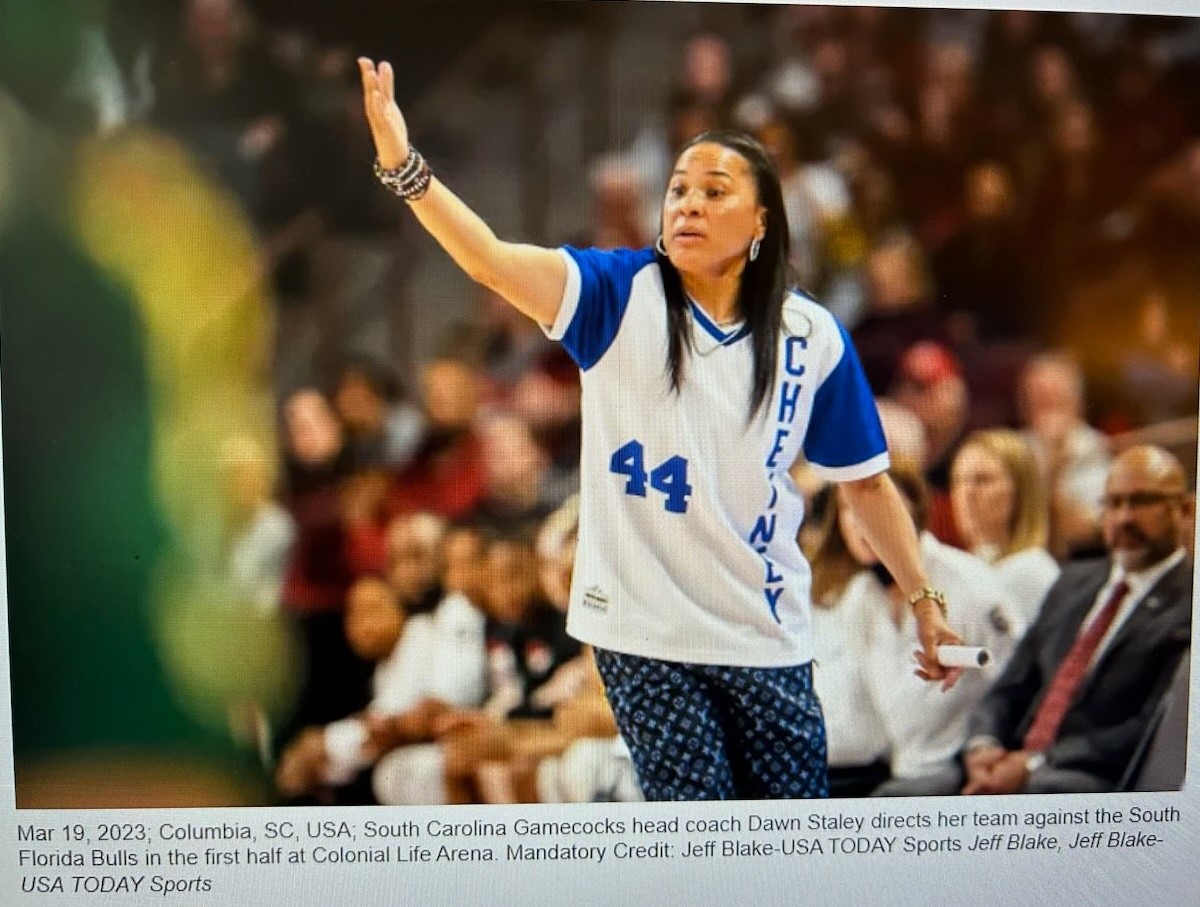
Yesterday afternoon in our little microcosm of Gamecock women’s basketball fans in the stands – shout out to Section 118 – a buzz went up and around about Coach Staley’s attire for this second game of the post season, the final game at home for the Gamecock women at Colonial Life Arena in the 2022-23 season. The biggest question away from the action, the excitement we feel every time we watch our girls play, whether or not we will make the Sweet 16 in Greenville next weekend – yes, those are important questions. But the first one we asked was what is Coach Staley wearing today?
And the answer was a white and blue Cheyney University jersey – Cheyney is the nation’s first and only HBCU to make it to the Final Four of the NCAA tournament in women’s basketball. Coached by basketball Hall of Fame Coach Vivian Stringer in 1982, the team lost to Louisiana Tech in the championship game.
Coach Staley responded to questions regarding her choice of attire for the win that sent her team to the Sweet Sixteen next weekend in Greenville: “For them to be led by Coach Stringer, who opened doors that now I walk through, it was truly an honor to wear this jersey and to represent them.”
“Yolanda Laney, who wore this (jersey) … She actually started leagues for us,” Staley said. “When I was younger, we played in something called the DBL, and she was very much a part of creating that league to give younger players an opportunity to just come together and play in the summertime, so I have fond memories of that.” —-Emily Adams, Greenville News (March 19, 2023)
Dawn said it. I believe it. That’s all, folks.
*********************
Congratulations to Coach Staley on this honor – we are proud of you, and what you stand for.
Equal Pay Day—representing all women—is March 14. Women working full-time, year-round are paid 84 cents and all earners (including part-time and seasonal) are paid 77 cents for every dollar paid to men.
LGBTQIA+ Equal Pay Awareness Day is June 15. Without enough data to make calculations, this day raises awareness about the wage gap experienced by LGBTQIA+ folks.
Black Women’s Equal Pay Day is July 27. Black women working full-time, year-round are paid 67 cents and all earners (including part-time and seasonal) are paid 64 cents for every dollar paid to non-Hispanic white men.
Moms’ Equal Pay Day is August 15. Moms working full-time, year-round are paid 74 cents and all earners (including part-time and seasonal) are paid 62 cents for every dollar paid to dads.
Latina’s Equal Pay Day is October 5. Latinas women working full-time, year-round
are paid 57 cents and all earners (including part-time and seasonal) are paid 54 cents for every dollar paid to non-Hispanic white men.
Native Women’s Equal Pay Day is November 30. Native women working full-time, year-round are paid 57 cents and all earners (including part-time and seasonal) are paid 51 cents for every dollar paid to non-Hispanic white men.
Asian American, Native Hawaiian and Pacific Islander Women’s Equal Pay Day is TBD. Asian American, Native Hawaiian and Pacific Islander women working full-time, year-round are paid 92 cents and all earners (including part-time and seasonal) are paid 80 cents for every dollar paid to non-Hispanic white men.
Thanks so much to the American Association of University Women for the above images and information they provided on this significant component of Women’s History Month in 2023.
And thanks to Brazilian illustrator Camila Pinheiro for designing the 2023 US Open Tennis Tournament poster celebrating 50 years of equal prize money for men and women, featuring one of the leaders associated with that seismic achievement in 1973: Billie Jean King. A mere twenty-eight years later the Australian Open awarded equal prize money for men and women beginning in 2001, another six years passed before Wimbledon followed suit in February, 2007; Roland-Garros quickly followed Wimbledon in March, 2007 – thirty-four years after the US Open adopted the equal prize money policy for women and men in the sport all four Majors participated in the policy that became the first Grand Slam of pay equity for all players.
“UnEqual” pay was the powder keg that ignited my activism in the women’s movement of the 1970s. From a nontraditional career for women in the accounting profession that began in 1967 with the shocking discovery that my compensation of $650 monthly at the Houston office of Arthur Andersen & Co., one of the most prestigious international accounting firms at the time, was $250 less than a work buddy making $900 a month for the same job. Only difference according to the partner in charge of personnel at the firm when I confronted him: my friend was a guy who might have a family to support one day. The risk for me, according to Mr. Terrell, was the need for maternity leave.
I wasn’t bold enough at the time to tell him why that was an unlikely scenario; I was, however, angry enough to leave the firm. This was my first job in the real world following graduation from the University of Texas at Austin, my first personal introduction to discrimination by men in power who had no respect for women in the workplaces they controlled, my first feelings of being lesser than despite high academic achievements and even higher work ethics. At twenty-two years of age, I was born again – this time as an activist for equal pay.








 I'll Call It Like I See It
You must be logged in to post a comment.