

On Thursday, March 27th., Pretty and I lost our beloved Texas dog Spike – not totally unexpectedly because he was old for a big dog, yet somewhat of a surprise because he had been in a slow decline for a long while before suddenly finding movement almost impossible Thursday morning. He told me and Pretty he was ready to go with his soulful big brown eyes. That afternoon an angel of mercy came to our home to help ease his passing. Our family has lost a cornerstone that cannot be replaced.
In January, 2022, I published the “Spike Story.”
When my cousin Martin saw Spike for the first time he said, “Sheila, that ain’t nothing but a cur dog. Plain as day.”
That was in the spring of 2012, the year my two mothers died within two weeks of each other. I was a motherless child by any definition at the end of April, the month Spike appeared on Worsham Street in Texas as a motherless cur dog which according to the Merriam-Webster dictionary definition, and my cousin Martin, meant he was a mongrel or inferior dog – surly or cowardly.
When that cur dog showed up on Worsham Street in front of our house, Pretty and I had four other dogs: Annie, Red, Chelsea and Ollie. I tried to convince my neighbors across the street to keep him, but both of them had cats as well as dogs plus jobs that required their daily presence. I was a stay at home writer. My neighbor Lisa and I tried to find his owner for several days but finally realized someone had dumped him in our neighborhood so he belonged to Worsham Street. I called Pretty to talk to her about him – she was working and living most of the time in South Carolina while I had been in Texas to take care of my mother – and since we split the four dogs into two separate households – what was one more?
At first Spike was skittish around Red, Annie and me. He preferred to stay in the yard, but one night the rains came; I saw him sitting on the back porch looking at Red and me on the bed through the sliding glass door which I got up to open for him. He came inside that rainy night – never to be an outside dog again.

Spike sound asleep with his buddy Red on our sofa in Texas
(spring, 2012)
Red was quick to be surly – Spike not so much
Spike seemed to understand that he was the low dog in the pack. Red was the alpha male because that’s how terriers roll. Smallest in size – but Red was the recognized “star.” Annie was a big dog like Spike but much older. She allowed Red to lead as long as she approved of his leadership, but don’t ever cross her. Spike learned to avoid her, but he loved Red. Red adored Annie. Typical love triangle similar to humans. Am I right?
The math Pretty and I had originally calculated worked well when we were in different homes but changed dramatically when we were together in South Carolina. Then we knew we had five dogs. Looking back to those years I’m not sure how we managed but we loved them all.

Spike, Red and black lab Chelsea in back yard on Canterbury Road
Spike fell in love with Chelsea on his first trip to South Carolina in 2012; it was a feeling that stayed with him as long as she lived – a feeling that remained with him forever after she died in March, 2016. To this day he whined or barked when he saw a big black dog walking by on our street from his perch on the couch in our living room on Cardinal Drive.
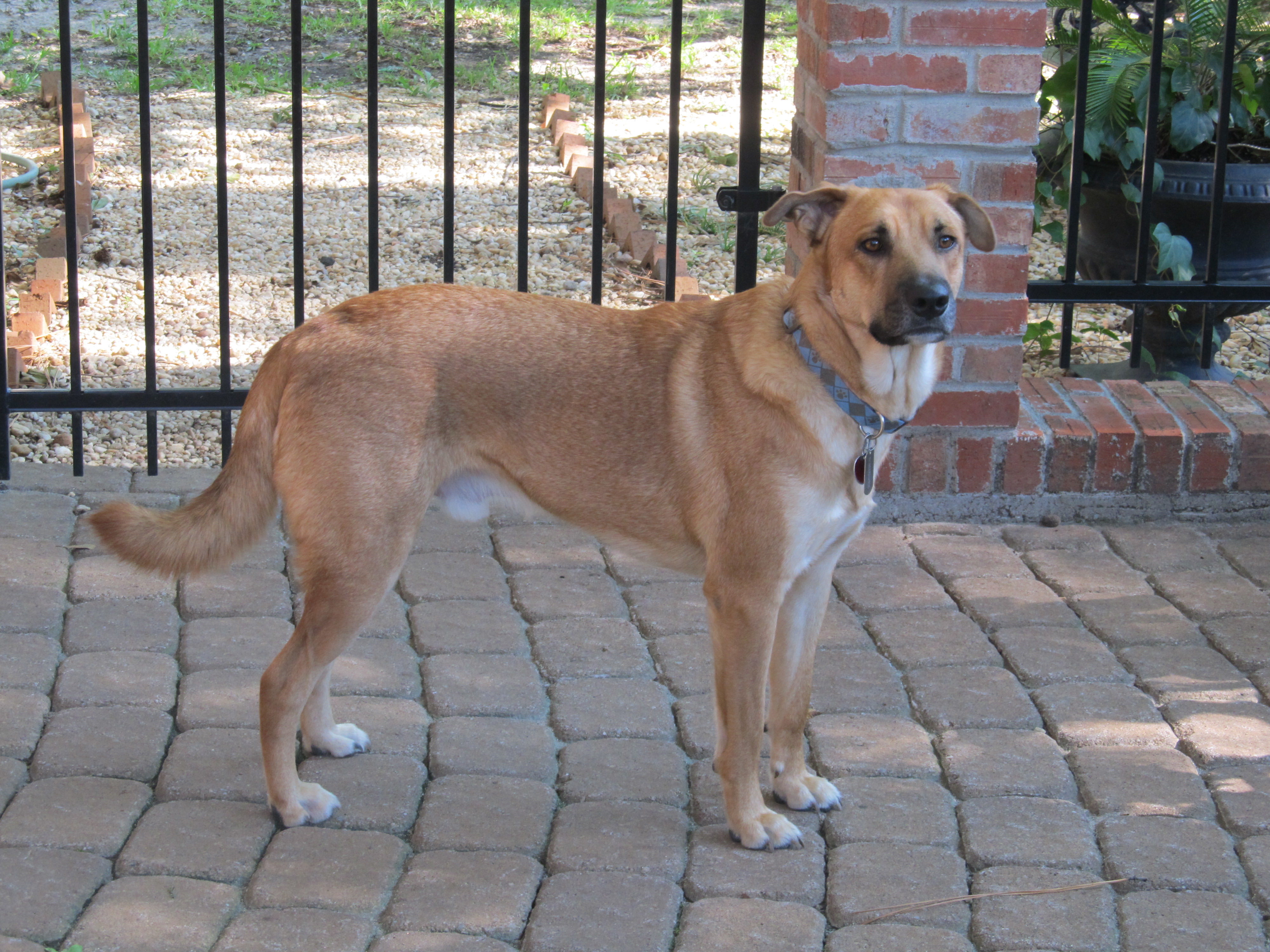
Spike at home on our patio at Casa de Canterbury in July, 2012

Spike and Chelsea on my grandparents’ bed in September, 2014
my grandparents would be horrified if they knew
One by one Spike’s pack succumbed to illness and old age, and he became the sole survivor in the spring of 2016. Pretty and I promised each other we would shower him with affection, treats, walks, to give him the attention he hadn’t experienced as the interloper of the original four. We tried for months to lavish him with our love – perhaps partially to assuage our own grief. What happened surprised both of us. Spike’s grieving was as real as ours, and he didn’t like being an “only” dog. He missed his pack.
Enter Charly in the summer of 2016. Charly was twice rescued: once by Pawmetto Lifeline and then by Pretty, Spike and me.

Spike and Charly in our living room – 2019
when you can’t be with the one you love, honey, love the one you’re with
Now we have another little old man about the same size as Red, but Carl and Spike aren’t buddies, though – neither is Carport Kitty who definitely dislikes our three dogs. That’s okay. Charly runs interference between Spike and Carl who has learned the importance of pretending CK doesn’t exist. Spike has a pack again. Pretty and I love them all.

Spike on his walk – January 11, 2022
By the way, cur dogs are really a wonderful breed of “hard-working treeing hounds” with traits that include being devoted to their people, protective of their environment and fabulous additions to families.
So to my cousin Martin I say thank goodness Spike ain’t nothing but a cur dog. Pretty and I wouldn’t have him be anything else.
************

Spike – March 27, 2025
Rest in peace, Buddy. You were simply the best.





 I'll Call It Like I See It
You must be logged in to post a comment.