Category: The Way Life Was

  • an other-worldly woman of substance


    Photo by eberhard grossgasteiger on Pexels.com

    The reality is that you will grieve forever. You will not “get over” the loss of a loved one; you will learn to live with it. You will heal and you will rebuild yourself around the loss you have suffered. You will be whole again, but you will never be the same. Nor should you be the same. Nor would you want to. — Elisabeth Kubler-Ross (1926-2004)

    Kubler-Ross devoted most of her adult life to death and dying. She was a pioneer in hospice care, palliative care, and a leading researcher in the lives of the terminally ill. “One of her greatest wishes was to build a hospice for abandoned infants and children infected with HIV to give them a lasting home where they could live until their death. Kübler-Ross attempted to set this up in the late 1980s in Virginia, but local residents feared the possibility of infection and blocked the necessary re-zoning. In October 1994, she lost her house and many possessions, including photos, journals, and notes, to an arson fire that is suspected to have been set by opponents of her AIDS work.” (Wikipedia)

    In her lifetime Kubler-Ross wrote over twenty books on death and dying, was in the National Women’s Hall of Fame, was one of Time magazine’s Top Thinkers of the Twentieth Century, Woman of the Year in 1977, and became a leader as an advocate for spiritual guides and the afterlife despite scandals from her association with a charlatan medium in the late 1970s.

    When I enrolled my mother in hospice care in 2011, I didn’t realize the connection the excellent end of life care she received through the program had been co-founded by a woman who believed in treating the dying with dignity. The team of caregivers we had for the last few months of Mom’s life were compassionate, capable, and centered on her needs. I was also amazed by their assistance throughout the first year of my grieving process following her death.

    As I approach the twelfth anniversary of my mother’s death, I want to honor Elisabeth Kubler-Ross during Women’s History Month, one of the women who had the courage to explore her passion for peace, to protest injustice, to pursue theories considered to be too controversial in an unknown frontier. Elisabeth gave us permission to grieve for losses too painful to deny.

    Yes, the reality is that we will grieve our losses forever, but it’s also true we will be whole again. Never the same, but whole again. That’s cause for celebration.

    ******************

    For all those who grieve.
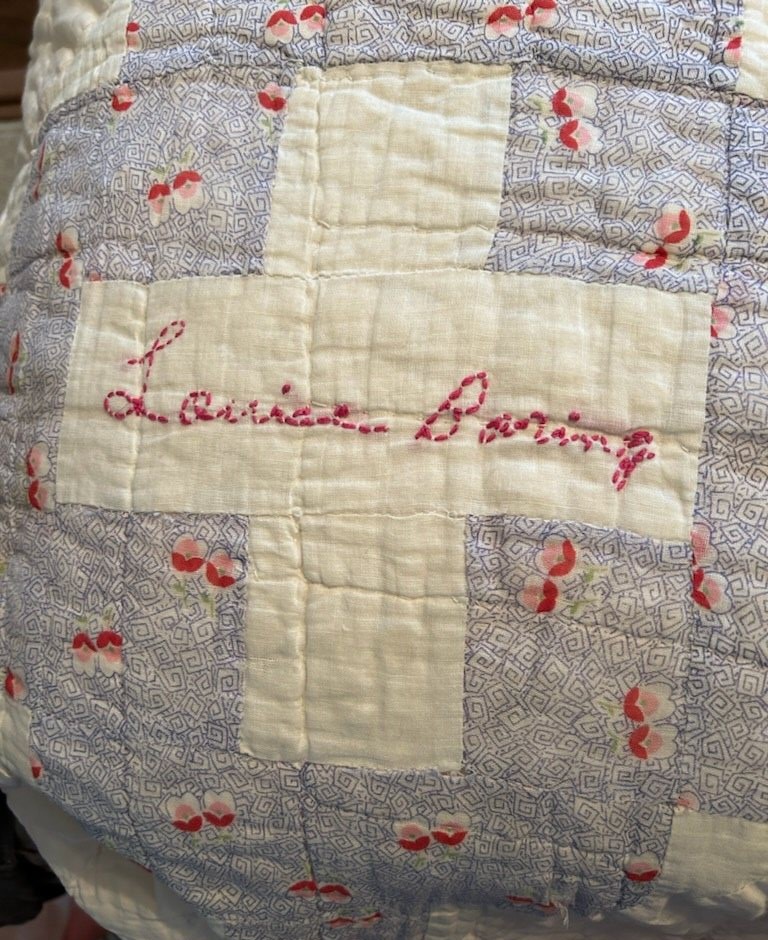
  • The Great Depression Friendship Quilt


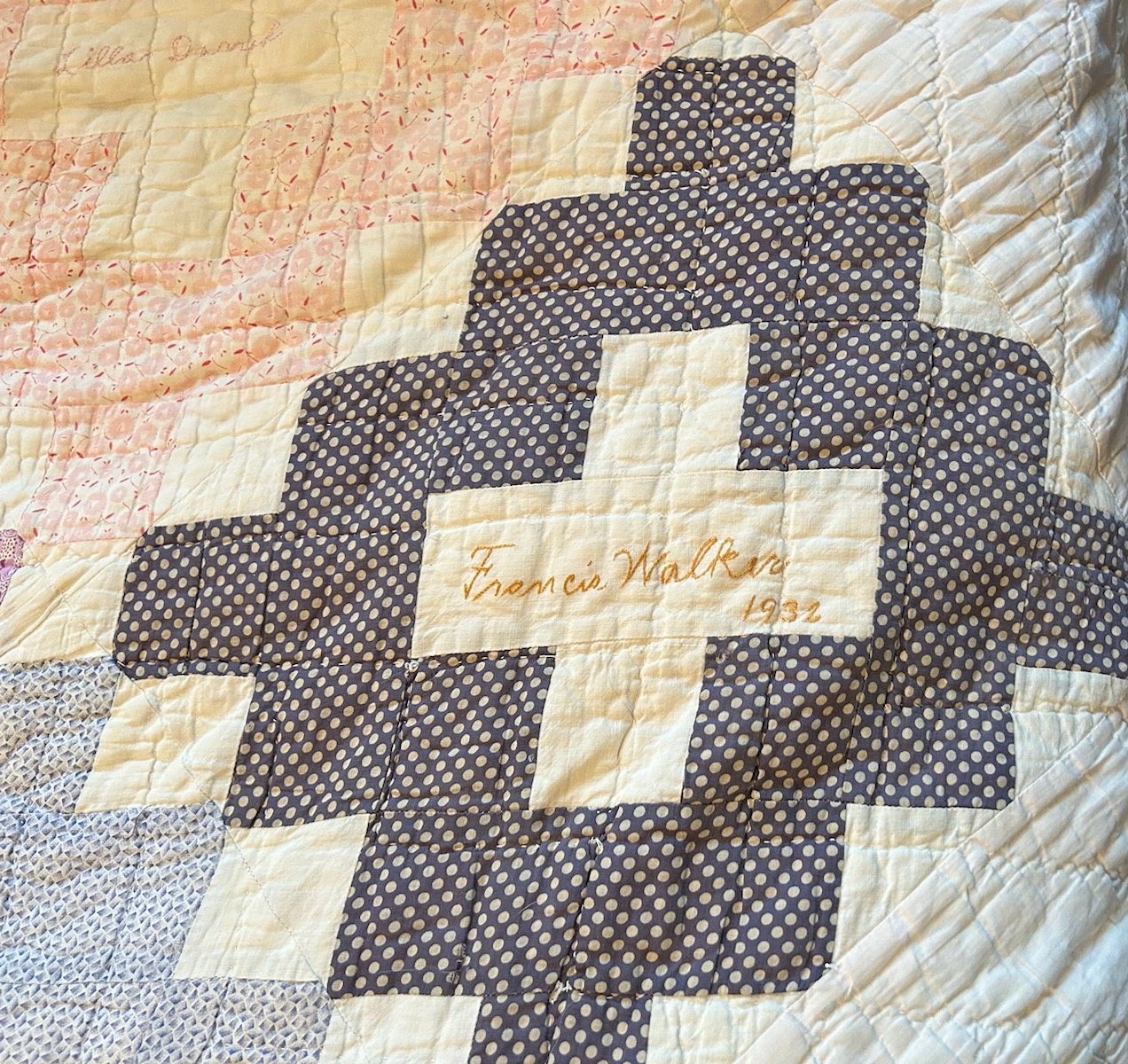
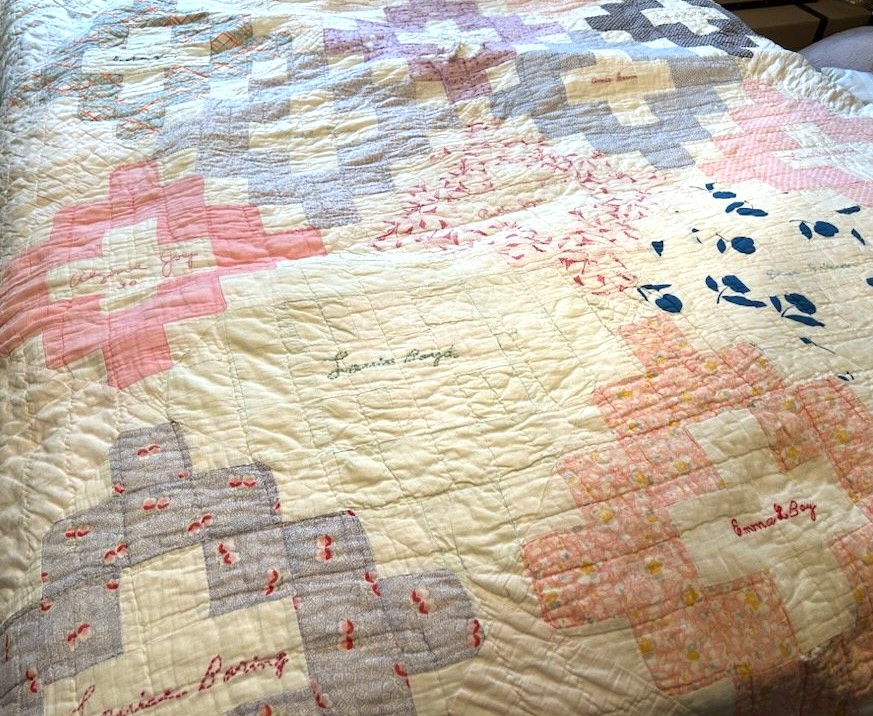
    Since I neither quilt nor sew, why would the friendship quilt above have special significance to me? Because the signature in this particular block was made by my maternal grandmother Louise Boring (1898-1972) as part of a friendship quilt given to my paternal grandmother Betha Morris (1903-1983) by a group of her friends during the Great Depression before Louise and Betha became in-laws in 1945 when Louise’s daughter Selma eloped with Betha’s son Glenn. My grandmother Betha Morris a/k/a Ma to me kept the quilt forever, and I miraculously ended up with it.

    Quilts were popular during the Great Depression of the 1930s because they were usually made from leftovers of scraps from other sewing. The “friendship quilt” was unique in its composition because it was composed of signed blocks of the same pattern, often followed by an inscription.

    Note that Lucile Whitfield’s date shown was 1930 while the only other date (1932) belonged to Francis Walker. I’m assuming those are the only dates to indicate when the quilt was begun and when it was finished.

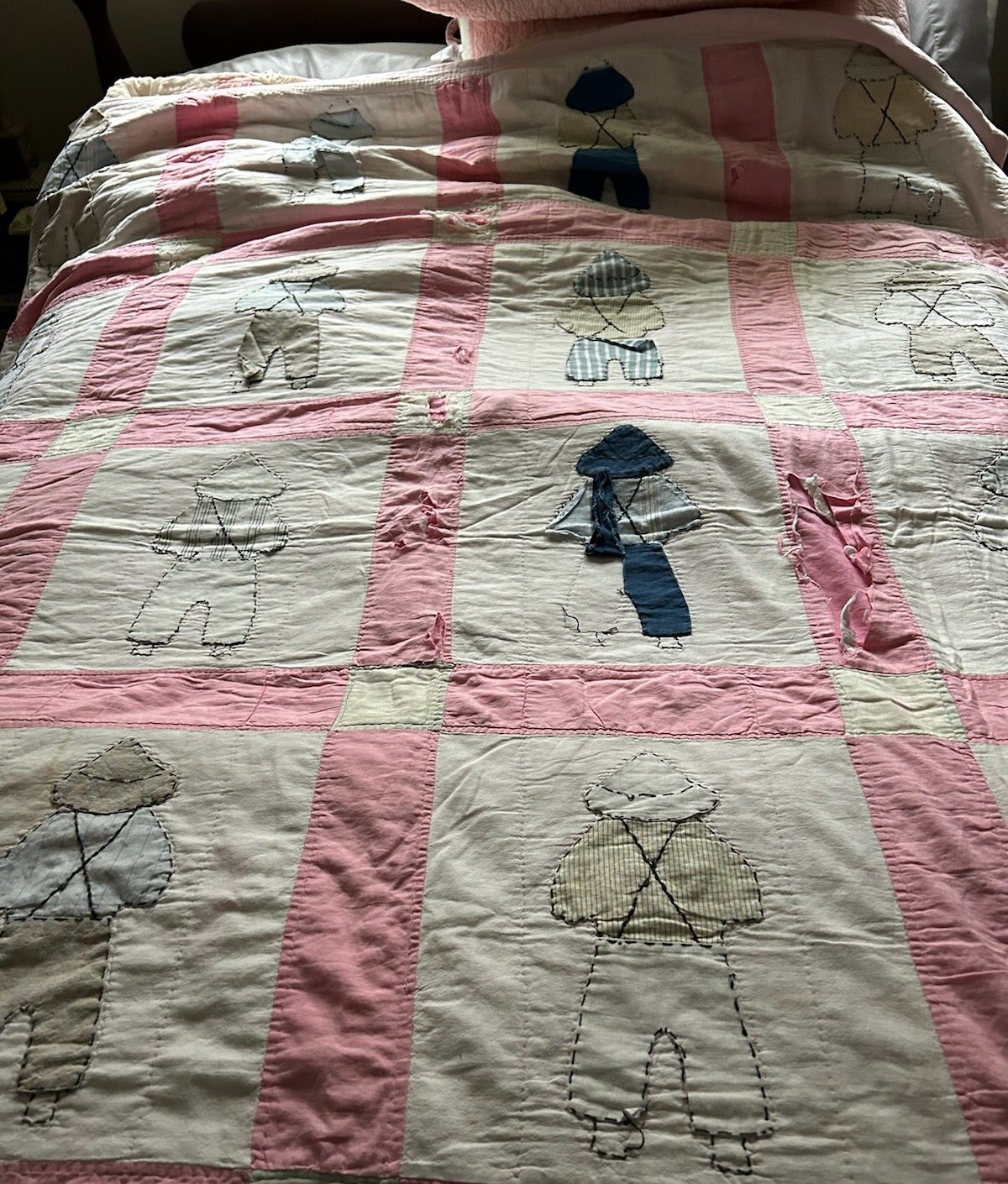
    I remember asking my grandmother Ma about the names on the quilt when she took it down from the top (and only) shelf in the tiny closet in her spare bedroom where I often slept as a child. That room felt like a refrigerator in the winter time, and I begged Ma for more covers. She would get her friendship quilt and one more I still have.

    Somehow in my travels, moves, relocations, embarrassing exits that took me from my little hometown of Richards, Texas, with its familiar names on the friendship quilt to far away places I didn’t know existed seven decades ago, I managed to hang on to these two quilts that have come to rest in a closet at our home on Cardinal Drive in South Carolina.

    Due to circumstances beyond our control regarding Pretty’s health, I was banished to sleep in our “guest room” on my paternal grandparents’ bed, another treasure, which required reinstating these two quilts which seventy years ago kept me warm. Although the quilts now show wear and tear, they still kept me warm on a cold night this week. As I fell asleep under the weight of the quilts, I thought about my grandmothers and their connection to The Great Depression of the 1930s they survived to become major influences in my history – two women whose love and devotion became my North Star that led me home.

  • CELEBRATE International Women’s Day!


    Invest in Women — Accelerate Progress

    (theme for 2024)

    In South Carolina where Pretty and I live, 54% of the population are women, but not one woman sits on the South Carolina Supreme Court; we are the only state in the nation without a female justice. Only six state senators out of 46 are women, 20 out of 124 House members are women. These statistics indicate we rank 48th. of 50 states in women’s legislative representation according to the Center for American Women and Politics.

    Do the math: only 15% of the lawmakers making our laws in this state on reproductive rights, on health care for women and children, on domestic violence, on gun control, on climate change, on school safety, on police brutality against people of color, on issues affecting marginalized populations in the state, on banning books that promote inclusiveness and social justice – on these and all other laws in our state affecting every citizen – only 15% of those lawmakers are women.

    The voting odds are stacked against women, and history is not on our side, either. Women’s groups have been talking about underrepresentation in our state for nearly forty years. One of the true pioneers for women’s rights in South Carolina, Barbara Moxon, began a group called Advocates for Women on Boards and Commissions in 1988. I was the treasurer for that organization which developed extensive publicity on the need for more women political appointees while also providing aid and encouragement for female members to apply for appointments. We had limited successes in our efforts.

    The consequences of the 2024 election in November will have a generational effect not only on the nation but also on our state. Bravery, courage, dogged persistence, and financial support will be mandatory for any woman who puts herself forward in the political climate of these challenging times, but I am thrilled that a woman who has been my close friend for a very long time has answered the call for a change in leadership by campaigning for a Senate seat in South Carolina District 10.

    This woman has spunk, and I have always admired spunk combined with proven leadership qualities. I will have more to say about her in the days to come during her campaign, but for today as part of your celebration of International Women’s Day, please go to her website; get to know her better, and invest in a woman who will accelerate progress for all. http://www.franciekleckley.com.

    You tell it, Sister Girl.

    Onward.

  • wild woman sisterhood


    Wild Woman Sisterhood – it’s never too late to join an organization whose mission is “to help you embody your authentic nature and live a truly fulfilling life.” Getting closer to my 78th. birthday in April, my thoughts turn to the women I once was – WWS suggests they deserve a little more kindness than I typically have for them.

    Make peace with all the women you once were. Wait a second – you mean, all those women? The young woman in her early twenties whose nightly pilgrimage through the halls of her college dormitory ended in frustration when the soft knock on her beloved’s door woke a surly roommate instead of the woman of her dreams, a roommate who recognized she was, indeed, lost at two o’clock in the morning but on a much different level from her proffered confusion about room numbers.

    Or are you asking me to make peace with the young woman in her late twenties who had crisscrossed the country 3,000 miles one way several times, eventually knocking on a door in a seminary dormitory that finally welcomed her with open arms only to discover the excitement of infidelity + way too much alcohol consumption = a detour in her journey that had no GPS in the 1960s. Make peace with that young woman on a quest to find authenticity before she understood the question – much less had a clue to an answer for herself? Sorry – no flowers for either of those young women in their twenties in the 60s.

    As for the women in her thirties, forgiveness is at least a possibility because they began to openly acknowledge their own truths that belonged to each other; they were no longer two women on a journey plagued by internal battles but one survivor forged by the burning of incense and cooled by the sweetest honey. This woman understood that wandering in the wilderness had always been about her search for authenticity.

    Forty years later the women in my twenties, thirties and decades after ask me to honor, forgive, listen, bless and let them be because they are the bones of the temple I sit in now, the rivers of wisdom leading me toward the sea. If it’s not too late, I’d like to lay flowers at their feet and join a sisterhood of wild women committed to living a truly fulfilling life at any age.

    ********************

    Slava Ukraini. For the women and children of Ukraine who began their third year of resistance last month against enemies determined to wipe democracy from the face of the earth. I’d also like to lay flowers at their feet.

  • the Orangeburg Massacre: yet another people’s struggle against oppression

    the Orangeburg Massacre: yet another people’s struggle against oppression


    In 2006, Cleveland Sellers’ twenty-two year old son Bakari was elected to the South Carolina Legislature, making him the youngest African American elected official in the country. Speaking with emotion at a SC State memorial service to honor those lost in the Orangeburg massacre, Bakari Sellers said, “We join here today in our own memorial to remember three dead and 27 injured in yet another massacre that marked yet another people’s struggle against oppression. These men who died here were not martyrs to a dream but soldiers to a cause.”

    The Orangeburg Massacre occurred on the night of February 8, 1968, when a civil rights protest at South Carolina State University (SC State) turned deadly after South Carolina highway patrolmen opened fire on about 200 unarmed black student protestors. Three young men were shot and killed, and 28 people were wounded. The event became known as the Orangeburg Massacre and is one of the most violent episodes of the civil rights movement, yet it remains one of the least recognized.

    The above excerpts from HISTORY.com editors on February 07, 2022, related to an event known in South Carolina history as the Orangeburg Massacre which took place on February 08, 1968. I remembered the year, but I didn’t remember the Orangeburg Massacre when I moved to South Carolina in 1974.

    I was in my first year of a “real” job in February, 1968, working for one of the Big 8 CPA firms when the Orangeburg Massacre occurred. While I sat in my cubicle on the 17th. floor of the Bank of the Southwest building in Houston, Texas, I didn’t realize history was being made by students my age at historically black South Carolina State University in the small town of Orangeburg, South Carolina, more than a thousand miles from where I sat.

    Imagine being a black student at SC State, going to a bowling alley with friends on February 05, 1968, only to be turned away by owner Harry Floyd who claimed his All-Star Bowling Triangle bowling alley was exempt from the Civil Rights Act of 1964 since his bowling alley was private property. Whites Only, the sign said.

    Students from SC State and nearby Claflin University began nonviolent protests that lasted for two nights, but on the third night their nonviolence took an extremely violent turn when South Carolina highway patrolmen opened fire on about two hundred unarmed black student protestors. Three young black men were killed with another twenty-eight protestors wounded.

    The three students who were shot and killed by the police were: Freshman Sammy Hammond was shot in the back; 17-year-old high school student Delano Middleton, whose mother worked at SC State was shot seven times; and 18-year-old Henry Smith was shot three times. (History.com)

    Among the wounded that night was a young civil rights activist named Cleveland Sellers, Jr., who was born in neighboring Denmark, South Carolina, a town with a population under 2,000 when he was born in 1944; he had returned to his home state in 1967 to pursue a teaching career following years of activism in the Civil Rights Movement which put him on the government’s radar as a militant. On the night of the Orangeburg Massacre Cleve Sellers was shot in the arm, taken into custody at a local hospital and charged with inciting a riot on the campus. Two years later in September, 1970, a South Carolina judge allowed the state to convict him of rioting at the bowling alley. Sellers was sentenced to one year of hard labor but released after seven months. He was the only protestor prosecuted – nine police officers were charged with shooting at the protestors…all were acquitted.

    Harry K. Floyd, Sr., owned and operated the All-Star Triangle Bowling Alley until his death in 2002 at which time his son Harry K. Floyd, Jr., took over. The Floyd family closed the bowling alley in 2007 due to “financial difficulties” according to wikipedia. The site remains on the National Register of Historic Places and has supposedly been bought by a nonprofit in 2020 with the goal of turning it into a memorial for the Civil Rights Movement in Orangeburg called the National Center for Justice.

    February 08, 2024, marked fifty-six years since the Orangeburg Massacre, and I felt Black History month was an opportunity to remember, to honor the personal sacrifices made by ordinary citizens who refused to yield to discrimination based on their race. Cleveland Sellers, Jr., went on to serve his native South Carolina by becoming the director of the African American Studies Program at the University of South Carolina, by becoming the 8th. president of Voorhees College in Denmark, and by raising his youngest of three children, Bakari, to follow in his footsteps as an activist who honored the Orangeburg Massacre.