storytelling for truth lovers

  • wonder women – southern style (Part I)


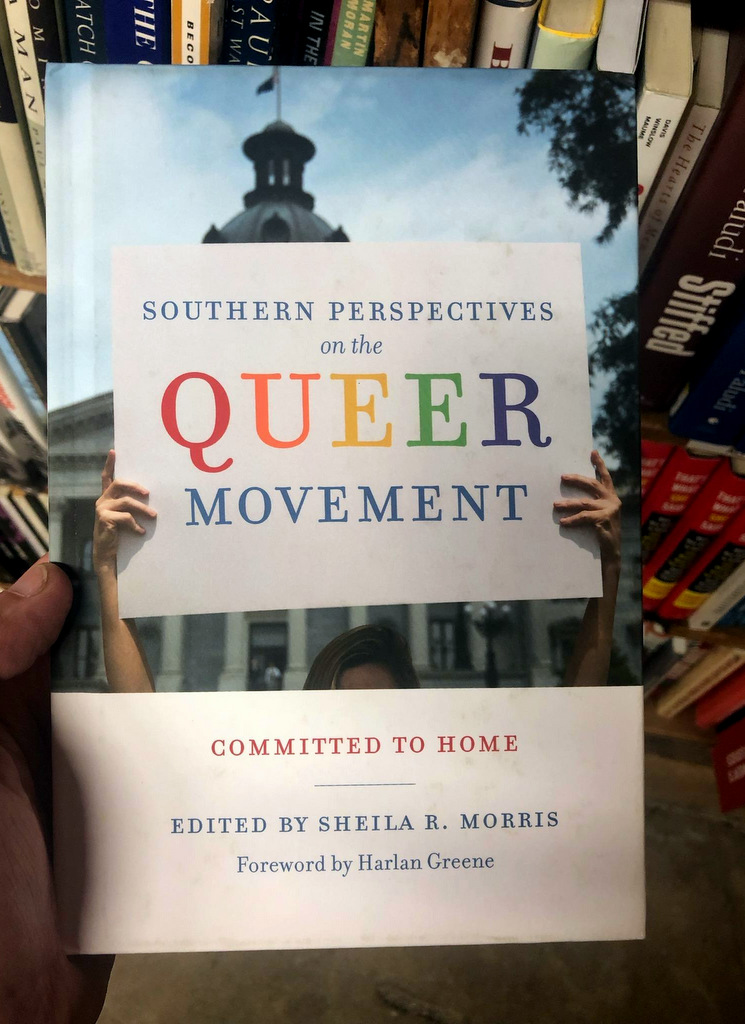
    Don’t get me wrong. The men whose stories were included in Southern Perspectives on the Queer Movement: Committed to Home are just as important as these women I celebrate today, but it is Women’s History Month after all. As I wrote in the Prologue of the book: “The narratives in this collection tell the stories of ordinary people who became extraordinary in our struggles for equality in a place and time that made change seemingly impossible.”Ordinary women and men became extraordinary as they organized the LGBTQ grass roots movement in a hostile environment from the HIV/AIDS pandemic in the 1980s to marriage equality in 2014….and beyond. The fight continues.

    Candace Chellew-Hodge, the current pastor of Jubilee! Circle and one of the co-hosts of the first LGBTQ radio show in South Carolina which began in 2005, Rainbow Radio, had this to say about that experience in Southern Perspectives: “[On Rainbow Radio] for the first time, a long-silenced group of citizens was granted access to the microphone, and their stories of hiding, living in shame, and feeling condemned by their God and their family were at once heartbreaking and revolutionary. They were stories of hardship, trial, tears, laughter, triumph, and joy, even in the mist of oppression and despair.”

    Candace Chellew-Hodge co-hosted Rainbow Radio

    In the fall of 1980, according to Harriet Hancock’s essay in Southern Perspectives, her son Greg came out to her with the support of Harriet’s sister Diane who was very close to her nephew. With the words Mom, I’m gay, Harriet’s life changed forever. Greg was the middle child of her three children. He was enrolled at the University of South Carolina – along with Harriet who at 44 had decided to go back to college to become an attorney.

    “My heart broke for him, but somehow I managed to keep my composure. I sat down, and with a sigh of relief, I said, “Is that all?’…I don’t think we consider the struggle that many gays and lesbians have in overcoming their own internalized homophobia. Unfortunately some never make it.”

    Now known in South Carolina as the Mother of Pride for her activism in organizing the first Pride Marches in Columbia in the early 1990s and countless other outrageous acts and everyday rebellions against social injustice during the next 30 years, the Harriet Hancock LGBT Community Center was named to honor her commitment to the queer community and continues to be a beacon of enlightenment for youth and adults in all segments of the population.

    Harriet and her son Greg at an early Pride March on State House steps

    “My phone rang at midnight…[An older gay man] told me I was a troublemaker for organizing the march and how it would make more trouble for gay people…The last thing he said to me was ‘There will be blood running down Main Street tomorrow, and it will be on your hands.’” – Harriet Hancock in Southern Perspectives

    Thankfully, the caller was wrong, and those empowered standard bearers became the catalysts for change in South Carolina and kept marching every year –  all the way to the nation’s capitol a few years later.

    “In 1993 I went to Washington, DC, for the national march….I stayed outside the city and took the subway to the Mall. I heard people getting excited on the train on the way to the mall, and it sounded like a symphony orchestra to me. By the time I walked up the stairs from the train and stepped out in the sunlight, it was as if the drums and tympani were exploding.” – Deborah Hawkins in Southern Perspectives

    Deborah Hawkins, owner of lesbian bar Traxx

    By the time Deborah marched in DC in 1993, she had owned and operated a lesbian bar near the railroad tracks in Columbia since March, 1984. “I was thinking we needed a place where women could gather. We needed a country club, a place where we could get together for more reasons than just beer and such. I felt like it was my home, and I wanted people to come in and be happy. I was the hostess. I wanted the women to have somewhere to go, because a lot of them were lacking someone in their life to let them know they were loved. I could see…they were different and felt the difference, and I wanted them to know that I cared about them and loved them. That was my goal for opening Traxx.” — Southern Perspectives

    Candace once thought of South Carolina as a place you went through when you were driving someplace else. Nevertheless, she moved from Atlanta to Sumter in 2003 in search of a new family life that led her to become a reluctant apostle to the LGBTQ people of faith in the midlands for the next 15 years. Harriet was born in 1936 and raised in Columbia in a house built on land deeded to her family in 1784. A disastrous 25-year marriage to a troubled man led her away from the state but her determination to make a better life for herself and her children brought her home in 1978 to her larger family in Columbia that loved and supported her. Deborah’s family lived in the same house in West Columbia from the time she was born until the day she left for college. As a young adult in the 1970s, she hitchhiked around Europe for six weeks with three friends, all planning to never come back home. Riding around in a van through the Transylvania forest at a hundred miles an hour on the Autobahn,  the group of four travelers realized they’d gotten in the wrong vehicle. It was time to go home.

    These women were ordinary women who became extraordinary  – their stories are remarkable.  They heard voices crying for help in a wilderness of needs in a state smothered by conservative rural  leadership. Here are we, they answered. We won’t leave you, but we will work for change.

    Stay tuned for the conclusion.


  • on International Women’s Day, I salute Pretty


    “I knew I was a lesbian, and I also knew I wouldn’t disguise who I was,

    because to do so would send the message to my son Drew

    there was something wrong with it.

    If I didn’t name it, if I didn’t share it,

    if I didn’t acknowledge it, if I didn’t own it,

    if I wasn’t proud of it,

    he was going to believe there was something wrong with it.

    That became my mantra.

    If I never in my life denied I was a lesbian,

    if I treated it as just a part of my life,

    then he would be okay with it.”

    Teresa Williams a/k/a Pretty   (1980s)

    Southern Perspectives on the Queer Movement: Committed to Home

    Today on International Women’s Day, I celebrate one of the women I most admire for her courage in her journey toward living an authentic life not only for herself but also for her son in the days before Will and Grace and Ellen. With obstacles on every side, without the support of the family who had always been there for her, this warrior mother stood up, came out and never looked back.

    What would I do without Pretty…her warrior spirit lives on every day.  I’m glad she’s on my side, too.

    Drew, Pretty and me 

    Stay tuned.

  • the 21 club


    Although South Carolina has been my home state for nearly 50 years, I was born and grew up in Texas. During one of my countless classic goodbye scenes with my parents in my early twenties, daddy quoted one of his favorite sayings, “you can take the girl out of Texas, but you can’t take Texas out of the girl.” No truer words were ever spoken. My reasons for leaving the state were complicated but boiled down to my attempt to figure out how to live an authentic life as a lesbian away from a family I assumed would not be supportive. I yearned for freedom – from what? As the song “Desperado” reminds me: freedom, oh freedom…that’s just some people talking.

    From 2010 – 2014 I had a second chance to live in Texas by buying another home there in order to care for my mother who was then a freedom seeker herself in a losing battle with dementia that destroyed the woman she had been. While these second chance Texas years were deeply painful, they also gave me an opportunity to experience a new relationship with my mother as well as to renew family bonds with many cousins I had rarely seen for several decades.

    Two of the cousins I spent time with were Eloise Robinson Powell and Frances Kelly Lee. Frances drove me to visit with Eloise in her home on O Avenue in Huntsville several times while I was there – as I had visited there when I was a child. Eloise was a double cousin – her mother married my grandmother’s brother, her father married my grandfather’s sister. Repeat three times.  Regardless of how you explain it, Eloise was a double first cousin of my father, and they were very close friends.

    This past week I learned that Eloise had left her home on O Avenue to move permanently into an assisted living facility in Huntsville. I felt despondent at the thought of that move, but I needn’t have. Eloise called me today, and we talked for almost an hour with lots of laughter and wonderful reminiscing about our double family ancestors. I can’t imagine how she felt about leaving her home of a lifetime, but I know for sure she took her memories with her. She is looking forward to an annual gathering of three friends on March 20th. in her new home where there will be cake, she told me, but no mention of her birthday on the 21st. She prefers to keep her birthdays to herself. I won’t tell either.

    I will tell Eloise is the second member of what we now call the 21 Club. Frances has a birthday on February 21st, Eloise is the 21st of March, I have April 21 and Pretty has May 21. None of us have any excuse for forgetting the other’s birthday, although I have to say Eloise is usually the only member to send a card. If I hadn’t had my second chance in Texas, I’m not sure the 21 Club would have been chartered.

    Earlier this week I received a surprise UPS package from my cousin Frances who is a regular cousin for me. Frances’s mother and my paternal grandmother were Robinson family sisters and oh my, what sisters they were. Whenever those two were together, the rest of the family wasn’t spared from their fun poking and gossip sessions. My grandmother and her sister Thelma got together as often as they could, and my grandmother invited me many times to drive the short distance to Conroe from Richards with her. I never said no to a trip with her.

    The UPS package Frances sent contained three family treasures from the house on O Avenue that Eloise asked Frances to ship to me. I was thrilled and wanted to share them with my cyberspace family.

    William James and Margaret Antonio Moore Morris family – circa 1903

    My great-grandma Morris is the unsmiling woman seated in the first row. She was born on July 14, 1864 and married my great-grandfather William on December 15, 1880. They had 11 children in 23 years. Nine of their children are in this picture. The eldest, John Thomas, had been told to leave home when he turned 18 so he was gone. The youngest, Bernice Louise, would not be born until 1906. The little boy to the right of Grandma Morris was my grandfather George Patton who was born in 1898. Eloise’s mother Hattie Jane was the woman standing to the left on the top row. Aunt Hattie was born in 1889.

    Margaret Antonio Moore Morris and William James Morris in younger days

    Margaret died on June 06, 1963 when she was 98 years old. Since I was 17 years old when she died, I had seen her several times throughout her life in Huntsville. I never met my great-grandfather because he died in 1927.  My most distinct memories of her were her tiny frame clothed in a black or navy dress, her frail appearance as she pushed a small chair in front of her that enabled her to walk through the house, long hair piled in a bun on top of her head, sweetest smile as she spoke, now let’s see, you must be Glenn’s daughter?

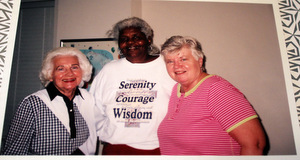
    The 21 Club and my great-grandmother Morris are part of my women’s history month. I celebrate these women for their strength, their courage in the face of adversity, our shared DNA, their ongoing sense of humor with stories that always make me laugh.

    When I talked to my cousin Eloise on the phone today, she told me a story about something that happened when she was in the third grade of her rural Crabbs Prairie elementary school in Walker County. The teacher asked the children in the class to give the definition of various words – one of them was the word “income.” One little girl raised her hand, stood up and said, “I opened the door and in come the dog.” The little girl forever was known as Income.

    my cousins Eloise (l.) and Frances in 2014

    (used without permission from anybody)

    Stay tuned.


  • beam me up, scottie – it’s Women’s History Month!


    Last night I took a trip in time travel with Stephanie Rule who narrated a documentary called On the Basis of Sex which looked at the people, places and events that shaped the American woman’s odyssey to become an equal citizen in her own country. The documentary beamed me up, Scottie and I looked down and back to see images no longer fresh but just as real as my participation in the women’s movement during the late 1960s through the failure of the ratification of the Equal Rights Amendment in 1982.

    March is Women’s History Month, and we rightly honor the sacrifices of those women who refused to remain second class citizens and stood together to work for the common good so that all women might have freedoms to choose what happens with their own bodies, to choose who they love and marry, to choose where they work, to choose where they govern. I am Woman, hear me write.

    Women today also look back to remind ourselves of our courage and strength in the midst of adversity. Luanne Castle’s award-winning book Kin Types is an example of a contemporary writer who is not afraid of looking back.

    “Kin Types exhumes the women who have died long ago to give life to them, if only for a few moments. Through genealogical and historical research, Luanne Castle has re-discovered the women who came before her. Using an imaginative lens, she allows them to tell their stories through lyric poems, prose poems, and flash nonfiction.” (https://www.writersite.org)

    Storytellers and storytelling – that’s what made On the Basis of Sex compelling for me last night and then another woman merrildsmith had this quote in her Monday Morning Musings titled “Art through Time and Space”: (https://merrildsmith.wordpress.com)

    “I think the life of my community and most communities depends on the storytellers. We only know anything about the Roman Empire or about the lives of the people within the Greek polis from the plays that exist. We can find out from historical archives what laws were in place, but who they affected and how they affected those folks and those people – we only know from the stories and from the storytellers of that culture.”

    –Tarell Alvin McCraney, playwright, from an interview on All Things Considered, March 2, 2019

    I celebrate the storytellers today including Stephanie Rule who beamed me up with memories of game changing days gone by. Check her out on MSNBC.

    Stay tuned here for a post on the first woman elected to Congress, Jeanette Rankin, coming soon. I leave you with a profound thought I read  from yet another woman writer, Canadian Susan Nairn, on her blog “Polysyllabic Profundities” this morning:

    “But time has a way of taking moments and turning them into memories in the blink of an eye.”

    (https://polysyllabicprofundities.com)

  • red rants and raves over lady gaga and the president’s fixer


    Oh my, oh my. Sometimes I long for the wit and wisdom of The Red Man who, sadly, left Pretty and me three years ago this month at the ripe old age of 14. Red, our rescued Welsh terrier who became my alter ego for eight years through his blog Red’s Rants and Raves had an opinion on anything and everything.

    Pick a topic – any topic. Red readily shared his thoughts without filters or fancy speech. For example, one of his favorite phrases was Sweet Lady Gaga. Paw snaps and twirls, he would add for emphasis so imagine the field day he could have had with the 2019 Academy Awards Sunday night when the real Lady Gaga and Bradley Cooper sang their cozy, sexy rendition of “Shallow” which won the award for Best Song. Sweet Lady Gaga, indeed. Paw snaps and twirls forever.

    Another frequently quoted phrase by The Red Man was shit house mouse. Yes, shit house mouse loses something when I write it, but when Red uttered those words the occasion called for desperate exhortations, even demanded them. I feel certain the seven hours of testimony by Michael Cohen for the US House Oversight Committee today would be the perfect event for a vigorous shit house mouse.

    From the opening gavel, introductory remarks, closing remarks, banging of the ending gavel and all of the questions and answers in between, the nation had the opportunity to watch a spectacle of alleged criminal conspiracies reaching to the office of the president of the United States intermingled with a multitude of lesser sins committed by the flawed fixer who earned that name over a period of ten years serving as the president’s loyalist. High drama today on Capitol Hill. Shit house mouse.

    Stay tuned.

    The Red Man