Tag: black lives matter

  • black women called “Mayor” from sea to shining sea


    A world wide pandemic from an attack by an unseen enemy known as Covid-19,  increasing public protests across the country led by Black Lives Matter against systemic racism in the criminal justice system and other institutions,  police brutality in the murders of George Floyd, Breonna Taylor and Rayshard Brooks; the deaths of two iconie Civil Rights leaders: Congressman John Lewis and Reverend C.T. Vivian – the crises facing the mayors of American cities in 2020 was a perfect storm of despair from the loss of people, jobs, faith in the federal government and too often hope for the future. And yet, a growing number of black women stepped up courageously to meet the challenges of local government leadership..

    “I’m an independent reform candidate. I do not represent the past.” – Mayor Lori Lightfoot

    Indeed, Mayor Lightfoot was elected mayor of Chicago, Illinois in April, 2019 to shine a bright light into the future as she became the first openly gay African American woman ever elected mayor of a major American city.  Chicago is located in the Great Lakes region of the Midwestern United States, the 3rd. largest city in the country according to the 2020 census with a population of over 2.6 million people.

    Two thousand miles west of Chicago on a peninsula between the Pacific Ocean and San Francisco Bay lies the 16th. largest city in the country: San Francisco, California. In July, 2018,  London Breed was elected mayor of that city in a special election to become the first African American woman to serve as mayor of this municipality which has a population of almost 900,000 people. According to Jay Barmann in the San Francisco News Tuesday, September 15, 2020, Mayor Breed said:

    “People are pretty much tired of what we’re living in, as it relates to COVID. I’m tired of talking about it. I’m tired of living in it,” Breed said in her usually candid fashion in a press conference Tuesday. “I’m tired of doing all the things you are tired of doing, because I want to enjoy my life. I want to live. I want to go back to normal.”

    But, she cautioned, we still haven’t turned any corners on the coronavirus, it’s still spreading in the Bay Area, and there’s even been an uptick in hospitalizations in San Francisco in the last week. “We are not out of the woods when it comes to COVID,” she said. (end of quote)

    The driving distance between San Francisco on the West Coast of the US  all the way across the country to the Mid-Atlantic region of the East Coast where the 20th. largest city in the country, Washington, D.C. is located, is a distance of approximately 2,800 miles. DC has a population of more than 720,000 people according to the 2020 census and in the mayoral race in 2014 Muriel Bowser became the first African American woman to be elected mayor of her city. Mayor Bowser brings a refreshing approach to gun control:

    “You have a mayor who hates guns. If it was up to me, we wouldn’t have any handguns in the District of Columbia. I swear to protect the Constitution and what the courts say, but I will do it in the most restrictive way as possible.”

    Ranking 36th. on the list of American cities by population sits Atlanta, Georgia with a population of almost 525,000.  Atlanta is 625 miles south of Washington, D.C., considered to be part of a sub-region of the US known as the Deep South,  and is located among the foothills of the Appalachian mountains. Atlanta Mayor Keisha Lance Bottoms, an African American woman, was elected mayor in 2017. In a speech addressing the Democratic National Convention in August, Mayor Lance Bottoms had these remarks on the importance of voting in the 2020 election:

    “We know how important it is that we elect real servant leaders, leaders like Joe Biden and Kamala Harris—people of honor and integrity, who hold justice close to their hearts and believe that the lives of my four Black children matter. In the words of womanist poet Audre Lorde, “Your silence will not protect you.”

    Finally, I felt compelled to check out black female mayors in other places like, let’s say Atlanta’s neighboring state of South Carolina, my home state for the past fifty years. Tann Vom Hove, senior fellow at City Mayors Research, listed two black female mayors from Hampton County (Francenia Ellis in Furman, pop. 275; Patricia Williams in Brunson, pop. 550), one from Union County (Mary Ferguson Glenn in Carlisle, pop. 450), one from Charleston County (Miriam Green  in Awendaw, pop.1,300), one from Laurens County (Stellarteen Jones in Gray Court, pop. 800),  and one from Calhoun County (Helen Carson-Peterson in St. Matthews, pop. 1,900).

    Through my personal research of watching the 6 o’clock local ABC news last night, I was introduced to Mayor Alfred Mae Drakeford who is the first African American female mayor of Camden, SC in Kershaw County. Camden is 40 miles west of our house, has a population of 7,200 and is full of Revolutionary War history but is better known in our home as one of Pretty’s favorite “antiquing” towns.

    Thank goodness for the black women mayors wherever they are regardless of the size of their cities – may they continue to serve their communities and always strive to preserve the Constitution of the United States against all enemies not only in 2020 but also in years to come.

    America, America, God shed her grace on thee – and crown thy good with sisterhood from sea to shining sea.  Amen.

    Stay safe, stay sane, and please stay tuned.


  • you are out of your lane


    “There will be a resistance to your ambition. There will be people who say to you, ‘You are out of your lane,’ because they are burdened by only having the capacity to see what has always been instead of what can be. But don’t let that burden you.” – Senator Kamala Harris on a live stream conversation for 2020 Black Girls Lead conference

    When Democratic presidential nominee Walter Mondale picked Geraldine Ferraro as his vice presidential running mate in 1984, I was joyful that the defeat of the ratification of the Equal Rights Amendment in the women’s movement of the 1970s hadn’t translated to a total wipe-out of our opportunities for political office at the highest level in America. I was optimistic. Incumbents Reagan and Bush (GHW) won 49 of the 50 states.

    When Hillary Clinton was nominated 32 years later in 2016 by the Democratic party to be the president of the United States, I was ecstatic at the prospect of finally having a woman as commander-in-chief. I was optimistic for the defeat of Republican nominee Trump particularly after his misogynistic remarks during the “nasty” campaign. The election results showing Clinton’s win of the popular votes but the electoral college majority supporting Trump made for dismay, tears, depression, you name it that night in our home as well as the next 4 years of enduring a president who delivered on his campaign agenda of serving the wealthy at the expense of the poor, dividing the country through white nationalists at the expense of people of color, punishing refugees seeking asylum by separating parents from children and detaining them at our borders in inhumane conditions.

    This past week I was giddy when I watched Democratic presidential nominee Joe Biden select Senator Kamala Harris to be his vice presidential running mate in the 2020 election scheduled for November 3rd. I celebrated her choice not only because she is a woman but also because she is a woman of color  born in California to a mother who immigrated from India and a father who immigrated from Jamaica. Her parents met at Berkeley through their activism in the Civil Rights movement of the 1960s. A first for Black women and a validation of their support of Biden that pushed him over the finish line here in South Carolina at a time when his candidacy was in jeopardy – and not just for their support of Biden. Black women are the most reliable voting constituency for the Democratic party in many local, state and federal elections. As Harris herself says on the campaign trail, ” I hear you. I see you.” I am once again optimistic for the election of a woman whose very presence on the ticket  reflects more nearly the diversity of our country.

    Many call the 2020 election an inflection point for America. In the midst of a world wide Covid pandemic that has been routinely dismissed by the administration in the West Wing, a tremendous social upheaval against systemic racism by Black Lives Matter that intensified with the murder of George Floyd, the grief over the loss of Congressman John Lewis – we have an opportunity to correct the go it alone policies of isolation that foster fear for our allies and hope for our enemies. The times they are a-changing for sure.

    “There will be a resistance to your ambition. There will be people who say to you, ‘You are out of your lane,’ because they are burdened by only having the capacity to see what has always been instead of what can be. But don’t let that burden you.”

    It’s time to shake off the burdens of intolerance, hunger, inequalities in education, health care and housing, police brutality against minorities – the politics of divisiveness that have blinded us for centuries. Senator Harris is not out of her lane. We shouldn’t be either. Be woke, America. Vote.

    Stay safe, stay sane and stay tuned.


  • the good name of John Lewis, American patriot


    I no longer have to imagine a world without John Lewis as I did when I originally published this piece in July, 2020 – because I have now lived in that world in real time for almost three years. I miss him.

    ********************

    I cannot imagine a world without John Lewis. I knew him first as a Civil Rights activist in the 1960s when I was in college, but I’ve known him longest as a congressman from our neighboring state of Georgia who for the past 33 years fought for social justice issues in the US House of Representatives. When John Lewis spoke, I listened. On July 17, 2020 his voice spoke for a final time as he drew his last breath, but his words will live on for me and countless others across the planet he loved.

    Two of my favorite quotes from Congressman Lewis:

    “We may not have chosen the time, but the time has chosen us.”

    “If you see something that is not right, not fair, not just, you have a moral obligation to do something about it.”

    Then, this quote from a 2003 Op Ed by Congressman Lewis in the Boston Globe was particularly meaningful for me: “I’ve heard the reasons for opposing civil marriages for same-sex couples. Cut through the distractions and they stink of the same fear, hatred and intolerance I have known in racism and bigotry.” 

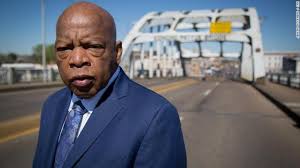
    From being beaten by police on Bloody Sunday at the Edmund Pettus Bridge in Selma, Alabama in 1965 to observing the creation of a Black Lives Matter Plaza in Washington, D. C.  near the White House in June of this year, John Lewis was a presence and driving force for good for more than 50 years. I truly cannot imagine a world without him.

    “You must be able and prepared to give until you cannot give any more. We must use our time and our space on this little planet that we call Earth to make a lasting contribution, to leave it a little better than we found it, and now that need is greater than ever before.” (quote provided by Jonathan Capehart in The Washington Post on June 10, 2020)

    One of my father’s favorite biblical sayings was “a good name is rather to be chosen than great riches.” (Proverbs 22:1)  The name of Congressman John Robert Lewis who died yesterday at the age of 80 will be written in our American history as a good name, perhaps even an “exceptional” one according to remarks by former President Barack Obama as he remembered Lewis today.

    I cannot imagine a world without the compassionate leadership of John Lewis, an American patriot. Your journey is over, John – your job was well done. Rest in peace.

    ************************

    John’s job was, indeed, well done. What about ours? Will we leave this little planet we call Earth a little bit better than we found it? That is the challenge we face daily.   Onward.