

Tag: women’s history month

  • March Madness Away from Basketball

    March Madness Away from Basketball


    Although NCAA women’s basketball takes center court in our home during the month of March every year, Pretty and I also welcome an annual springtime celebration of Women’s History in March. Basketball bracketology should be discussed by experts, and neither Pretty nor I qualify. We were, however, both teachers at one point in our lives and did learn how to develop a lesson plan.

    My plan today features a civics lesson Americans have either forgotten and/or not been taught, so think of this as a brief refresher course that is not sanctioned by anyone and won’t require a registration fee. Hang on to your recliners, my friends. This is high drama. The United States government is structured with three separate but interdependent branches: the legislative (Congress), the executive (President and Cabinet), and the judicial (Supreme Court and federal courts), each with specific powers and responsibilities. Being a contrarian, let’s work backwards as we consider three women who have been leaders in each equal branch under the Constitution.

    Judge Ketanji Brown Jackson’s parents, Johnny and Ellery Brown, had a front row seat at their 51 year old daughter’s confirmation proceedings to be appointed the first Black woman to the United States Supreme Court during the Senate Judiciary Committee’s public hearings in April, 2022. Their faces remained noncommittal, even stoic, when their daughter’s faith, views on pornography, questions of character were attacked by the Republican Senators in the room.

    The confirmation hearings that began with President Joe Biden’s nomination of Judge Jackson had a zoo-like quality with the zookeeper a/k/a Chairman Dick Durbin doing his best to maintain order – decorum was out the window. Johnny and Ellery Brown had undoubtedly seen worse behavior as natives of Miami growing up in the Jim Crow South but as public school teachers in Washington, D.C., they had also seen the impact of the Civil Rights Movement of the 1960s which gave their children more opportunities for success. Judge Jackson was born on September 14, 1970, in Washington, D.C. She was confirmed to the Supreme Court by the Senate with a 53-47 vote on April 07, 2022, and was sworn in on June 30th. of that year.

    When Judge Jackson was 27 years old in 1997, a woman named Madeleine Albright, who then President Bill Clinton had nominated to become the first female Secretary of State, went through her own Senate confirmation hearings in an atmosphere much less combative than the circus Judge Jackson was forced to endure. Republican Senator Jesse Helms who chaired the Senate Foreign Relations Committee led then United Nations Ambassador Albright through the process that ended in a unanimous Senate vote to confirm. Wow. Those were the days.

    Madeleine Albright was born on May 15, 1937, in Prague, Czechoslovakia (now the Czech Republic). In 1939 the Nazi occupation forced her family to become refugees in England, but they returned home after World War II; only to flee again when the communist coup occurred. Her father Josef Korbel had been a member of the Czechoslovakian diplomatic service and sentenced to death by the communist regime. The second time her family fled Madeleine and her mother Anna took a ship to Ellis Island in November, 1948; Josef joined them later. They eventually settled in Denver, Colorado, where Josef accepted a position at the University of Denver. These European immigrants had found a home.

    Madeleine Albright’s storied career represents to me the best of America. To be “the first” woman in any field, to be known as a woman who “tells it like it is,” to successfully navigate the political land mines of our nation’s Capitol to serve our country in an ever changing world – these are accomplishments we celebrate; but to achieve as an outsider, a refugee, merited our highest honors including the Presidential Medal of Freedom bestowed by President Barack Obama in 2012.

    Madeleine Albright died on March 23, 2022, following a long battle with cancer. The first woman ever called Madam Secretary of State left us as the first Black woman battled for her position on the Supreme Court in a contentious, even embarrassing at times, public hearing while her parents, husband, daughters, brother and the American people watched. The coincidental timing was remarkable to me.

    Nancy Pelosi was born on March 26, 1940, and served as the 52nd. Speaker of the House of Representatives, having made history in 2007 when she was elected the first woman to serve as Speaker.  She made history again in January, 2019, when she regained her position second-in-line to the presidency – the first person to do so in more than six decades.

    Pelosi was the chief architect of generation-defining legislation under two Democratic administrations, including the Affordable Care Act and the American Rescue Plan.  She led House Democrats for 20 years and previously served as House Democratic Whip.  In 2013, she was inducted into the National Women’s Hall of Fame at a ceremony in Seneca Falls, the birthplace of the American women’s rights movement.  In 2024, she was awarded by President Biden the Presidential Medal of Freedom, the nation’s highest civilian honor.

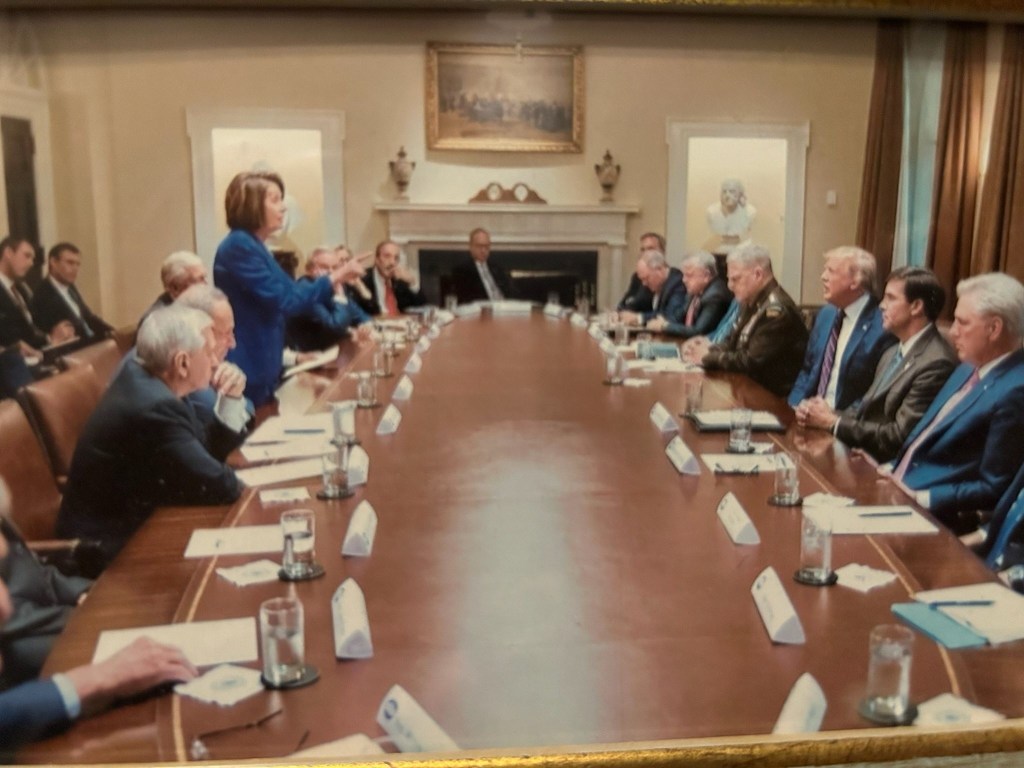
    Pelosi has represented San Francisco in Congress for 37 years,  currently serving as Speaker Emerita of the House and as the Representative for California’s 11th. Congressional District, but it is one picture of her during Trump’s first presidential term that occupies a place of honor in my office as the recipient of the Sheila R. Morris Calling It Like She Sees It Award.

    Speaker Pelosi at a cabinet meeting during the first Trump administration

    I had a vision of hope for the future when I heard Judge Jackson’s answers to the questions posed three years ago during her confirmation process, a glimmer of hope for equality and fairness for my granddaughters. I felt that same spirit of hope in the legacy Madeleine Albright left, her persistence in pursuing freedom for all nations from the position of an immigrant in this country, the world peace she strived for. Jackson. Albright. Pelosi. I salute all three of these warrior women during Women’s History Month for their shared destiny of becoming a “first” in the judicial, executive, and legislative branches of government in the United States of America – three women who broke not only glass ceilings in government but also understood that real power belongs to those willing to serve for a greater good.

    Class dismissed.

  • an other-worldly woman of substance


    Photo by eberhard grossgasteiger on Pexels.com

    The reality is that you will grieve forever. You will not “get over” the loss of a loved one; you will learn to live with it. You will heal and you will rebuild yourself around the loss you have suffered. You will be whole again, but you will never be the same. Nor should you be the same. Nor would you want to. — Elisabeth Kubler-Ross (1926-2004)

    Kubler-Ross devoted most of her adult life to death and dying. She was a pioneer in hospice care, palliative care, and a leading researcher in the lives of the terminally ill. “One of her greatest wishes was to build a hospice for abandoned infants and children infected with HIV to give them a lasting home where they could live until their death. Kübler-Ross attempted to set this up in the late 1980s in Virginia, but local residents feared the possibility of infection and blocked the necessary re-zoning. In October 1994, she lost her house and many possessions, including photos, journals, and notes, to an arson fire that is suspected to have been set by opponents of her AIDS work.” (Wikipedia)

    In her lifetime Kubler-Ross wrote over twenty books on death and dying, was in the National Women’s Hall of Fame, was one of Time magazine’s Top Thinkers of the Twentieth Century, Woman of the Year in 1977, and became a leader as an advocate for spiritual guides and the afterlife despite scandals from her association with a charlatan medium in the late 1970s.

    When I enrolled my mother in hospice care in 2011, I didn’t realize the connection the excellent end of life care she received through the program had been co-founded by a woman who believed in treating the dying with dignity. The team of caregivers we had for the last few months of Mom’s life were compassionate, capable, and centered on her needs. I was also amazed by their assistance throughout the first year of my grieving process following her death.

    As I approach the twelfth anniversary of my mother’s death, I want to honor Elisabeth Kubler-Ross during Women’s History Month, one of the women who had the courage to explore her passion for peace, to protest injustice, to pursue theories considered to be too controversial in an unknown frontier. Elisabeth gave us permission to grieve for losses too painful to deny.

    Yes, the reality is that we will grieve our losses forever, but it’s also true we will be whole again. Never the same, but whole again. That’s cause for celebration.

    ******************

    For all those who grieve.

  • March Madness starts Women’s History Month for Pretty and me

    March Madness starts Women’s History Month for Pretty and me


    Women’s History Month for Pretty and me begins with March Madness every year. While we fall woefully short of being perfect card-carrying lesbians in areas like do it yourself home improvements and/or knowing all the lyrics to Brandi Carlisle’s music – no disrespect to Brandi Carlisle whose songs we do love – we get better marks for being lesbian in two unrelated categories: devotion to our dogs (and now cats), obsession with sports (particularly women’s college basketball and professional tennis).

    This first March weekend we kept I-26 hot driving a hundred miles north to Greenville, South Carolina from our home in West Columbia and riding the same hundred miles back on Friday, Saturday and Sunday to watch the University of South Carolina Gamecock Women’s basketball team play in the 2023 Southeastern Conference Tournament. We rode with two of our gay boys’ basketball buddies who cheer with us in our very loud Section 118 of the Colonial Life Arena during the regular season for every home game.

    (clockwise) Garner, Brian, Pretty and me

    standing in line on beautiful day in Greenville at Bon Secours Wellness Arena

    Garner and me with Carolina logo featuring our

    Gamecock mascot The General

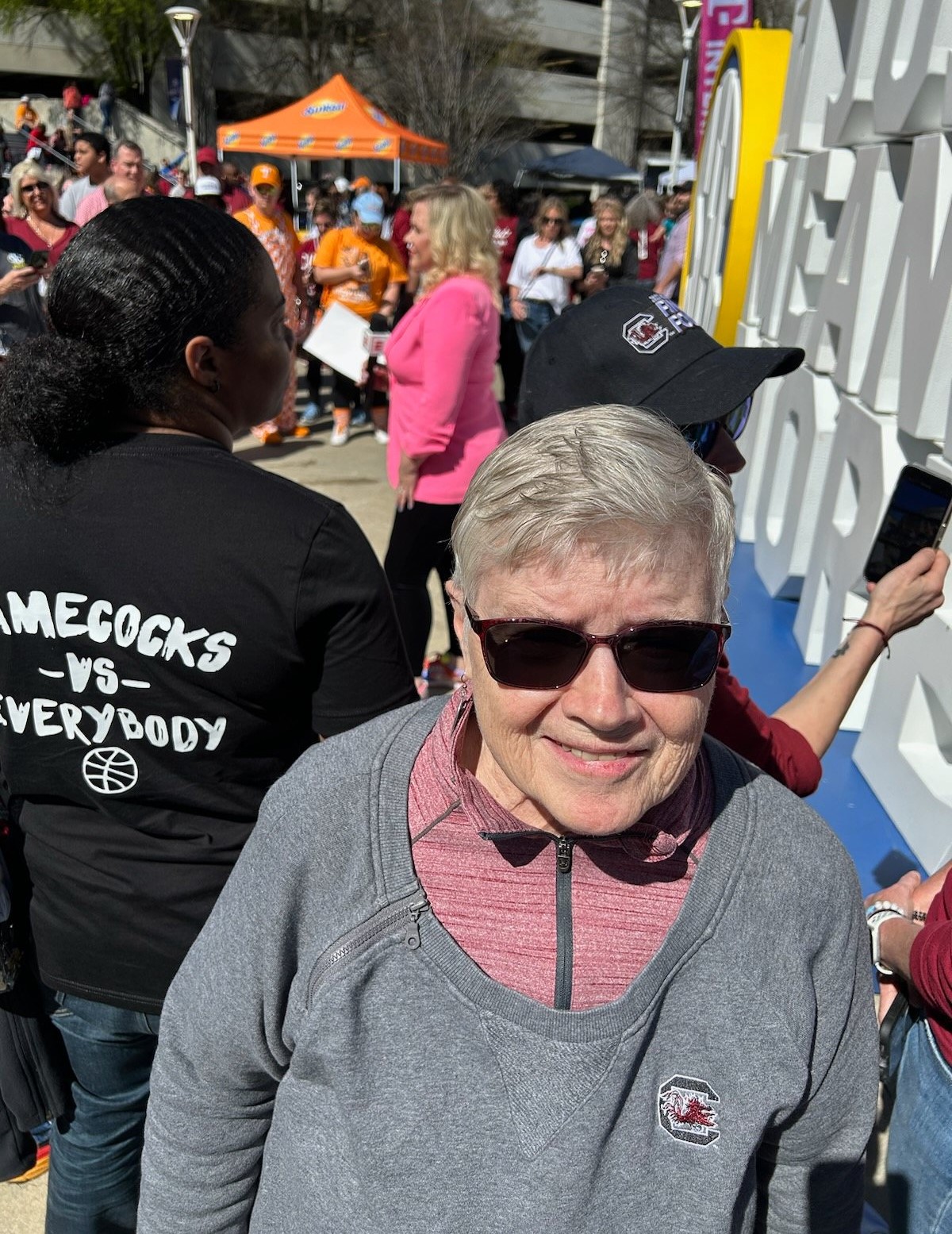
    Garner took this pic of me and ESPN analyst Holly Rowe on College Game Day

    (Holly Rowe is the person in pink – Gamecock fans behind me)

    Pretty and I love our Gamecock women’s basketball team

    the smiling faces of Champions2023 SEC tournament

    (2022-23 regular season Champions, too with perfect record of 16-0 in the conference)

    Photo by DWAYNE MCLEMORE, The State Newspaper

    Head Coach Dawn Staley also happy as she cuts the net

    photo by DWAYNE MCLEMORE, The State Newspaper

    Head Coach Dawn Staley was named SEC Coach of the Year for the sixth time in 2023 as she completes her 15th. season with the University of South Carolina; the 2023 Tournament Championship win marked the seventh SEC title in the past nine seasons. Coach Staley’s Gamecock teams have won National Championships in 2017 and 2022, but the best team may be her current one which has an overall record of 32-0 staying in the #1 spot of the AP Poll every week from the beginning of the year. The 16-0 regular season record for the Gamecock women made them conference champions for the sixth time under Coach Staley. This team is one for the record books, but what is a remarkable team without great players?

    The names of seniors Aliyah Boston, Zia Cooke, Brea Beal, Laeticia Amihere, Victaria Saxton, Kiera Fletcher, and Olivia Thompson will leave behind a stellar history for women’s Gamecock basketball not only for their team championships on the basketball court but also individual records that set high standards for the players who come after them. These young women have been inspirational in their dedication to their craft, community, and loyal fans who look forward to following their futures.

    Thank you, Coach Staley, for guiding your teams to greatness – it’s been such a fun ride for your fan base which includes Pretty and me. More than that, however, thank you for preparing your players for making our world a better place.

    ***********************

    Slava Ukraini. For the children.

  • two singular American warrior women: one shared destiny

    two singular American warrior women: one shared destiny


    Judge Ketanji Brown Jackson’s parents, Johnny and Ellery Brown, have had a front row seat at their 51 year old daughter’s confirmation proceedings to be appointed the first Black woman to the United States Supreme Court during the Senate Judiciary Committee’s public hearings this week. Their faces remained noncommittal, even stoic, when their daughter’s faith, views on pornography, questions of character were attacked by the Republican Senators in the room.

    The confirmation hearings that began with President Joe Biden’s nomination of Judge Jackson had a zoo-like quality with the zookeeper a/k/a Chairman Dick Durbin doing his best to maintain order – decorum was out the window. Johnny and Ellery Brown had undoubtedly seen worse behavior as natives of Miami growing up in the Jim Crow South but as public school teachers in Washington, D.C. they had also seen the impact of the Civil Rights Movement of the 1960s which gave their children more opportunities for success. Judge Jackson was born on September 14, 1970 in Washington, D.C.

    When Judge Jackson was 27 years old in 1997, a woman named Madeleine Albright, who then President Bill Clinton had nominated to become the first female Secretary of State, went through her own Senate confirmation hearings in an atmosphere much less combative than the circus she was forced to endure. Republican Senator Jesse Helms who chaired the Senate Foreign Relations Committee led then United Nations Ambassador Albright through the process that ended in a unanimous Senate vote to confirm. Wow. Those were the days.

    Madeleine Albright was born on May 15, 1937 in Prague, Czechoslovokia (now the Czech Republic). In 1939 the Nazi occupation forced her family to become refugees in England, but they returned home after World War II; only to flee again when the communist coup occurred. Her father Josef Korbel had been a member of the Czechoslovokian diplomatic service and sentenced to death by the communist regime. The second time her family fled Madeleine and her mother Anna took a ship to Ellis Island in November, 1948; Josef joined them later. They eventually settled in Denver, Colorado where Josef accepted a postion at the University of Denver.

    Madeleine Albright’s storied career represents to me the best of America. To be “the first” woman in any field, to be known as a woman who “tells it like it is,” to successfully navigate the political land mines of our nation’s Capitol to serve our country in an ever changing world – these are accomplishments we celebrate; but to achieve as an outsider, a refugee, demands our highest honors including the Presidential Medal of Freedom bestowed by President Barack Obama in 2012.

    Madeleine Albright died yesterday, March 23, 2022 following a long battle with an enemy we all know: cancer.

    The first woman ever called Madam Secretary of State left us as the first Black woman battled for her position on the Supreme Court in a contentious, even embarrassing at times, public hearing while her parents, husband, daughters, brother and others watched. The coincidental timing was remarkable to me.

    Yet I had a spirit of hope for the future when I heard Judge Jackson’s answers to the questions posed yesterday, a glimmer of hope for equality and fairness for my granddaughters. I also felt that same spirit of hope in the legacy Madeleine Albright leaves, her persistence in pursuing freedom for all nations, the world peace she strived for. I salute both of these warrior women during Women’s History Month for their shared destiny, for the heritage we can honor by emulating their courage in our own outrageous acts of everyday rebellions.

    Onward.

  • the battle my grandmother lost

    the battle my grandmother lost


    March is Women’s History Month. I planned to write a new post today to celebrate a universally celebrated woman, but I have two excuses for re-blogging this post from February, 2019: (1) I was glued to the televised Senate confirmation hearings for a Supreme Court nominee by President Biden of a Black woman, Judge Ketanji Brown Jackson, who I sincerely believe will one day be universally celebrated (2) I unabashedly celebrate one of the women who was certainly not well known beyond Grimes and Walker County, Texas but a woman who loved me dearly for as long as she lived.

    my early years in my hometown of rural Richards, Texas

    (circa 1949)

    my dad and me at a family picnic in matching shirts

    made by my grandmother (circa 1951)

    a birthday party dress made by my grandmother (circa 1951)

    my grandmother made this dress and a  picture postcard of me

    for her family Easter card in 1949

    Bless her heart. My grandmother tried and tried to reshape my fashions which upon reflection she probably hoped would reshape my life. One of the most dreaded phrases my mother ever spoke to me – the one that made me cringe-was “Your grandmother is making you a new dress and needs you to walk down to her house to try it on. No arguments, no whining, just go.”

    I absolutely hated to stand on her little stool while she endlessly pinned away to make sure  the pattern she bought from a grand clothing store in the much bigger town of Navasota  fit perfectly on my small body. She pulled, tugged here and there, made me turn around as she measured whatever cloth she had purchased when she bought the pattern. I prayed silently that the aroma I smelled was her pineapple fried pies…the only possible redemption from the hell of being poked and prodded for a new dress I didn’t want to wear.

    My grandmother Betha Day Robinson Morris and I lived within shouting distance of each other in the tiny town (pop. about 500) of Richards until my dad found a new job that took us out of the place I called home when I was 13 years old. Our new home in Brazoria was less than two hours from Richards so we came back every other week for most of my teenage years. Distance did not deter my grandmother from her sewing, however.

    She usually managed to have something for me to try on whenever we visited. I finally surrendered to her passion for sewing because as I grew older I came to understand sewing was an important part of her life, but to this day I dread hearing Pretty say she brought something home for me to try on.

    my grandmother surveys her granddaughters

    before Easter Sunday church services in 1963

    I was 17 years old and wearing a dress my grandmother made for me

    while my younger cousin Melissa modeled her store-bought outfit

    My grandmother continued to sew for me until I was in my twenties. Every Christmas she wrapped a large box in her best wrapping paper and favorite bow saved from the previous Christmas to give to me. I always opened with feigned surprise at the dress she made for me to wear to church and praised her for being able to still find the perfect pattern and material for me even when I wasn’t there to try it on.

    I’ll never forget the last time I opened a gift of clothing she made for me. She had made a pants suit – unbelievable. I could see she was pleased with herself for breaking from the dress tradition she wanted me to wear to making the pants she now understood would forever be my choice of clothes. The year was 1968 – I was 22 years old – my grandmother would have been 55. The pants suit represented a rite of passage for both of us.

    Unfortunately, I never could bring myself to wear the pants suit which was made with a hideous polyester fabric and a horrible bright green and white large zig zag pattern. I couldn’t bring myself to wear it, but I carried it with me around the country wherever I moved for the next 30 years. I would carefully hang it in my closet as a daily reminder of  the love my grandmother gave me for as long as she lived.

    My grandmother Betha was a flawed individual but what I wouldn’t give today to hear my mother say “Sheila Rae, your grandmother is making you a new dress and wants you to try it on. No arguments, no whining, just go.”

    ************

    P.S. When our granddaughter Ella gets new clothes, she can’t wait to try them on! Her mother Pretty Too has a friend Nicole who has a sewing machine and recently taught herself how to sew in a week – my grandmother would have been very impressed with that.