Tag: WWII

  • a man of letters – prejudice by any other name is still prejudice


    Two years ago in the summer of 2018 I published posts containing letters written by my father to family members from his teenage years in the early 1940s to his death in 1976.  I called the series “a man of letters” – it became one of my favorites published here. I included letters from other members of my family in the series. On this Memorial Day I remember with shame and sadness this exchange between my grandmother and her two sons who would be swept up in WWII in the European theater. 

    While the war took center stage in everyone’s mind in 1942 and my dad noticed that his hunting and fishing buddies in Richards, Texas had a younger sister, apparently hormones were also raging in my dad’s brother Ray who would have been almost twenty years old in April of 1942 when he received a surprise letter in the mail from his mother. It was dated April 27th.

    “Dear Ray, Your daddy and I were tickled with your surprise visit this past weekend. You always have to work, and it was a treat for us to have you home for a whole weekend. I am pleased to see that your appetite is still good. I’ve never seen anyone love chicken and dumplings the way you do!

    Now, son, I need to have a serious talk with you about Geneva Walkoviak. I know that you had two dates with her while you were home. We can’t have you getting too serious about Geneva. And, I’m sure you know why. Even though she is pretty and seems sweet enough, the facts are that she is Polish and Catholic and those are two things that don’t mix in our family. You may not be able to appreciate the problems with that, but take my word for it. You stay with your own kind. Now, let’s leave it at that. I know you wouldn’t want to let us down.

    Try to make it home for your daddy’s birthday this summer.  All our love, Mama and Daddy”

    Polish. Catholic. Prejudice takes twists and turns through the years, decades, centuries. The names change, but the sentiments do not. Polish people in Richards at that time had a distinct accent – they were often first and second generation immigrants who farmed the contrary Texas land. The children rode a small yellow school bus to the red brick schoolhouse in town carrying the hopes and dreams of their families in tiny brown paper lunch bags. The men and boys got their haircuts at my grandfather’s barbershop. Their money, as is always the case in prejudice, was evidently neither Polish nor Catholic.

    Today bigotry is often based on what language is spoken, skin color, or country of origin. Hispanic refugees and others seeking asylum in this country are subjected to inhumane treatment that is unacceptable to all of us who respect the values our nation was founded on: everyone is entitled to life, liberty and the pursuit of happiness. We do not separate children from their mothers and then put them in prison camps. We’ve done that before to African-American slaves whose families were ripped apart and scattered to the four winds. That is not who we think we are. That is not who we are, is it?

    Catholics – Jews – Muslims. The religion roller coaster ride continues with death-defying speed and mind-boggling ticket prices.

    What a tangled web we weave in a small rural southeast Texas community consumed by the thought of a war in 1942, and yet my grandmother decided to set aside time to write a letter to my uncle which sadly exhibited the same kinds of prejudice that created anti-Semitism in Germany which was the impetus for the war in the first place, where a name like Walkoviak and a pretty Catholic girl named Geneva could become the target of pointed prejudice.

    I am ashamed and saddened by this letter. I do not find it surprising, however, because I remember my grandmother as a wonderful strong funny woman – but flawed. She would have been 39 years old when she wrote that revealing letter to her son. I’m not sure her positions changed during the next forty-five years of her life. She agonized over voting for the Democratic candidate John Kennedy in 1960 because of his Catholicism, for example; but I do recall she relented in later years when her grandson, one of Ray’s sons, married a Catholic girl.

    My dad, on the other hand, must have been blissfully unaware of the family drama because three months after his mother’s letter to his brother, he wrote to his parents following a visit  for his father’s birthday on July 29th. His father turned 44 on that birthday. This letter is dated August 1, 1942.

    “Dear Mama and Daddy, It was good to be home for Daddy’s birthday this week. I’m back at work today, and the grocery store is still standing. And, I’m still stocking shelves. Talk about boring. At least, it gives me money for school and to help Lucy and Terrell with the bills. It’s hard to believe I’ve been in Beaumont for a whole year. The War is the big topic on campus and off. Doesn’t look like we’re doing very good against the bad guys. Daddy, you better go up to Washington and see Mr. Roosevelt. I think he needs some good advice for a change. You could get things going in the right direction.

    I didn’t see much of Ray while we were home. He spends a lot of time with Geneva Walkoviak. She’s the only one he likes to spend money on. Of course, I guess you didn’t see much of me, either. Selma and I went to see the same movie three times. I’m beginning to like her more than her brothers.

    Probably won’t be home again until Christmas. The classes are a little harder this year. But, you’ll see that my grades are hanging in there really good. I want you to be proud of me. Your son, Glenn Morris”

    Obviously my uncle Ray rejected his mother’s ultimatum and continued to date the pretty Polish girl who happened to be Catholic. That made me smile.

    Throughout 1942 the impact of the war came closer and closer to home as more  young men enlisted – teenage boys were leaving their farms, day jobs, and classrooms to join the armed forces. They would soon cross oceans by sea and air to defend their country from the Axis powers.

    Stay tuned

    Ray and his mama

    my Uncle Ray 

    my grandfather George, my daddy Glenn and my grandmother Betha

    My Aunt Lucy

    Stay safe, stay sane and stay tuned.


  • Vive la France! D-Day, the donald, and the drop shot


    The French have it all this week: 75th. Anniversary of the Allied invasion in WWII that began on the beaches in Normandy on June 06, 1944 (commonly referred to as D-Day); an American president on the continent who truly can’t stop himself from revealing his ignorance of, oh well, just about every nasty thing he finds to tweet about on an hourly basis; and the final week of the 2019 Roland-Garros tennis tournament, the second Grand Slam event of the year which finds familiar names in the men’s semi-finals and fresh faces in the women’s semis.

    I am swept along by the stirring images of the American cemetery in Normandy, the stories of the amazing four women ages 92 – 99 known as the Rosies who were not only the Riveters but also the draftswomen and/or anything else needed, these four women representing all the women who worked building the planes, ships and bombs necessary for our soldiers waging a war in Europe, Africa and the Pacific. These women are in France for the D-Day Anniversary remembrance and will bring their memorie as well as their flowers for one of the crosses in the cemetery which belongs to a brother by his sister who has never had the opportunity to visit his grave. Tom Brokaw will also be on this site as he pays tribute one more time to the fallen soldiers of WWII who inspired his book in which he named them our Greatest Generation.

    One of the women who wins the French Open this year will be a first time winner of a Grand Slam. The names of the four remaining women in the draw will be familiar only to those who follow women’s tennis regularly: Ash Barty of Australia, Johanna Konta of Great Britain, Marketa Vondrousova of the Czech Republic and seventen-year-old Amanda Anisimova of the USA. These remarkable women managed to eliminate more familiar  tennis names like the Williams Sisters, defending champion Simona Halep, #1 player in the world Naomi Osaka, Madison Keys, Sloane Stevens, and 108 additional competitors who fought their hardest on the clay courts but lost to better players on a given day.

    The men at Roland-Garros are also down to the final four, but their names are not only familiar but famous. Roger Federer of Switzerland meets his long-time rival Spanish clay court warrior Rafael Nadal in a much anticipated semi-final match. Federer has won 20 Grand Slam tournaments to Nadal’s 17. The Serbian Novak Djokovic has 15 Grand Slam titles but came into the French as the winner of the previous three major tournaments so a win for him would put him in a category all his own. Austrian Dominic Thiem will play Djokovic in the other semi-final on the men’s side. The French got the final four men in the correct order, but who could have predicted the women’s semi-finalists? I can’t wait.

    Last  and definitely least, an American president trolls the international twitter space with irrelevant nonsense and makes his trip for D-Day a public relations nightmare for his staff and everyone he encounters on the other side of the Pond. I felt sorry for the Queen during his toast at the state banquet. She looked like she was wondering if her dogs would be more entertaining than this presidential impersonator from the Colonies. Poor Queen Elizabeth. And can anyone really believe the British royalty told the president to bring his whole commoner family for dinner?

    Stay tuned.


  • never forget


    Veteran’s Day is our day set aside to honor the men and women who serve and have served in defense of our democracy at home and abroad. This past year I did an entire series on my family’s experiences during WWII. (See archives for “a man of letters.”)

    The following are a few pictures from that series.

    my navy uncle Charlie with my mother

    my air corps Dad

    .

    my air corps uncle Ray

    My uncles and my dad survived WWII but are no longer here to “never forget” each other and their comrades, so we must remember for them.

    Stay tuned.


  • a man of letters (10) – some of us are lucky


    March, 1945 began as February had ended – with more missions to fly (Reuthingen and Bohlen) – but with an unexpected visit from a friend who had been with him in navigation school in Texas and an equally unexpected promotion. In a letter dated March 06th. he wrote the following:

    “Dear Folks,

    Today I got a letter from you, Mama, and a Valentine box of candy, of which both were appreciated same. I get about as many packages now as I do letters. Well, I have about 10 more missions to go. Really going to town. Tremendous amount of speed.

    Art Montana just came over to see me. I had about a day and a half with him. He has 12 missions in. I told him I had more hours on oxygen than he’s got in his whole stay in the Air Corps. He’s looking good. He says I’m gaining weight. I do weigh about 10 stones now. That’s British for 140 pounds. A stone is equivalent to 14 pounds. I don’t think the scales are right. I know I’m not that heavy. Although my eyelids feel like they weigh tons sometimes. Not so good, huh?

    Mort and Montana are at the same field. They don’t run around together much. Mort drinks quite a bit. Montana takes a drink occasionally, but not excessively.

    I had good news in one way today, but it’ll mean a little more work for me. Oh, well. I guess I can stand anything for a while. Understand I’m not moaning. Silver looks better than gold anyway, doesn’t it?

    Well, folks, I guess you’ve had it for tonight.

    I love you, Glenn Lewis”

    Glenn Lewis wanted to tell his parents about his promotion from second to first lieutenant on March 6th. His insignia changed from a gold bar to a silver one. He had mixed emotions about the change with good reason. The March targets continued at a relentless pace.

    Gelsenkirchen, another industrial center for the Third Reich…Kassel again…Koesfeld…Hamelin, a town in lower Saxony, famous for its medieval tale of The Pied Piper of Hamelin. No fairy tales being told that day as the smoke rose from its ruins.

    Zoesen…Molbes…Berlin again…Dorsten…Recklinghausen…each city and town a dot on a map that became worn with repeated markings. Every day brought more assignments and more waiting for orders to fly.

    On April 1, 1945 the newly promoted 1st. Lieutenant Morris wrote the following letter to his girl back home, Selma, who was in the middle of her second semester at Baylor University in Waco:

    “Dearest Darling,

    Today, Easter Sunday, I went to church. I was very happy to make it. I thought I wouldn’t be able to. (I know, don’t end a sentence with a preposition.) Oh well, some of us are lucky.

    I hope you had a nice service. I’ll enjoy a good church service when I get back.

    I got your beautiful picture, and it doesn’t flatter you contrary to what you said. It is a lot like you, but there are a lot of things I see in you that can never be captured in a picture, if you know what I mean. There’s something about you that would make a good boy leave a good home. Even me.

    I just listened to Jack Benny. How about that? You wouldn’t think I could but that’s combat for you.

    Well, Love of my Life, until soon,

    I love you,

    Glenn”

    Selma

    1st. Lieutenant Glenn Morris

    Finally, on April 07, 1945 the Flying Fortress flew its 35th. and last mission that targeted an air field in Wesendorf, a city in Lower Saxony. Lieutenant Glenn Morris and almost all of his crew had been lucky to survive a second world war which destroyed millions of people around the globe. D-Day was two months away in June, the atomic bombs in Japan would follow in August; but for these men of the Flying Fortress the war was effectively over.

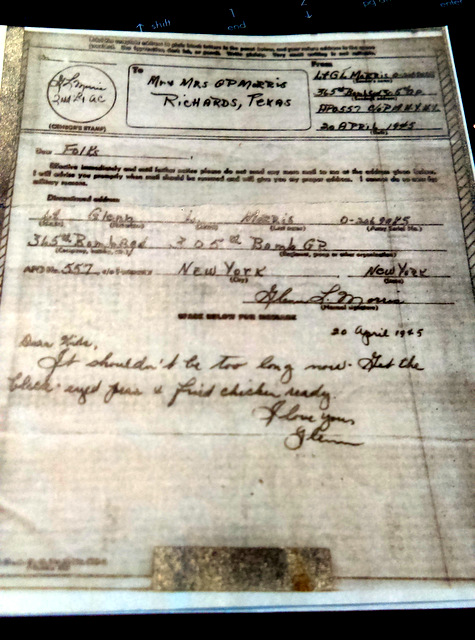
    On April 20, 1945 Lt. Morris wrote to his parents one final time from  Europe.

    “Dear Kids,

    It shouldn’t be too long now. Get the black-eyed peas and fried chicken ready.

    I love you,

    Glenn”

    In a world before the internet with its instantaneous communications via social media, Skype, email, iPhones, iPads, and smart phones – in a world before smart tvs or any tvs for that matter, a young boy became a man while he penned letters to his family and girlfriend back home in a tiny southeast Texas town still divided into black and white by one Main Street with no traffic lights. From the flowery love letters to the letters characterized as much by what they didn’t say as what they did, the idealism of his youth underwent extraordinary trials by fire.

    Stay tuned.


  • a man of letters (7) – absence makes the heart…


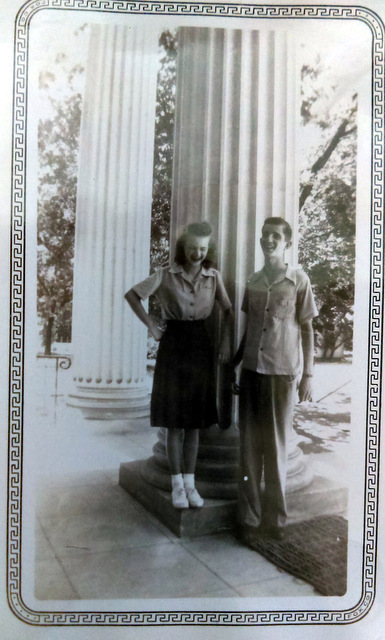
    Glenn at home in Richards, Texas before the war

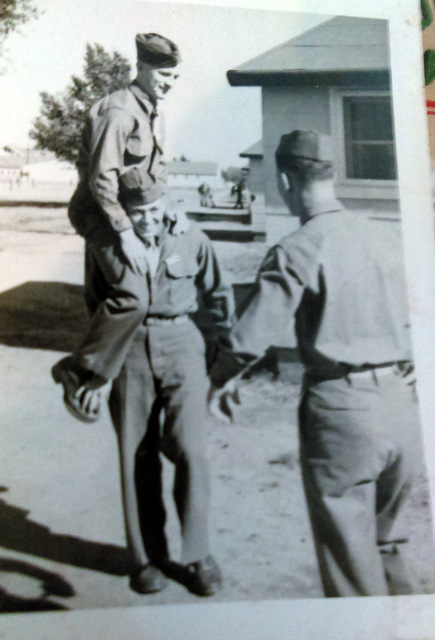
    Remember the slightly underweight 18-year-old rural Texas boy who enlisted in the Army Air Corps in June, 1943 and wrote to his parents that he had to do “what I feel is right for me” following his enlistment? Eighteen months later, this 20-year-old young man horsed around with his Air Force buddies at a base near London, England – waiting for their first combat assignment. Thanksgiving had come and gone; now Christmas loomed large in their minds. They would be an ocean away from home during the holidays in 1944.

    Glenn (on shoulders) and his buddies

    On December 19, 1944, 2nd. Lt. Glenn L. Morris wrote this letter to his girlfriend Selma who was finishing her first semester at Baylor University in Waco, Texas.

    “Dearest Darling,

    I promised myself that I’d write every day to you once I got overseas. Do I do that? Not quite. We do have a pretty heavy schedule right at the present. That should be over with fairly soon. Then I’ll try to write every 2 days anyway. It’s just twice as hard to write now since you can’t say anything that might endanger our security here. Oh well, I’ll have a lot to tell you when I get back. I probably won’t tell you much then, cause we’ll have more important things to talk about. Me & you, for example. Selma, do you want a ring. I mean, you told me all the time you didn’t, so I naturally believed you so sincerely that it made me quite unhappy, if you remember. Anyway, I wouldn’t give you one unless I was there in person.

    There isn’t much entertainment for officers here. The food is good, I think. They don’t have much candy, however. That wasn’t so subtle, was it? If you can get any old beat up candy bars, ship them to your old daddy. Be a good baby cause I love you,

    Glenn”

    Meanwhile, back in Waco at Baylor University…

    Selma made new friends

    Glenn wrote another letter to Selma on December 22, 1944. He had marriage on his mind.

    “Dearest Darling,

    As the fog comes on little cats’ feet. (Where have I heard that before, oh yes ‘Fog’; Carl Sandberg). I’ve forgotten what romantic stuff I was about to give you. You’d be surprised at the sentimental thoughts I’ve been thinking anyway. By the way, will you marry me?

    Last night Dan and I played basketball. We played two games and won both. Some sort of league. All I know is I can hardly walk I’m so sore. Honey, do you think I’m getting old. I’ve told you about my mustache, haven’t I? If I haven’t, it’s really sharp. Of course, it is a shade blonde. I think you would like it. Most of my public does.

    Saw a show tonight, ‘Road to Frisco.’ It was pretty good. The title was ‘They Drive by Night’ when I saw it before.

    Well, Baby, outa space again.

    I love you,

    Glenn”

    On Christmas Eve, December 24, 1944 the Army Air Corps lieutenant wrote again to Selma.

    “Dearest Darling,

    As I think of all the Christmases past, my thoughts naturally are of you. You will always be associated with my pleasant memories. I have no memories other than good ones of you. In fact, I think of you as everything good. I’m not as good as you are, honey, in thousands of ways, but I do love you, if that makes up for any of my faults.

    Would you like to know how I’m spending Xmas eve? Well, the whole crew got together a little while ago & played poker. I never played poker you know before getting into the Army. I think I’m weaker in many ways than I used to be. Well, we sent the boys (enlisted men) after some little pies they can buy at their club. They should be back shortly. We have a pretty good time together.

    Darling, I’m anxiously awaiting your first letter. I’m sure you are writing and will never quit as I’ll never quit loving you.

    Merry Xmas, Glenn”

    Hm. Does absence make the heart grow fonder…or wander…

    Selma and a boy named Tommy at Baylor

    We’ll leave Glenn waiting for his first letter from Selma at Christmas with combat waiting for him just around the corner. His mother, father and sister Lucy celebrated Christmas in Texas, but both sons were worlds away so the mood was somber.

    Glenn and Ray’s sister Lucy (far l. and far r.)

    with their parents George and Betha

    Stay tuned.