Pretty’s cryptic text read thank you for sharing this horror. She was referring to my photo of the victim in the tale, the deceased bright red cardinal lying in state at that very moment on the lid of our city of West Columbia green trash roll cart.
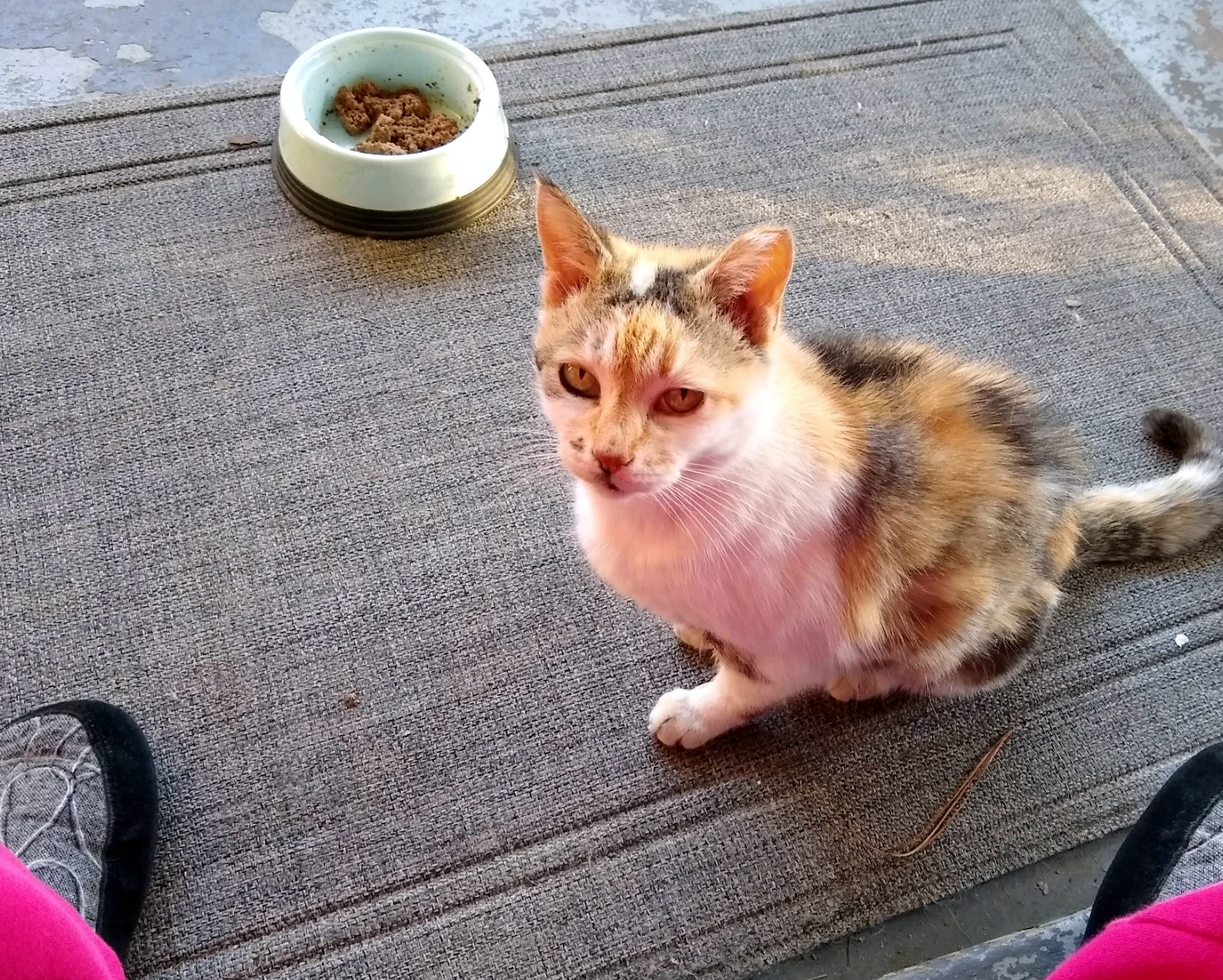
Carport Kitty – the picture of innocence
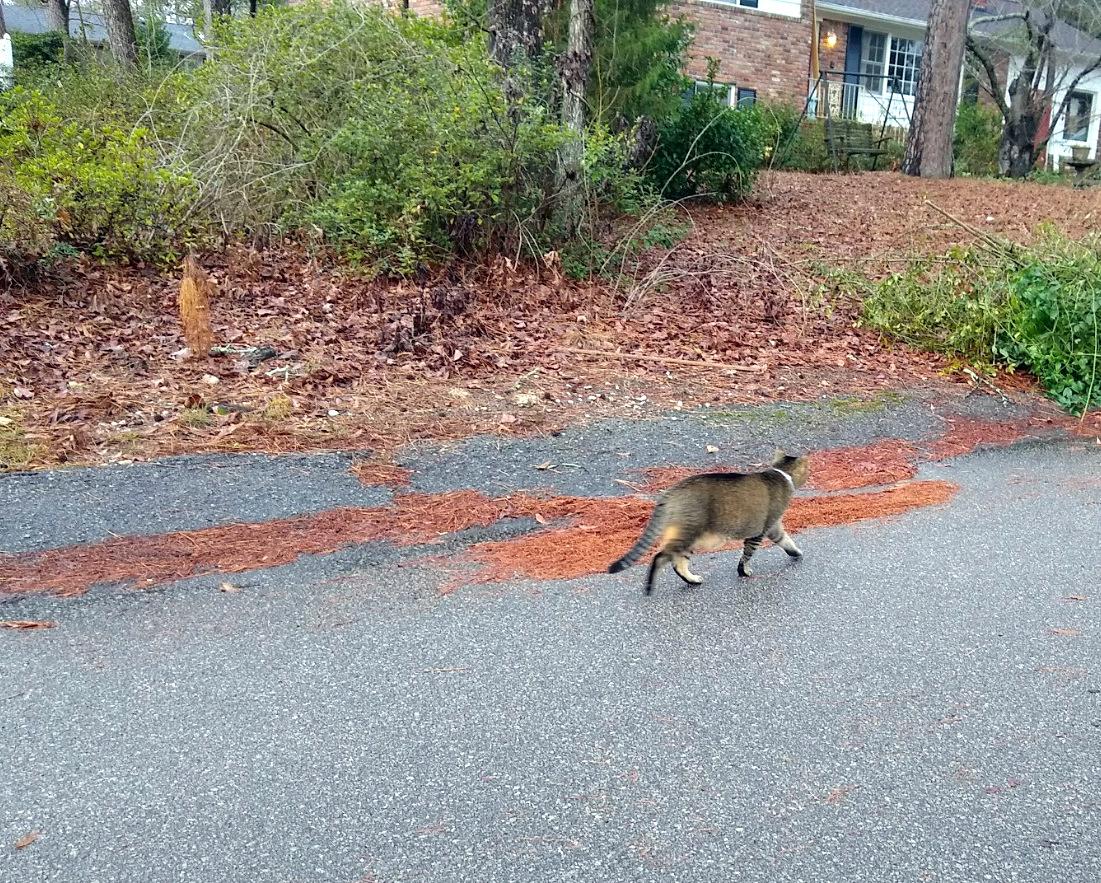
Bully Cat leaving the scene.
Guilty until proven innocent!
I caught a glimpse of Bully Cat and a black cat racing past the carport when I opened the kitchen door that afternoon. Not an unusual sight for me since I regularly guarded Carport Kitty’s food bowl from her scavenging enemies or conniving conspiratorial friends. I’ve never figured out which category they belonged to; but I knew BC and company looked bigger, younger, stronger, more well fed while CK remained frail regardless of her food intake.
When I accidentally discovered the remains of the cardinal in the yard a few minutes later, I thought well what did you expect? This is the cycle of the animal kingdom which you have invited into your family. Sigh. I picked the little fellow up, gently placed him on the lid of the roll cart, took a photo for posterity and sent it to Pretty who was properly horrified. Misery loves company.
Pretty and I both agreed Carport Kitty couldn’t have been the culprit. Surely she was much too old and slow with her weak back legs to catch anything. Which left us with You Know Who to accuse.
…and then Tweety Bird said I did, I 100% did taw a puddy tat.
Covid is over – no need to ever wear a mask again. Anywhere. All gone. If you see someone wearing a mask these days, like at the grocery store or ball game or again, anywhere, that person is a wild-eyed raving liberal who never voted for Donald Trump for president in America or Russia.
Vladimir Putin has no evil intentions toward Ukraine or any other country really. Instead, he has strong leadership in Russia where he is adored by 71% of the Russian people and by Donald Trump who always knows a good deal when he sees it. Putin’s army of 200,000+ surrounding Ukraine should not be considered excessive forces, and their march toward taking over a third nuclear plant in that country is to protect the people in Ukraine from blowing up themselves along with NATO allies and the European Union. Besides, Americans don’t need to worry about what goes on over there.
Joe Biden should have left well enough alone without trying to support his vision of democracy. The good tourists who walked through the US Capitol on January 6th. 2021 were simply tring to prevent a peaceful transfer of power since Biden had been elected in an unfair election. And now look where we are because of him. Back in bed with NATO supporting a small country with a president named Zelenskyy whose name we can’t even spell, much less pronounce, because he won’t do the right thing and surrender to Putin before his country is blown to smithereens. Putin just wants to get back what belongs to him and his oligarchs who insist their yachts were legitimately obtained.
And don’t even get me started about the gasoline prices.
************
Oh, wow. That was fun. Who knew misinformation or disinformation could be entertaining. To quote Pretty this morning, I’m depressed by having my news ruined by the truth – which inspired me to forget truthtelling for a day to write fiction we’d rather hear. Sigh.
Please stay tuned – truth is stranger than fiction.
As the wheels of our jet plane touched down last Wednesday the 23rd. of February on our runway at the Houston Intercontinental Airport, Pretty shared the news that Texas governor Greg Abbott had sent a letter to the Department of Family and Protective Services, calling on licensed professionals and the general public to report the parents of transgender minors to state authorities if it appeared the minors were receiving gender affirming medical care which would now be considered child abuse. I tried to process that bombshell news as our plane screeched to a halt and taxied to our gate. No time really for deep thought as we disembarked and joined the hordes of passengers trying to find the baggage carousel while throngs of people pushed against us moving in the opposite direction to board flights bound for who knows where. We must have looked like ants that had lost their GPS – going back and forth, to and fro, hurry, hurry.
Pretty blamed my break up with Texas on the weather. We left temperatures in the sunny 70s in South Carolina only to be met by a ferocious cold wind as soon as we stepped outside the Houston terminal. Jesus Cristus, we were freezing. Our motel for the first two nights of our visit was on Lake Conroe near Montgomery where Pretty and I had a home for four years, and the woman who checked me in that first night punished me for my comment on her not wearing a mask while advertising Covid safety protocols on their website. She put us in a room facing the lake, but it was only accessible by carrying our luggage through a wind tunnel with gusts of hurricane force. I recognized revenge when I felt it; I was chilled to the bone. Pretty was, too. I also recognized the look she gave me when we got to our room, the look that meant why can’t you leave things alone just once, Boomer?
Texas was the place I’d been born in 1946, the place I had been educated by public schools through high school, the place I had graduated from college, the place where I had my first grown-up job at what was then a Big Eight accounting firm in downtown Houston, and finally the state I left a year later in 1968 to seek my fortune in a city that was as foreign to me as South Carolina was to South Dakota. For the next fifty plus years no matter where I roamed I always flew and/or drove home to Texas for Christmas and usually in the summer time to reconnect with family and friends; to celebrate the mystique of the spirit that defined native Texans as, well, native – to renew the bond I had with the land itself. When my mother became someone else who couldn’t remember how to play the piano and was in a memory care unit in Houston, I stayed for long periods of time in the state with Pretty’s encouragement to be with her.
This visit, however, was our first trip back since 2017. That would be five years in case anyone is counting. New knees and Covid were the main culprits in my sabbatical from the state. Yet here we were for four nights and days that would be filled with visits to family and friends who had kept in touch over the years: meeting friends at a favorite Mexican restaurant the first night we were there, taking donuts to talk to three little boys who were small when we last saw them but now had grown up and were taking classes online; calling on a cousin who will be 98 this month and still going strong, another cousin who now at 81 is the primary caregiver for her husband she has always adored, two first cousins who met us for lunch and brought pictures from the past that sparked memories, memories.
The weather was cold and gloomy every day we were there which gave the countryside a harshness I had never associated with the rolling hills that I claimed to be my country. The cattle now grazing needed hay from the ranchers to make it through the unsparing times. Pretty and I drove through my home town the second day of our visit on the way to the little cemetery where most of my family were buried. I felt sadness as I saw what was left of the town and home I loved. Nothing remained but the remnants of wooden houses in severe disrepair and falling down brick buildings. The town was no more.
Russia invaded Ukraine the second day we were in Texas. When we were in our motel rooms at night, I watched the news on tv. Pretty followed the events on Twitter during the day and kept me up to speed. Regardless of the source, everyone agreed that the not unexpected invasion of a sovereign democracy had begun. Local news in Houston typically focused on murders in the city every day until the devastating international tragedy began and replaced the stories. I was not in a good place when I announced to Pretty and cousins at lunch the next day that this was my last trip to Texas until they brought my ashes in a nicely decorated urn to the little cemetery on one of the rolling hills of Grimes County.
That was overly dramatic and untrue. Of course I will go back – hopefully not in an urn. The ACLU has filed suit against the state of Texas to protect the rights of transgender minors and their parents. Pretty managed to locate wonderfully warm coats and sweaters for us on Day Two, thank goodness. We ate our comfort Mexican food in a different place every day – even at the Houston airport when we had time for margaritas before the flight home. I loved being with friends and family, and I also loved going to watch the Gamecock women’s basketball team beat the Aggies on their home court in College Station. As a UT grad in rival territory, I was thrilled with the final score 89 – 48. We had an hour’s drive to get back to our motel room on Lake Conroe after the game, but when we walked through the wind tunnel to get to our room, I didn’t even notice the cold.
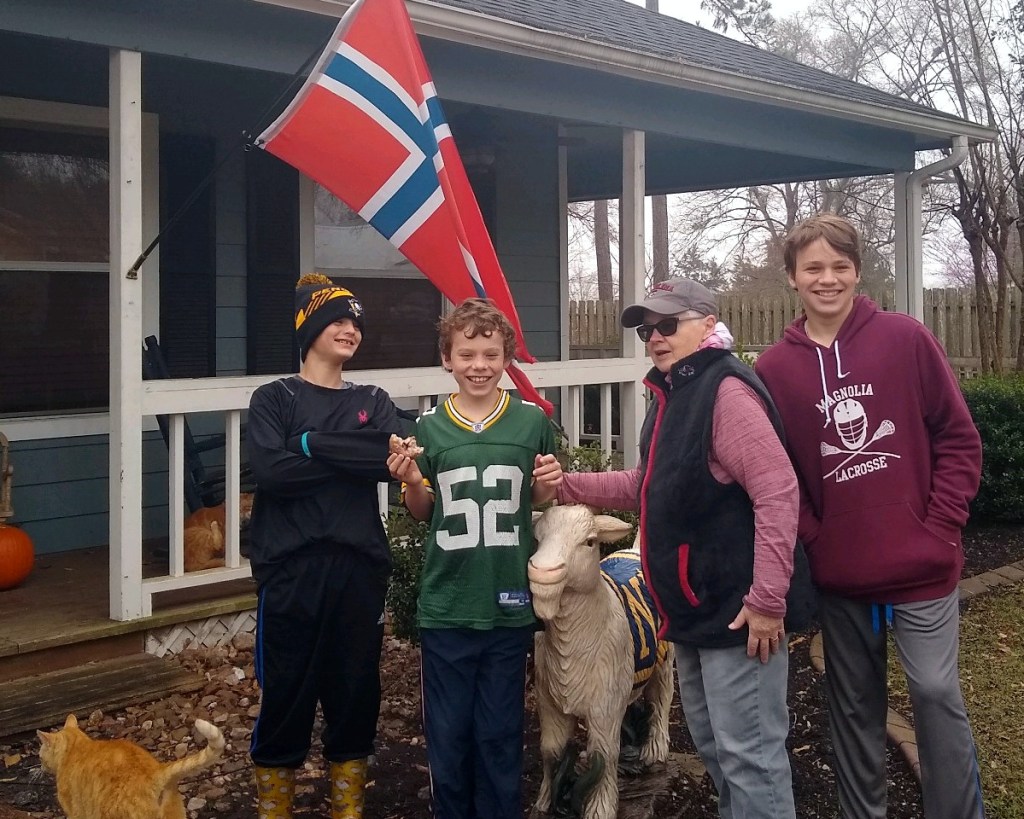
the Fabulous Huss Brothers
l. to r. Dwight (11), George (9) and Oscar (13)
Thanks to Becky for the photo!
*****************
Stay safe, stay sane, get vaccinated, boosted and please stay tuned.
In the tiny Sears Roebuck kit house I grew up in, boundaries were both invisible and highly visible. The home was owned by my maternal grandmother and shared with two of my mother’s adult brothers in addition to my daddy, mother and me. The home was crowded. When I think back on it, I don’t know how we all managed to eat and sleep there – not to mention the scheduling of everyone’s turn in the single bathroom which barely had space to turn around to close the door after entering. That room was tight, and boundaries were tightly defined.
While the home itself was small, the lot on which it sat was large, a corner lot with an unattached garage (with an attached outhouse that may help explain the bathroom scheduling inside) behind the house. Beyond the garage a small pond which we called a tank in rural Texas lay quietly in an “in-town” pasture that had no fences. My back yard was spacious, vast in a small child’s mind, unique in comparison to the other small frame houses sitting on the few dirt roads that connected them.
Although the tank wasn’t very big, the fish and frog population that lived there mysteriously thrived, encouraging our relatives from the bigger cities of Houston, Dallas, Rosenberg, et.al., to make regular fishing trips to our place “in the country.” They came with their poles, rods, reels, live and artificial bait to try to land Ol’ Biggie, the name my Uncle Toby gave to the wiser large perch and catfish that proved elusive most of the time. During those early years I preferred running around the banks of the tank with my cousins to dropping a line with a squiggly worm in the water.
At random times, though, I made an exception to enjoy the company of a full-bodied black woman named Pearl who walked across another invisible line to come fishing in our tank. One paved road we called main street distinctly divided black and white people in my community in those days in the late 1940s and early 1950s; that street should have been painted blood red. Pearl lived in an area of town on one side of the street I knew simply as The Quarters. I would be much older when I realized the name referenced slave quarters that still separated her world from mine.
Pearl told me the best stories about all the fish she had caught in the hottest fishing holes around the county. I believed every word she said because I trusted the deep rich voice that spoke. Pearl and my grandmother were good friends who visited together whenever she got ready to leave with her bucket full of fish. Pearl had the best luck catching perch in our tank – never very large – but she bragged that the little ones were better to fry anyway. Made sense to me. My mother also adored Pearl which surprised me since Mama didn’t adore anyone including herself.
Pearl Harris was the first black person in my life. She was warm, affectionate, funny and always kind to me. I have no idea how she came to be friends with my grandmother. I suspect they met in the general store in town where my grandmother clerked. Whatever the circumstance, I felt their friendship was authentic. They were easy with each other. I now know Pearl’s walk across the invisible racial divide to our fishing tank was not only brave but necessary to put food on the table for her family. My grandmother could relate to that need, too.
Wanda Sykes says in her Netflix comedy routine that I’ve watched at least four times now, seriously, at least four, that all white people need to have at least one black person who is their friend. Wanda thinks that friendship just might be a starting point to heal the racial divide that is at the center of income inequality and a host of other problems in our country. From a little girl growing up in a Texas town big enough for only one general store but large enough to contain two worlds separated by skin colors of black and white, I say I couldn’t agree more, Wanda. Bravo.
RIP Pearl Harris (1893 – 1957).
***************
You may remember this post from last year. I will remember Pearl for a lifetime.
Stay safe, stay sane, get vaccinated, get boosted and please stay tuned.







 I'll Call It Like I See It
You must be logged in to post a comment.