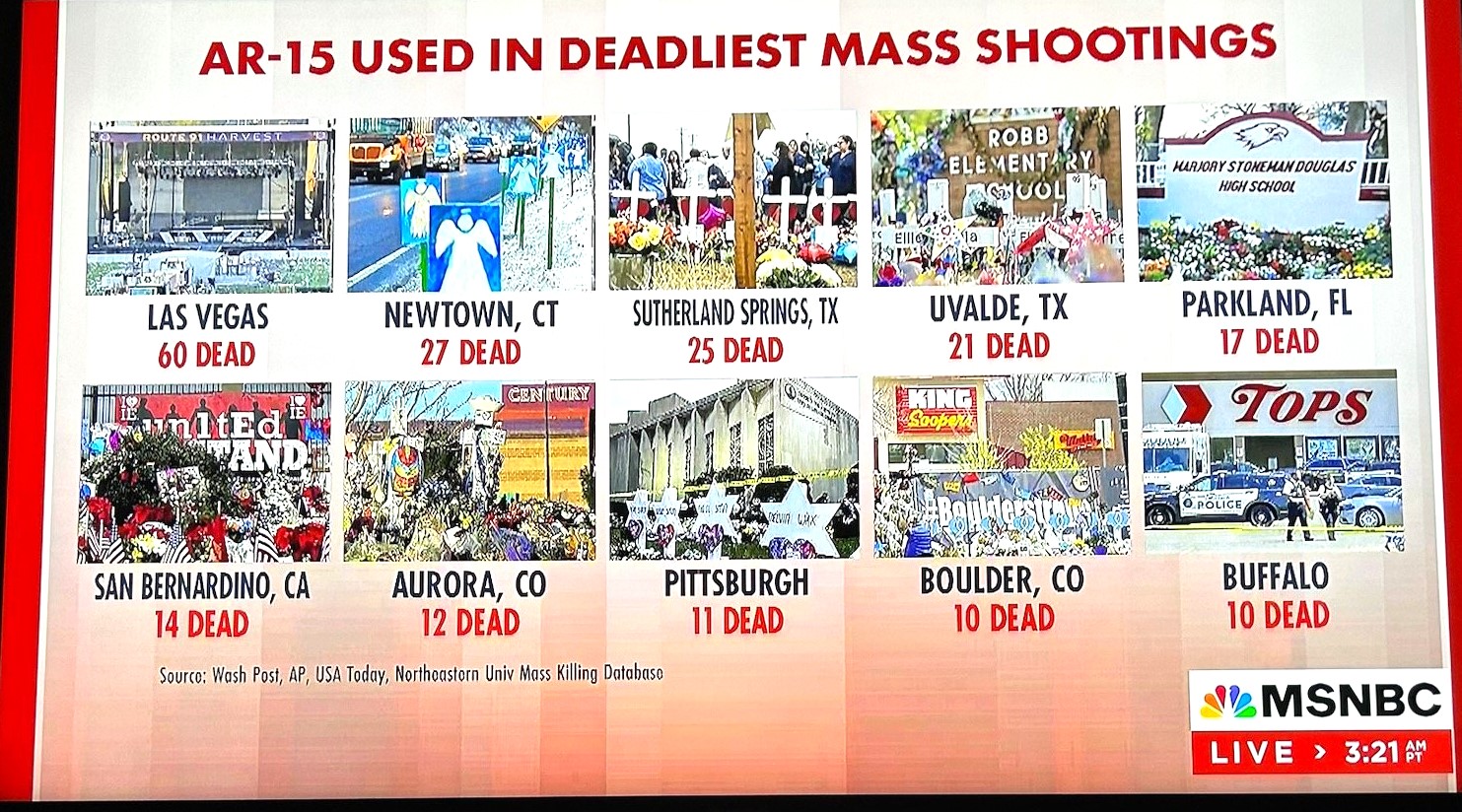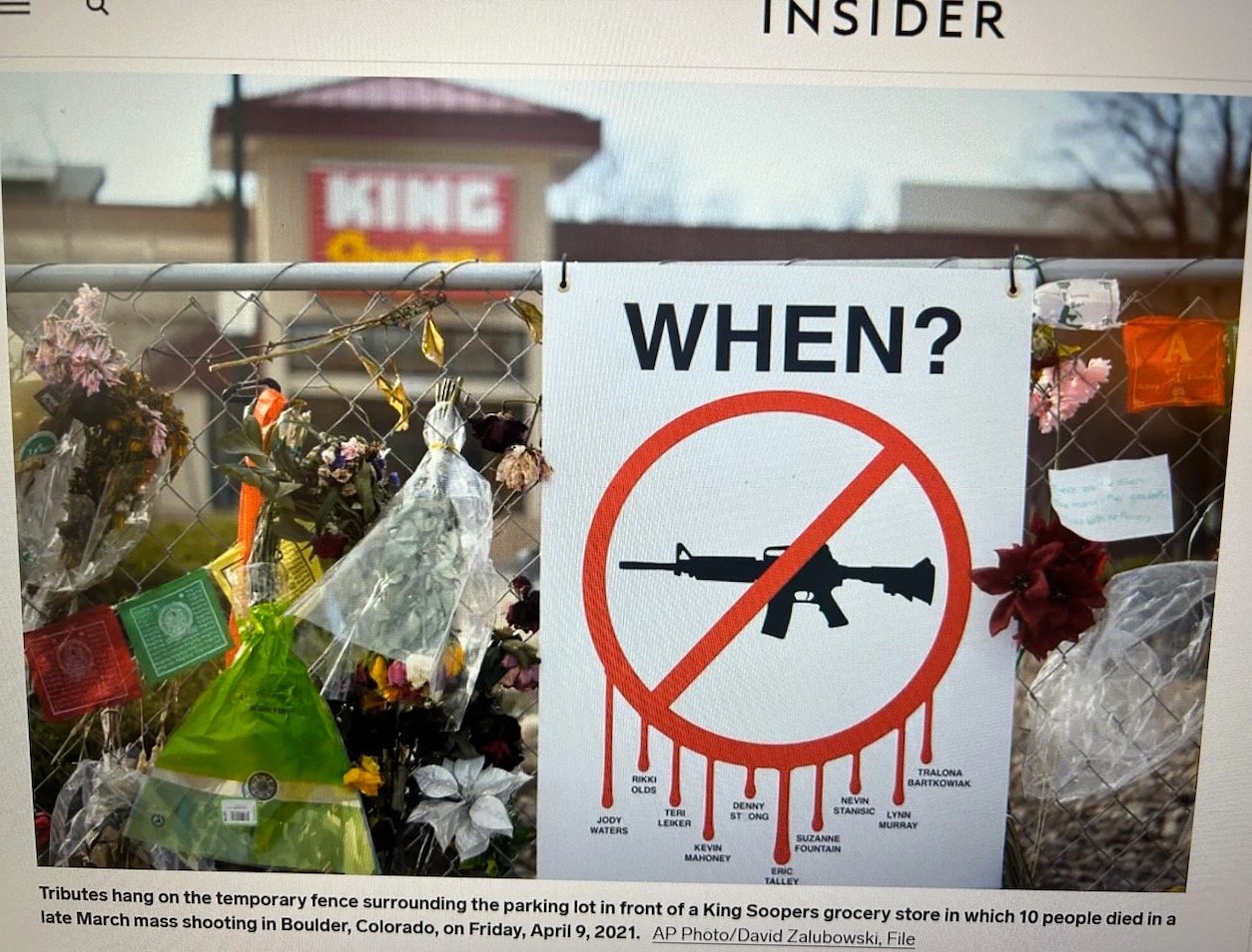
Civil war has been declared on American citizens going about their activities of daily life by other American citizens using AR-15s, the chosen weapon of this war.
Is anybody listening?
Ban the damn things. Ban them all.
by sheila morris

A thirty-eight year old man accused of murdering five neighbors in Cleveland, Texas was captured in a smaller Texas town called Cut and Shoot that was less than 20 miles from where the crime happened after a massive four day manhunt by a collection of law enforcement organizations.The man lived next door to the victims which included two women aged 21 and 31 respectively, a 25 year old woman and her 9 year old son, and an 18 year old young man. According to the 9 year old’s father, the neighbor walked into their home armed with an AR-15 rifle and began shooting after an altercation between them over a crying baby in his home and the neighbor’s shooting practice in the next door yard.
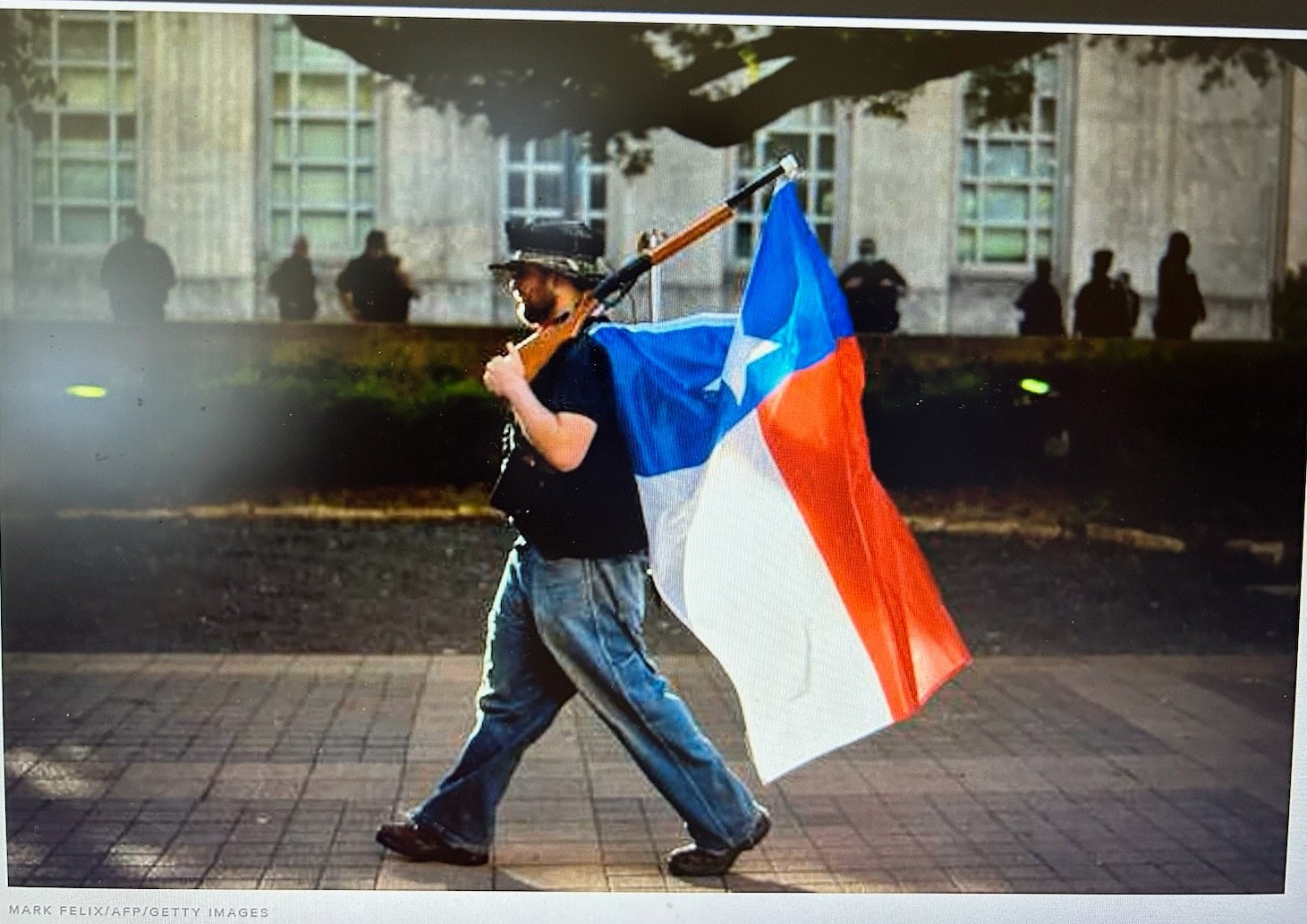
According to data published by Caroline Covington on July 28, 2022 in the Texas Tribune, Texans purchased more than 1.6 million guns in 2021 which was about 1 gun for every 14 adults in the state. Concurrently in 2021 the Texas legislature passed new laws allowing the open carry of handguns without a license to carry those guns under certain conditions per information provided by the Texas State Law Library. The Wild, Wild West of Hollywood westerns in the 1940s and 50s had returned to those thrilling days of yesteryear but the guns of the 21st. century were more powerful, more accessible, able to kill innocent people much quicker than the ones used in the 1952 Gary Cooper film High Noon.

When Pretty and I had a second home on Worsham Street in Montgomery, Texas from 2010 – 2014 we drove through Cut and Shoot whenever we made one of our countless thousand mile trips between South Carolina and Texas. During that time we used the Cut and Shoot post office as a sign we were almost to Conroe which meant we were less than an hour from Worsham Street. Even our dogs sensed the two day drive south and west was nearing the end when we slowed for the small town speed limit and stopped for several red lights there.
Now the name Cut and Shoot is infamous as the town where the Cleveland mass shooter was captured. The little town that got its name from a fight between two (who’s suprised?) religious groups, the home of ostensibly the only person with any claim to fame (professional heavyweight boxer Roy Harris) would achieve notoriety as the place where a middle-aged man with an AR-15 who killed five of his younger neighbors in Cleveland was found hiding in a closet in a house there.
I really don’t care if the people killed and/or the killer were shades of black, brown, white, or mix-ish; what I do care about is that somebody somewhere had an AR-15 rifle and a temper. Everyone has a temper to some degree – even our fifteen month old granddaughter Molly gets mad when she hears the word No, and she feels free to act out by throwing whatever is in her hand to the ground as hard as she can.
But not everyone has an AR-15 rifle, and in my opinion not everyone should.
Ban the damn things. Ban them all.

Today marks the 55th. anniversary of the assassination of the Reverend Dr. Martin Luther King, Jr.; it was the day following his final speech delivered at the Masonic Temple in support of the striking sanitation workers in Memphis, Tennessee and is usually referred to as his “I’ve Been to the Mountaintop” speech. Listening to that speech again today reminded me of Dr. King’s power to move people through not only his words but also, and perhaps more importantly, his delivery of those words. While the end of his speech is what I’ve read, listened to and quoted through the years, I had forgotten the sneeze story that preceded it. Please take a few moments to reflect on the following excerpt from a nonviolent Nobel Peace Prize winner whose thirty-nine year old life was taken by gun violence in the hours following his address in Memphis. If you have more than a few moments, I strongly recommend you listen to the entire speech available in cyberspace.
****************************
You know, several years ago, I was in New York City autographing the first book that I had written. And while sitting there autographing books, a demented black woman came up. The only question I heard from her was, “Are you Martin Luther King?”
And I was looking down writing, and I said yes. And the next minute I felt something beating on my chest. Before I knew it I had been stabbed by this demented woman. I was rushed to Harlem Hospital. It was a dark Saturday afternoon. And that blade had gone through, and the X-rays revealed that the tip of the blade was on the edge of my aorta, the main artery. And once that’s punctured, you drown in your own blood—that’s the end of you.
It came out in the New York Times the next morning, that if I had sneezed, I would have died. Well, about four days later, they allowed me, after the operation, after my chest had been opened, and the blade had been taken out, to move around in the wheel chair in the hospital. They allowed me to read some of the mail that came in, and from all over the states, and the world, kind letters came in. I read a few, but one of them I will never forget. I had received one from the President and the Vice-President. I’ve forgotten what those telegrams said. I’d received a visit and a letter from the Governor of New York, but I’ve forgotten what the letter said. But there was another letter that came from a little girl, a young girl who was a student at the White Plains High School. And I looked at that letter, and I’ll never forget it. It said simply, “Dear Dr. King: I am a ninth-grade student at the White Plains High School.” She said, “While it should not matter, I would like to mention that I am a white girl. I read in the paper of your misfortune, and of your suffering. And I read that if you had sneezed, you would have died. And I’m simply writing you to say that I’m so happy that you didn’t sneeze.”
And I want to say tonight, I want to say that I am happy that I didn’t sneeze. Because if I had sneezed, I wouldn’t have been around here in 1960, when students all over the South started sitting-in at lunch counters. And I knew that as they were sitting in, they were really standing up for the best in the American dream. And taking the whole nation back to those great wells of democracy which were dug deep by the Founding Fathers in the Declaration of Independence and the Constitution. If I had sneezed, I wouldn’t have been around in 1962, when Negroes in Albany, Georgia, decided to straighten their backs up. And whenever men and women straighten their backs up, they are going somewhere, because a man can’t ride your back unless it is bent. If I had sneezed, I wouldn’t have been here in 1963, when the black people of Birmingham, Alabama, aroused the conscience of this nation, and brought into being the Civil Rights Bill. If I had sneezed, I wouldn’t have had a chance later that year, in August, to try to tell America about a dream that I had had. If I had sneezed, I wouldn’t have been down in Selma, Alabama, been in Memphis to see the community rally around those brothers and sisters who are suffering. I’m so happy that I didn’t sneeze.
And they were telling me, now it doesn’t matter now. It really doesn’t matter what happens now. I left Atlanta this morning, and as we got started on the plane, there were six of us, the pilot said over the public address system, “We are sorry for the delay, but we have Dr. Martin Luther King on the plane. And to be sure that all of the bags were checked, and to be sure that nothing would be wrong with the plane, we had to check out everything carefully. And we’ve had the plane protected and guarded all night.”
And then I got to Memphis. And some began to say the threats, or talk about the threats that were out. What would happen to me from some of our sick white brothers?
Well, I don’t know what will happen now. We’ve got some difficult days ahead. But it doesn’t matter with me now. Because I’ve been to the mountaintop. And I don’t mind. Like anybody, I would like to live a long life. Longevity has its place. But I’m not concerned about that now. I just want to do God’s will. And He’s allowed me to go up to the mountain. And I’ve looked over. And I’ve seen the promised land. I may not get there with you. But I want you to know tonight, that we, as a people, will get to the promised land. And I’m happy, tonight. I’m not worried about anything. I’m not fearing any man. Mine eyes have seen the glory of the coming of the Lord.
(from afscme.org)
****************************
For everyone. Everywhere.


AAUW Equal Pay Calendar
Thanks so much to the American Association of University Women for the above images and information they provided on this significant component of Women’s History Month in 2023.
And thanks to Brazilian illustrator Camila Pinheiro for designing the 2023 US Open Tennis Tournament poster celebrating 50 years of equal prize money for men and women, featuring one of the leaders associated with that seismic achievement in 1973: Billie Jean King. A mere twenty-eight years later the Australian Open awarded equal prize money for men and women beginning in 2001, another six years passed before Wimbledon followed suit in February, 2007; Roland-Garros quickly followed Wimbledon in March, 2007 – thirty-four years after the US Open adopted the equal prize money policy for women and men in the sport all four Majors participated in the policy that became the first Grand Slam of pay equity for all players.

“UnEqual” pay was the powder keg that ignited my activism in the women’s movement of the 1970s. From a nontraditional career for women in the accounting profession that began in 1967 with the shocking discovery that my compensation of $650 monthly at the Houston office of Arthur Andersen & Co., one of the most prestigious international accounting firms at the time, was $250 less than a work buddy making $900 a month for the same job. Only difference according to the partner in charge of personnel at the firm when I confronted him: my friend was a guy who might have a family to support one day. The risk for me, according to Mr. Terrell, was the need for maternity leave.
I wasn’t bold enough at the time to tell him why that was an unlikely scenario; I was, however, angry enough to leave the firm. This was my first job in the real world following graduation from the University of Texas at Austin, my first personal introduction to discrimination by men in power who had no respect for women in the workplaces they controlled, my first feelings of being lesser than despite high academic achievements and even higher work ethics. At twenty-two years of age, I was born again – this time as an activist for equal pay.
**********************
Slava Ukraini. For the women.


the two OG cats post Carport Kitty
neighbor cat visits regularly


Charly getting white hair, too – but still always at my side
Carl’s life is as blurry as this picture with loss of hearing, vision –
but his smell for treats as healthy as ever

loyal old man Spike at his guard post: no retreat, no surrender

photo by mother Caroline
our granddaughters three year old Ella holds year old Molly
Okay, so I shamelessly stole the 2023 Oscar winner title for this little Monday morning personal multiverse that Pretty and I inhabit every day. Mea culpa. Enjoy – no goggles required.
Thankfully, all quiet on the Cardinal front today.
Stay tuned.
*************************
Slava Ukraini. Lest we forget the war rages on.
You must be logged in to post a comment.