
Although NCAA women’s basketball takes center court in our home during the month of March every year, Pretty and I also welcome an annual springtime celebration of Women’s History in March. Basketball bracketology should be discussed by experts, and neither Pretty nor I qualify. We were, however, both teachers at one point in our lives and did learn how to develop a lesson plan.
My plan today features a civics lesson Americans have either forgotten and/or not been taught, so think of this as a brief refresher course that is not sanctioned by anyone and won’t require a registration fee. Hang on to your recliners, my friends. This is high drama. The United States government is structured with three separate but interdependent branches: the legislative (Congress), the executive (President and Cabinet), and the judicial (Supreme Court and federal courts), each with specific powers and responsibilities. Being a contrarian, let’s work backwards as we consider three women who have been leaders in each equal branch under the Constitution.
Judge Ketanji Brown Jackson’s parents, Johnny and Ellery Brown, had a front row seat at their 51 year old daughter’s confirmation proceedings to be appointed the first Black woman to the United States Supreme Court during the Senate Judiciary Committee’s public hearings in April, 2022. Their faces remained noncommittal, even stoic, when their daughter’s faith, views on pornography, questions of character were attacked by the Republican Senators in the room.
The confirmation hearings that began with President Joe Biden’s nomination of Judge Jackson had a zoo-like quality with the zookeeper a/k/a Chairman Dick Durbin doing his best to maintain order – decorum was out the window. Johnny and Ellery Brown had undoubtedly seen worse behavior as natives of Miami growing up in the Jim Crow South but as public school teachers in Washington, D.C., they had also seen the impact of the Civil Rights Movement of the 1960s which gave their children more opportunities for success. Judge Jackson was born on September 14, 1970, in Washington, D.C. She was confirmed to the Supreme Court by the Senate with a 53-47 vote on April 07, 2022, and was sworn in on June 30th. of that year.
When Judge Jackson was 27 years old in 1997, a woman named Madeleine Albright, who then President Bill Clinton had nominated to become the first female Secretary of State, went through her own Senate confirmation hearings in an atmosphere much less combative than the circus Judge Jackson was forced to endure. Republican Senator Jesse Helms who chaired the Senate Foreign Relations Committee led then United Nations Ambassador Albright through the process that ended in a unanimous Senate vote to confirm. Wow. Those were the days.
Madeleine Albright was born on May 15, 1937, in Prague, Czechoslovakia (now the Czech Republic). In 1939 the Nazi occupation forced her family to become refugees in England, but they returned home after World War II; only to flee again when the communist coup occurred. Her father Josef Korbel had been a member of the Czechoslovakian diplomatic service and sentenced to death by the communist regime. The second time her family fled Madeleine and her mother Anna took a ship to Ellis Island in November, 1948; Josef joined them later. They eventually settled in Denver, Colorado, where Josef accepted a position at the University of Denver. These European immigrants had found a home.
Madeleine Albright’s storied career represents to me the best of America. To be “the first” woman in any field, to be known as a woman who “tells it like it is,” to successfully navigate the political land mines of our nation’s Capitol to serve our country in an ever changing world – these are accomplishments we celebrate; but to achieve as an outsider, a refugee, merited our highest honors including the Presidential Medal of Freedom bestowed by President Barack Obama in 2012.
Madeleine Albright died on March 23, 2022, following a long battle with cancer. The first woman ever called Madam Secretary of State left us as the first Black woman battled for her position on the Supreme Court in a contentious, even embarrassing at times, public hearing while her parents, husband, daughters, brother and the American people watched. The coincidental timing was remarkable to me.
Nancy Pelosi was born on March 26, 1940, and served as the 52nd. Speaker of the House of Representatives, having made history in 2007 when she was elected the first woman to serve as Speaker. She made history again in January, 2019, when she regained her position second-in-line to the presidency – the first person to do so in more than six decades.
Pelosi was the chief architect of generation-defining legislation under two Democratic administrations, including the Affordable Care Act and the American Rescue Plan. She led House Democrats for 20 years and previously served as House Democratic Whip. In 2013, she was inducted into the National Women’s Hall of Fame at a ceremony in Seneca Falls, the birthplace of the American women’s rights movement. In 2024, she was awarded by President Biden the Presidential Medal of Freedom, the nation’s highest civilian honor.
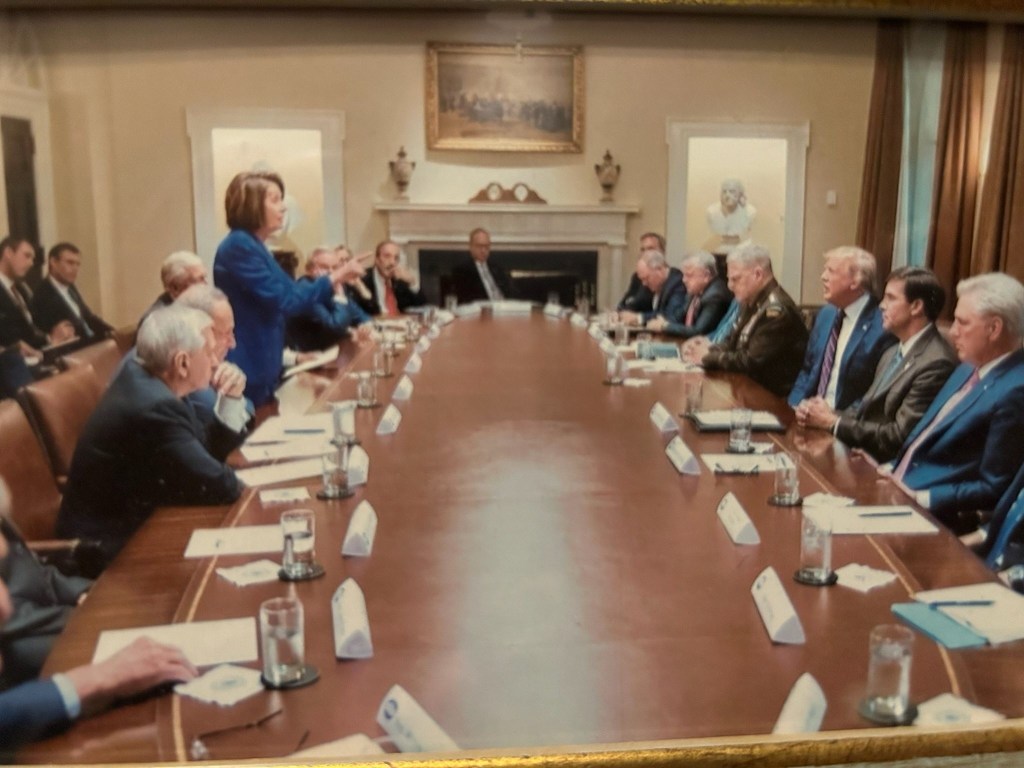
Pelosi has represented San Francisco in Congress for 37 years, currently serving as Speaker Emerita of the House and as the Representative for California’s 11th. Congressional District, but it is one picture of her during Trump’s first presidential term that occupies a place of honor in my office as the recipient of the Sheila R. Morris Calling It Like She Sees It Award.

Speaker Pelosi at a cabinet meeting during the first Trump administration
I had a vision of hope for the future when I heard Judge Jackson’s answers to the questions posed three years ago during her confirmation process, a glimmer of hope for equality and fairness for my granddaughters. I felt that same spirit of hope in the legacy Madeleine Albright left, her persistence in pursuing freedom for all nations from the position of an immigrant in this country, the world peace she strived for. Jackson. Albright. Pelosi. I salute all three of these warrior women during Women’s History Month for their shared destiny of becoming a “first” in the judicial, executive, and legislative branches of government in the United States of America – three women who broke not only glass ceilings in government but also understood that real power belongs to those willing to serve for a greater good.
Class dismissed.















 I'll Call It Like I See It
You must be logged in to post a comment.