Category: politics

  • what’s in your wallet?


    Quick, quick – let’s get the US economy rolling again. The stock market has hit big money where it hurts most – in the pocketbook. The number of people unemployed is 30 times higher than the number of people infected with the coronavirus. Let’s reopen everything right now! Hm. Let me think about that. Meanwhile, nine years ago in August, 2011 I published this post about my love affair with numbers, money and financial mayhem. It seems strangely relevant today.

    CONFESSIONS OF A FINANCIAL ADVISOR

     Forty years is a long time or a short time, depending on your perspective.  For example, if you’re talking about your work, career, job, employment, occupation, profession—it’s a long time.  If, on the other hand, you’re talking about life expectancy, it’s definitely short.  Context is everything.

    In order to spend forty years in some variation of giving advice to people about their financial futures, I had to be in love with numbers.  The love affair began at an early age when in elementary school my mind grasped the concept of “1 + 1= 2.”  Imagine the simplicity and order and, yes, the comfort of that equation.  Consider, then, the possibility of “2 – 1 = 1.”  Astounding.  Okay, maybe not astounding, but certainly intriguing to my young mind.  Addition, subtraction, multiplication, division.  Numbers could be manipulated and re-arranged in combinations that hid secrets or unlocked them.  Context was everything.

    At some point in my educational process, numbers were combined with dollar signs.  Dollar signs represent currency values, the medium of exchange for goods and services, or “must-have’s” and “can’t-resist’s.”  We become accustomed to seeing numbers with this “$” in front of them.  We learn that good news for us is a dollar sign followed by a large number, if it indicates what we have.  Bad news is a dollar sign followed by a big number, if it signifies what we don’t have.  Again, context is everything.

    Eventually, the numbers and dollar signs blur with the addition of a comma and several zeroes, which means the numbers are so big you don’t even want to discuss them.  Millions become billions that grow into trillions, and then someone wins the lottery.  Someone else loses her retirement savings.  A national election is won or lost as a result of the number of zeroes in the unemployment levels.  New words are discovered for numbers with dollar signs.  Net income before taxes, and net operating losses before moving corporate headquarters overseas.  Deficit—a nice, neat word for spending more than we have.  Surplus, a term of endearment.  Generally accepted accounting principles, a floating lifeboat in an ocean of corruption.  Stock markets that run up like bulls when greed has a green flag, or down like bears when fear chases them to their dens.  Ratios, which have something divided by something else. Price/earnings ratios.  The words melt in your mouth, not in your hands.

    Once upon a time, numbers were written by hand and manually checked for accuracy.  Checked and cross-checked to make sure that “1 + 1” still equals 2.  Long ago and far away, hamburgers with all the trimmings cost $0.25, and a gallon of gas was the same price.  Silver quarters and silver dollars were the currency of choice.  A penny saved was truly a penny earned.  And a copper one, at that.

    In the midst of those days, I consummated my love affair with numbers and became an accountant.  Not just a plain old accountant, but the ultimate—a Certified Public Accountant.  It wasn’t easy.  Professions rarely admit new members graciously, and it took three attempts for me to pass the entrance exams.  But, I knew my numbers wouldn’t disappoint me, and they didn’t.  They welcomed me into a world of debits and credits and spreadsheets that generated financial statements and the obligatory returns of the Internal Revenue Service.  It was a world I inhabited and embraced for twenty years.

    During that period, from 1968 to 1988, my faithful adding machine with the little spool of white tape that could be checked, torn off, and stapled to paperwork as a record of accuracy was my constant companion.  Regardless of the task, numbers were printed on white tape and preserved.  How could there be a shred of doubt about anything when numbers supported your position?  Need a bank loan?  Net income must be high.  Paying income taxes?  Taxable income must be low.  Which brings us to another new word—reconciliation, a word commonly used in domestic disputes but also invaluable in financial circles.  Numbers must be “reconciled” to tell different stories to different audiences.  Their historical framework must be plainly visible to the untrained eye.  Context is everything.

    And then one day towards the end of that time of long ago and far away, the numbers were swallowed by a machine called a computer.  They were devoured and simply vanished from their connection to the people and values they represented.  All control of reality was relinquished to a keyboard attached to a screen.  As I watched those screens over the next twenty years, numbers with dollar signs zoomed through cyberspace and into a Twilight Zone of futuristic projections with reckless abandon.  New Age economics clashed with Old World mathematics.  Did “1 + 1” still equal 2?  No one really cared.  Numbers were about possibilities, and the hopes and dreams of financial freedom with a few chronicled trends tossed in for good measure.

    By the year 2008, hamburgers with all the trimmings, in the world of the here-and-now, up close and personal, cost twelve quarters, and they weren’t really silver ones.  A gallon of gas cost more than the hamburger, and the price was determined by a four-letter word group called OPEC, which was run by men who lived across the Big Water and not just down the street.

    Since it’s impractical to carry enough quarters to buy hamburgers today for a family of four, we traded our coins for paper currency that is lighter in weight, which makes it easier to transport, and also encourages a whole new industry of manufacturing wallets and pocketbooks.  To ensure that Americans will purchase several of these to carry their currency, we have created “designer” brands with diverse colors, shapes, and sizes for the discriminating consumer.  Our paper dollars require protection and easy accessibility with a pronounced element of style.

    The paper money supply is monitored by various governmental agencies and the vast wasteland that is the financial media.  In the 21st century, it is now possible for all computers to talk to each other and for bank customers to swipe debit cards that look like credit cards to quickly access money from their bank accounts for purchasing goods and services without actually producing the paper.   Abracadabra.   Whoosh – the money flies out of one account and into another one as long as you remember your personal identification number which is subject to theft unless you protect your identity by paying more money to watchdog security systems.   Additionally, hundreds of thousands of advisors and analysts can experience the joys and frustrations of instant mass information, which bombards us every time we refresh our television or computer or iPad or iPhone or some other newer screens yet to be developed. Experts are available for every topic.

                Question: “What do I need to do to save for retirement?”

    Expert #1: “You are alone. You need to do it yourself.  Stay tuned to my television show, and I will teach you the secrets that have made me the gigantic success I am today.  Subscribe to my newsletter.  Buy my books.”

    Expert #2: “You are not alone, but you can do this yourself.  If you call my toll-free number, someone will personally help you in this time of financial uncertainty.  We are your friends.”

                Expert #3: “You cannot do this by yourself.  You need to work with an advisor who understands your needs and objectives.  Professional advice is the surest way to success.  We care about you.”

    You see the problem.  So many experts, so little time.  And context?  Clearly, it isn’t everything any more.  Context is defined and massaged to frame five-minute segments on twenty-four-hour, seven-days-a-week news programs.  In five minutes, answers are given to economic questions that have plagued theorists for years.  Five minutes later, different responses to the same questions create confusion for the listeners brave enough to stay tuned.  In the immortal words of Andrew Shepherd, the President in The American President, “It’s a world gone mad, Gil.”

     As for me, my forty years with numbers were good ones and passed too quickly. The people behind the numbers were always real and taught me many lessons that I would have never learned without them.  From parents planning for their children’s education, to seniors securing their estates for their families, to the gay and lesbian couples who were forced to find alternatives in planning for their futures because they had no legal status, I saw that the use of financial resources often reflected the caring character of my clients who owned them.  I am grateful to those clients and friends for their trust, which I diligently tried to earn through the values instilled in me by my dad—treat everyone equally and with respect because every person matters. And, most importantly, keep your sense of humor.

    Once in a while, when you lose that comedic edge and worry too much about the numbers and dollar signs, try to remember that it’s only paper, after all.  And, for perspective and context, avoid watching more than one financial guru at a time on whatever channel you select for your financial news.

    **************************

    Pretty trying to get our granddaughter to nap yesterday

    Yes, I know the photo is totally irrelevant to the subject matter, but Ella’s Nanas are shamelessly fascinated with her – even when she sleeps. Oh my goodness.

    Stay safe, stay sane and please stay tuned.

  • i was the world in which i walked


    In a nod to April as National Poetry Month for the United States and Canada, I celebrate with this post from March, 2015 about an unlikely American poet Wallace Stevens who saw poetry as a second language while the insurance business was his first, or maybe he should have been a prize fighter. Happy National Poetry Month to everyone who writes the poems we love to read! 

    My name is Sheila, and I’m a word-a-holic. I collect them, I store them, I love them. Occasionally I take them out of my hiding places and admire them again. Pretty does the same thing with words – but hers are published in books she takes from a shelf – books that have beautiful covers and words that are strung together in page after delicious page.

    This past week I found a prized addition to my collection – a totally random sighting while I was waiting for Pretty in the lobby of an office building. This jewel was engraved in very small letters on a large plaque as a kind of afterthought following the brief biography of an influential man of medicine.

    I was the world in which I walked. – Wallace Stevens

    I stared at the words…mulled over the words…and was knocked in the head with a bolt of fresh truth and knowledge.

    I was the world in which I walked.

    Uh oh, my little voice of reason whispered to me. You ought to be a bit more cautious in your complaints and cynicism and yes,  especially your downright negativity about “the world” being this or that because it turns out YOU are your world so that must mean the problems start with YOU.

    Well, that was so frightening I decided to find out who Wallace Stevens was to make such an audacious statement of truth. I turned to my trusted friend Wikipedia and got an eyeful. His tagline was Poet, Insurance Executive. He was an American Modernist poet born in Pennsylvania in 1879 to affluent parents. He went to Harvard and the New York School of Law but spent most of his life working for the Hartford  insurance company in Connecticut where he was a vice-president until his death in 1955.

    He started writing poetry later in life with his critically acclaimed works published after he turned 50. He won the National Book Award for Poetry twice: in 1951 and 1955. And he won a Pulitzer Prize for Poetry in 1955. Gosh, his world in which he walked must have been a bed of roses.

    Not so fast, my friend. Wally’s World was quite messy. The woman he married in 1909 had been a saleswoman, a milliner and a stenographer; his family opted to boycott the wedding because she wasn’t quite up to snuff, as we say in Texas. Wallace never spoke to his parents again during his father’s lifetime.

    From 1922 – 1940 Mr. Stevens spent a great deal of time in Key West, which became an inspiration for his poetry. That was the good news. The bad news was he didn’t play well with others and had unseemly arguments with Robert Frost whenever they were in Key West at the same time. As for his relationship with Ernest Hemingway in Key West, well apparently their disagreements turned to fisticuffs with Wallace having a broken hand and Hemingway a broken jaw in one of their notorious spats.

    So Wallace Stevens was, like most of us, a man who had been at least two worlds in which he walked… so I felt better about my negativity that, to date, has not caused me to come to physical blows with anyone but perhaps needs to be toned down a notch or two  with a more regular nod to the positives in which I walk.

    You are the world in which you walk. Chew on that for an extra minute.

    P.S. One of the more memorable quotes Pretty said to me when we first met was, “I think insurance companies are the scum of the earth.” At the time, I was an insurance agent.

    *************************

    Today perhaps more than ever we really are the world in which we walk – and how carefully we walk in that world affects more than ourselves. When we venture out,  we must try to remember the Covid-19 pandemic is not gone simply because we are tired of staying in. Be sensible in your choices, be sensitive to the needs of others.

    Stay safe, stay sane and stay tuned.

    Happy Legal Anniversary, Pretty 

    April 24, 2016


  • something old, something new – something special


    I realized today I first published this post about my Aunt Lucy and her friend Jan on March 08, 2013 less than two weeks before my aunt’s death on March 21st. When so much has changed as a result of Covid-19 and its invasion into our world along with all who inhabit it, I felt the need to revisit this story of a relationship that lasted until the storms of life raged no more against it.

    “I no doubt deserved my enemies, but I doubt I deserved my friends.”
    —— Walt Whitman

    Yesterday I visited with my favorite Aunt Lucille who lives in Beaumont which is ninety-nine miles east of Montgomery on Texas Highway 105. I always enjoy my visits with her. She’s got spunk, and contrary to Mr. Grant’s opinion of spunk on the Mary Tyler Moore show a gazillion years ago, I like spunk.

    Lucy refuses to give up her independent living apartment in a retirement community that offers assisted living and other higher levels of care for which she would qualify. Instead, she keeps her mind active with crossword puzzles and other word games in the daily newspaper. Her knowledge of current events acquired through the TV and conversations is as good as it gets. She pushes herself out of bed, showers, dresses and puts on makeup every day.

    My aunt Lucy will be ninety-three years old in May and has a list of ailments plus a personal pharmacy to treat them. A recent setback makes movement even more difficult for her, but she makes a determined effort to rejoin her friends at their reserved dinner table downstairs almost every evening. It’s a long walk from her apartment on the third floor to the lobby of the next building for meals. Trust me.

    Yesterday she told me one of her friends was coming by this afternoon for a visit. I recognized the name because she had talked about Jan for as long as I could remember. She told me Jan was recovering from a stroke and her caregiver would be bringing her by. When Jan arrived promptly at two o’clock, Lucy got up from the sofa in the living room and pushed her walker toward Jan’s. When they met in the middle of the room, they both smiled and hugged each other with genuine joy on their faces. After introductions all round, we sat down to talk.

    Lucy and Jan met in 1953 when they both lived with their husbands in an apartment complex in Beaumont. They first talked when they were outdoors hanging clothes on the clothesline behind their apartment building. Both women were new to Beaumont – Jan’s daughter was born in the spring before Lucy’s was born in October that year. They were new mothers who quickly became new friends. Their husbands luckily liked each other, too which meant the couples got together often. Lucy’s husband Jay died in 1979 while Jan and her husband Otis shared a sixty-fifth wedding anniversary before his recent death.

    What struck me as I listened to them talk about their families, about what was going on in their lives now was how remarkable it must be to have a friendship that stretches across sixty years of change and challenges. Their bond survived everything life threw at them. Hot and cold seasons came and went for six decades, but their loyalty to each other never got too hot to go up in flames or too cold to freeze and wither away.

    In a separate happening this week I was reminded of friendships I’ve lost in the past years along with the pain that accompanies losing them. We are a mobile society; our moving parts rarely stay in the same place for very long. We change our homes, our jobs and the people in our lives that go with them. Sometimes we just change the people in our lives. For Lucy and Jan, however, the new became old over sixty years – but always remained special. Their story of friendship is a remarkable one I continue to salute today.

    *************************

    Stay safe, stay sane and stay tuned.

  • my recipe for a Happy Birthday!


    They say you’re only 74 once so make the most of it.

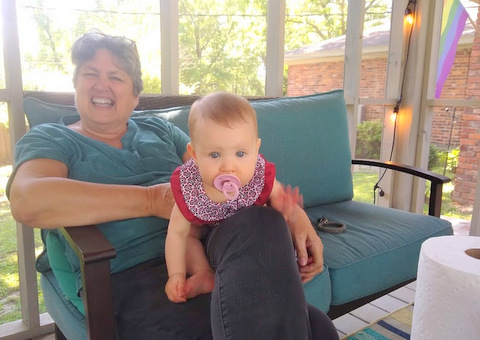
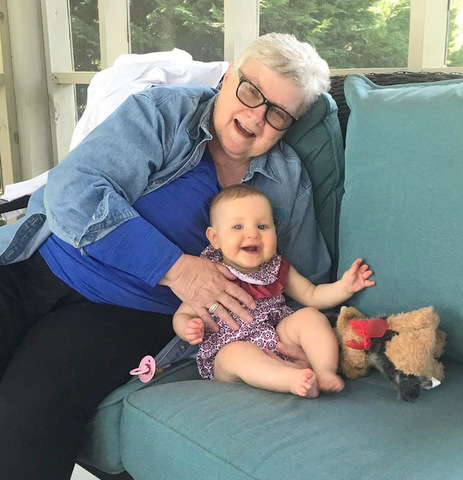
    Pretty brought our granddaughter to visit for my birthday today!

    Ella loves her Nanas

     Baby Ella brought her mother Pretty Too (holding cake)

    and her aunt twin sister Pretty Also (holding Ella)

    Pretty Too and Pretty Also made the most beautiful birthday cake EVER

    (per my request angel food cake with pink icing – wow!)

    Have a piece!

    NanaSlo living the good life today

    JOY!

    My good friend Dick Hubbard also surprised me by leaving  his delicious fudge at my back door this morning but shhh…Curtis didn’t want him driving over to our house to deliver it…virtual hugs and love to Dick who never forgets to bring fudge over for special occasions. He’s the Best!

    Many thanks to Caroline and Chloe for the fabulous cake and to Pretty for our family – it’s the light that pierces every darkness. I’m sending hope for better days to all of my friends in cyberspace this day – plus a virtual piece of cake and candy.

    Stay safe, stay sane and stay tuned.


  • the anchor holds


    “The anchor holds, though the ship is battered. The anchor holds, though the sails are torn. I have fallen on my knees as I faced the raging seas. The anchor holds in spite of the storm.”

    Lawrence Chewning wrote The Anchor Holds in 1992 during a period of deep depression in his life, but another musical friend Ray Boltz shortened the lyrics and gave the song a lyrical bridge in 1993. The piece, published in 1994 on a Ray Boltz album, was a signature song that was #1 on the national Inspiration charts for three weeks in 1995.

    Chewning was born in 1949 and grew up in Lee County, South Carolina on a cotton farm according to his bio. He became a songwriter, singer, speaker and was the pastor of a non-denominational church in Clinton, Massachusetts for sixteen years. Chewning accepted a position as a social worker for the State of South Carolina in 1994 –  working in foster care, child protective services,  as an adoption specialist – until his retirement from the state in 2018. He and his wife live in Florence, South Carolina where he continues to travel with his songs and preaching. (Florence is coincidentally 85 miles northeast of Columbia where Pretty and I live.)

    The Anchor Holds was unknown to me until recently when one of my Richards, Texas childhood friends, Tinabeth, sent me a link to the song covered by Shara McKee on what else but YouTube. The lyrics and melody have haunted me every day for weeks. That happens to me sometimes with songs Alexa plays for me in my private concerts when Pretty is out of the house on a mission.

    “I’ve had visions, I’ve had dreams. I’ve even held them in my hand. But I never knew they would slip right through like they were only grains of sand…I have been young but I’m older now, and there has been beauty these eyes have seen. But it was in the night through the storms of my life, that’s where God proved His love for me.”

    Like the song says I’ve had my share of visions and dreams slip through my hands to never be held again. Occasionally I can dimly remember young but I’m definitely older now – actually turning seventy-four tomorrow.  I have also seen so much beauty in my travels with Pretty who always prefers an adventurous trip to find beauties wherever they are. Sometimes they are closer to us, though, even close enough to touch.

    But it has been in the night through the storms of my life that I have found an anchor, an ability to stay the course regardless of the cost or loss. For Lawrence Chewning and for my friend Tinabeth, their faith in God is their anchor. I suspect my faith is not the same as the songwriter’s, but I do believe in anchors for our lives. I am confident the covid-19 pandemic has caused each of us to search for our own anchors to survive the fears created by the uncertainties, the upheavals in our lives.

    Maybe The Anchor Holds resonates with me because I am on the threshold of another birthday – maybe it’s coronavirus driven. Regardless of its pull on me, I believe it’s my song of hope for everyone across the oceans or across the street. My hope is for you to find your own anchor and let it hold you during these difficult days.

    “The anchor holds, though the ship is battered. The anchor holds, though the sails are torn. I have fallen on my knees as I faced the raging seas. The anchor holds in spite of the storm.”

    Our grandaughter Ella today while Pretty babysat

    (for sure one of the anchors of hope for Pretty and me)

    Stay safe, stay sane and stay tuned.