Las Vegas Aces star A’ja Wilson had a history-making career-high game Tuesday night in Atlanta, Georgia during one of the best player outings ever in the 27-year history of the Women’s National Basketball Association. Her 53 points matched the WNBA single-game scoring record set in 2018 and was only the third time in league history that a player had a 50+ point game. Wilson also had seven rebounds and four blocks during the game which saw the Aces bounce back from a loss to the Los Angeles Sparks on the previous Saturday to defeat the Dream 112 – 100. The only thing hotter than A’ja Wilson was the temperature which was also breaking records across the southern part of the country.
As the crow flies west the distance from our home in West Columbia, South Carolina to Atlanta, Georgia is approximately 200 miles. Traveling by grannymobile on Interstate 20 West the exact mile count is 214 and travel time is a little over three hours, while making that same trip with Pretty who prefers to avoid the interstates in favor of back roads like she did this past Tuesday the 22nd., the trip stretched closer to 300 miles and five hours in the grannymobile because she stopped along the way to search in remote antique malls for treasures to bring back with her to sell in her own empire. I don’t know how long that crow would take from our house to Atlanta, but I’m sure there would be fewer stops.
Pretty and our good friend Susan took their own sweet time on their drive Tuesday – they left at 9 a.m. with their only deadline destination the Gateway Center Arena @ College Park for a 7:00 p.m. WNBA tip between the Atlanta Dream and the Las Vegas Aces. Susan, one of our favorite Gamecock basketball buddies, was celebrating her birthday that day and invited Pretty to go to the game with her at the last minute when her husband Chris had to work. Whenever A’ja Wilson was anywhere in the neighborhood of her former alma mater, a huge University of South Carolina Gamecock nation travelled to see her play. Not even her most avid supporters, though, could have imagined her performance they would witness that night at the Gateway Center Arena.
Pretty was on Cloud 9 when she got home in the wee hours of Wednesday morning – I had kept up with the game on TV so I celebrated with her the next day. We talked about the joy Coach Dawn Staley must have felt not only when A’ja had the monster night but also to see three other Gamecock players (Laeticia Amihere and Allisha Gray for the Dream, Alaina Coates rejoining Wilson and the Aces) on the WNBA rosters. It was a great night to be a Gamecock.
Oh, yes. I almost forgot the other huge event. Two nights later the Trump airplane landed in Atlanta to drop off the former president so that he could drive to Fulton County to surrender for arrest for his alleged participation in RICO violations involving the Big Lie. As my favorite writer Eudora Welty said once upon a time, to know the truth I also had to recognize a lie.
Go Gamecock Women’s Basketball! Go Fulton County DA Fani Willis!
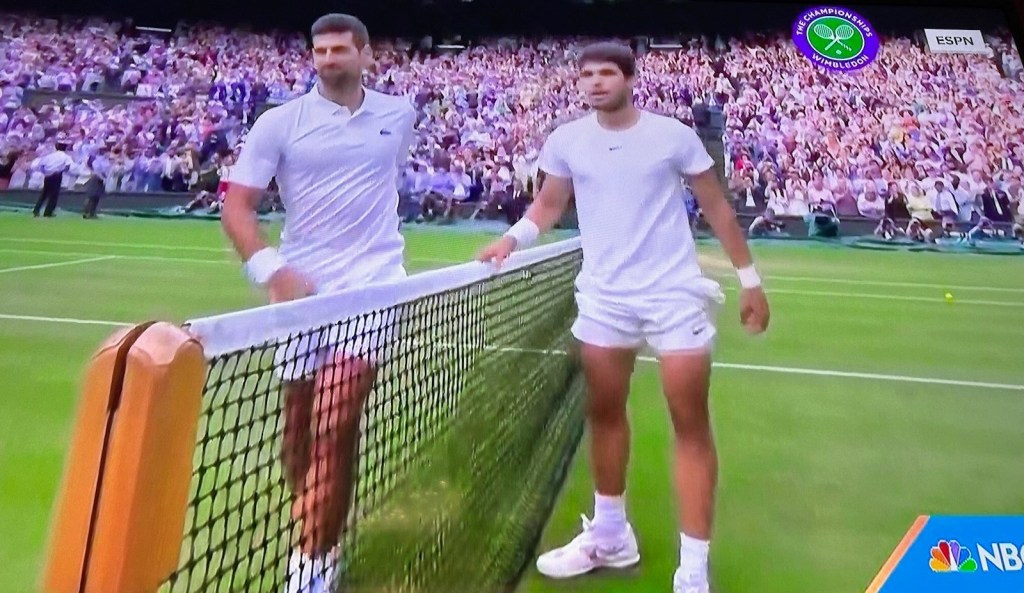
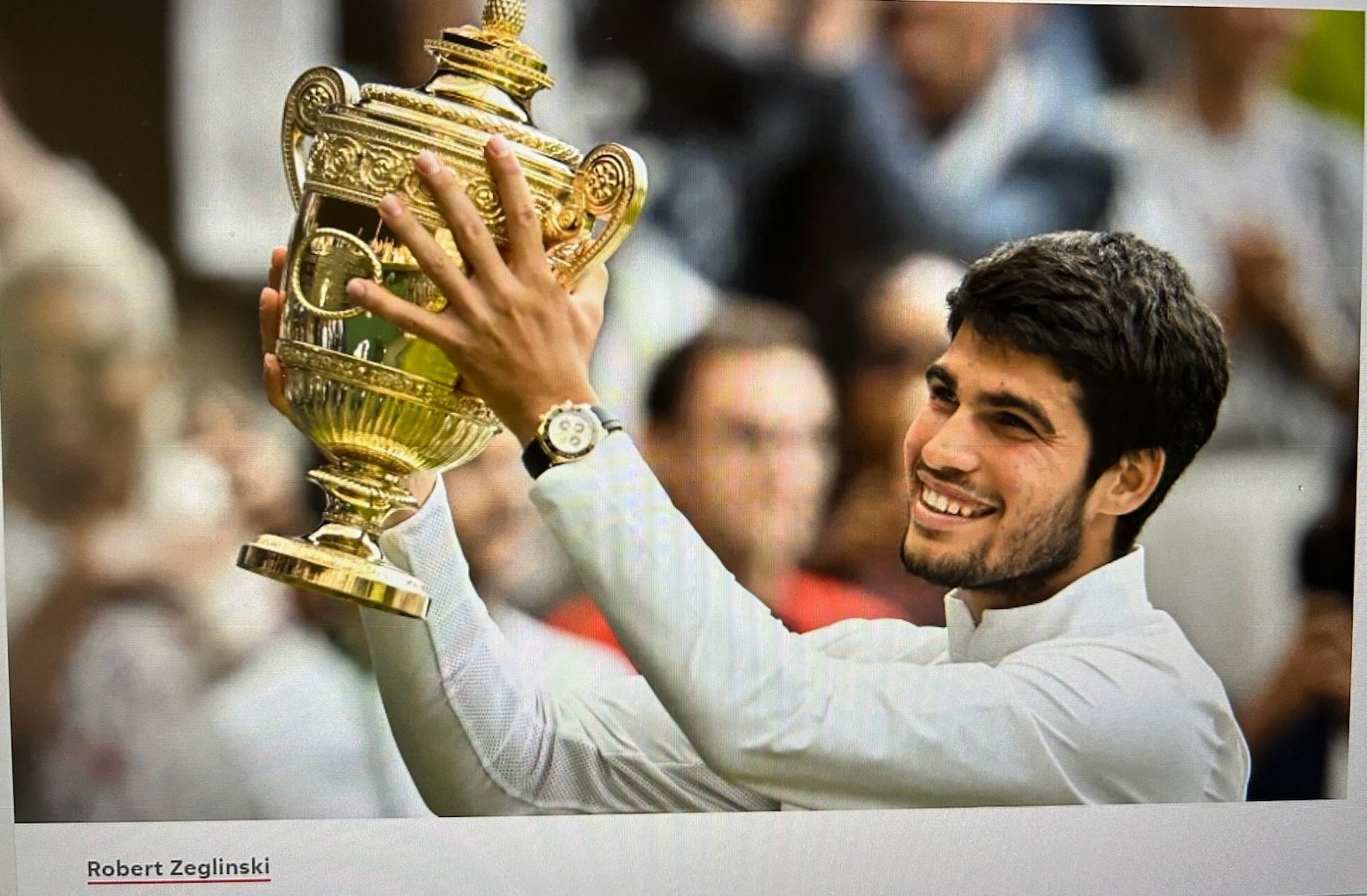
Fun tennis fact: The Championship at Wimbledon in 2023 for men’s singles was the first time in 25 years neither Roger Federer nor Rafa Nadal was included in the draw. Federer officially retired during the Laver Cup in September, 2022 at the age of forty-one; Nadal hasn’t played since January of 2023 but hopes to return to competition in 2024 for a farewell tour. He is thirty-seven years old with amazing resilience so fingers crossed he plays again.Regardless, as Wimbledon winds down this weekend I miss them both and resurrected this piece from July, 2018.
For tennis fans, when July rolls around, the sounds of tennis balls flying off rackets held by seasoned warriors or hopeful newcomers, tennis balls traveling through the air at record speeds or strategic spins, landing on immaculately prepared grass courts with awkward bounces that require extraordinary hand-eye coordination to even be struck by another racket held by an adversary across a 3-ft net – for that first fortnight in July and for those fans, the air is filled with the electric sights and sounds of Wimbledon, The Championships at the All England Club, the 3rd of 4 annual Major tennis tournaments but arguably the most revered for its traditions and longevity.
The first week of the two-week tournament at Wimbledon for 2018 is a wrap, as we say in the entertainment industry. I have had my usual bleacher seats in front of a tv this week – the same seats I’ve had for the past 51 years since the color telecasts started. My television sets have changed through the years, but my love of the game has remained steadfast. And cheerio, the addition of the Tennis Channel with its 24-7 coverage of the sport year round has been an awesome addition for Pretty and me.
Pretty once told me many years ago when we were in the middle of a dispute about how much time she devoted to playing tennis (which took her away from me) that “I had tennis before you. I’ll have tennis after you.” That put everything in perspective, let me tell you. As it turns out, she now has tennis with me in the bleacher seats but still longs to be able to return to the courts one day.
Today is Sunday in the middle of The Championships at Wimbledon so the players who survived the first week are resting to prepare for Manic Monday tomorrow when both the women’s and men’s singles round of 16 will be played. The winners of these matches will move on to the quarterfinals, and two of them will win the finals at the end of this week.
The women’s draw has been full of shocking upsets in week one with only one of the top seeds, Karolina Pliskova, remaining. And then, of course, all eyes including mine will be on Serena Williams who won the most important title of all last year when she and her husband served up their daughter Olympia who is the cutest baby ever. Serena has moved on to the second week, and I will be following her progress as I have followed her for the past 20 years. That’s right…t-w-e-n-t-y years. Serena at the age of 35 won her 23rd. major title which set the record for most women’s singles titles in the Open era when she won the Australian Open in 2017.
As for the men in the second week, what can I say? Names that now define a Golden Age of tennis are chasing the Wimbledon title again. Roger Federer who at 37 apparently embodies the ageless body of Dorian Gray had he been a tennis player. The passionate Spaniard Rafael Nadal whose Vamos! inspires the enthusiasm of crowds like touchdowns in a Super Bowl. Winners of the past 6 tennis majors, Federer holds 8 Wimbledon singles titles and Nadal two. Novak Djokovic, another tennis titan, is trying to reclaim his place among the greats but battling the most difficult opponent of all in recent years: himself. Two Americans, veteran big server John Isner, and unseeded unknown Mackenzie McDonald also will play on the big stage on Manic Monday.
And so sports fans, as The Red Man used to call his friends in cyberspace, Pretty and I will be on pins and needles starting at 7 am tomorrow as we cheer for our favorites from the bleacher seats at Casita de Cardinal. Time and tennis march on.
Soldier Field was like a religious experience for lifelong football fans. I grew up with Da Bears on television for the past fifty years. Teresa and I both knew most of the names on the murals that chronicled their fabled history. Red Grange. Papa Bear Halas. Dick Butkus. Walter Payton. William “Refrigerator” Perry. Jim McMahon. The wild and crazy players and coaches that were household names in our lives. It was like a trip to Mecca for a Muslim. It was holy ground for both of us.
Our seats were in an end zone and very good. Hundreds of Bears fans around us with a few scattered Panther blues in the midst. It was a very different culture from our games at home. One of our first impressions was the maleness of the game. There were very few women in the entire stadium. Testosterone was the hormone of the hour, and it raged with a vengeance. The row of men behind us defined Da Bears as I always thought of them. Big blue-collar guys in their mid-thirties who loved their beer and their Bears.
I learned some things I didn’t know, though. These men loved to sing. There was a fight song created in 1941, and the entire stadium was singing it on cue sixty-five years later. “Bear Down, Chicago Bears,” they sang lustily whenever the Bears made a good play or when the defense was asked to step up to stop us. That was a tall order this day. On the second play from scrimmage our quarterback, Jake Delhomme, hit our pro bowl receiver, Steve Smith, for a long touchdown pass to our end zone, and the tone was set. Teresa and I hugged each other, laughed, and were so excited. We couldn’t believe it, and neither could Da Bears. The rest of the game was close and could have gone either way, but we were never behind from that play in the first minute of the game. Unbelievable. Our relatively young professional football franchise held its own amid the echoes of the legends as the wind swirled around us.
I begged Teresa for the blanket I hadn’t wanted to bring as soon as we sat down. And, although she tried to get me to wait until I was cold beyond belief, she did relent and put it around us. She also brought out all the scarves and wrapped them around our heads so that we looked like blue blobs sitting on black coats. We spent much of the game jumping up and cheering but then quickly trying to bundle back up when our blanket slid off. We froze.
The men sitting next to us in our end zone said this was much too warm for football. They had wished for snow and sleet for the game so that our players wouldn’t be able to maneuver as well. The skies remained clear and sunny. The beer flowed freely, and the lines to the men’s restroom grew longer. The language grew saltier.
Sometime in the third quarter one of Da Bears sitting behind us discovered an older fan seated several rows down from us. The man had a rainbow colored scarf and Da Bear said, “Hey, there’s a f—ing fag down there. Look at that rainbow scarf. Yeah, he’s queer and he’s proud, too.” All his buddies began discussing the fag in the scarf and then progressed to speculation about the number of fags on the Panthers team. Steve Smith was the most likely, they decided. I found it interesting the suspected football fag would likely be the Most Valuable Player for our win. Teresa and I looked at the man in the scarf and whispered he was most assuredly not gay; he had simply made an unfortunate coincidental choice in color for his scarf at the game. We should know.
Da Bears behind us got drunker and rowdier and much louder as we entered the fourth quarter. At one point when they were out at the concession stands we talked about how offensive their language would be in other settings, but somehow we rolled along and didn’t get angry. Maybe we were overwhelmed by the panoramic spectacle of Soldier Field. Maybe we forgave them because we were gracious winners. Maybe we were too cold to care.
Toward the end of the fourth quarter the most vocal and possibly most inebriated Bear leaned down between me and Teresa and said to me, “You’re hot…I’d like to meet you in a hotel after the game for some fun. How about that?” I said thanks, but that wouldn’t be likely to happen. He took it very well. Then, a few minutes later he leaned down between us again and said to Teresa, “You’re hot, too. How about a little kiss?” Teresa said ok and pointed to her cheek, but he was distracted by another guy and she was spared his affection.
A little while later he leaned over again and said, “Hey, are you girls sisters?” Undoubtedly, there was a family resemblance due to the blue blobs on the black coats. “No, not sisters,” Teresa said. Silence as his inebriated thought process absorbed this. “Are you good friends?” He continued to try to figure out an increasingly puzzling situation. “Yes,” Teresa replied. “We are very good friends.”
He let this sink in, stood up, and said in a thundering loud voice, “Very good friends…hey, you’re not lesbians, are you?” Teresa looked at me. Our eyes met, and we smiled at each other.“Yes,” Teresa said in the middle of Da Bears end zone in Soldier Field. “We are lesbians.” Da Bear announced this to all his friends and everyone else within earshot of his voice. “They’re lesbians – we’ve got lesbians sitting in front of us!” The shock was too much for him. It measured somewhere between disbelief and horror. He sank slowly into his seat. What happened next was astonishing. As his buddies began to get into the spirit of the “outing” and started to make loud derogatory comments, Da Bear would have none of it.
“Hey, shut up,” he said to his friends. “That is not cool.” And with that, we never heard anything else from any of Da Bears for the rest of the game. Final score: Carolina 29 – Chicago 21. The underdogs won. Teresa told me later had she known we could quiet the end zone by telling them we were lesbians, she would have done it in the first quarter. I love that girl. She has set me free.
To be sure, I have had many “outings” in my sixty years as a lesbian, but none more memorable or more public than the one in that end zone at Soldier Field. An old Texas dyke with her South Carolina girlfriend on an unforgettable adventure surrounded by football history. It doesn’t get any better than this. It was bright and sunny the next day as our airplane left the runway in Chicago; Teresa and I both knew the Panthers hadn’t been the only winners that weekend.
***********************
Thanks for making the trip to Soldier Field with us in January, 2006 – looking at Chicago in the winter makes me feel a little bit cooler in the heat of the summer in South Carolina. The “Outing” was a memory maker. Stay cool, stay safe and please stay tuned.
On Sunday, Game Day, we were caught up in our shared football passion. What would we wear to sit in the cold at Soldier Field? Most of our fan apparel was for warm southern weather so we had to wear layers of our blue and black Panther colors that we brought. Scarves and gloves and stocking caps, too.
what we would have worn in South Carolina
“Let’s don’t bother with the blanket,” I said. “It’s too much trouble to carry it through the Art Institute.” Did I mention we were taking a detour to spend a couple of hours at the Art Institute on our way to the football game at Soldier Field? “I think we might need the blanket,” Teresa said. “You know I’ll be glad to carry it.” I reluctantly added it to our bag of extra scarves, head gear and binoculars. And off we went. The day was breathtakingly beautiful with bright sunlight, but the wind whipped its way into our bodies as it blew across Lake Michigan and onto the streets of Chicago as we walked.
The Art Institute was crowded with the people who were not on their way to the Bears game. We covered as much as we could and were thrilled with the works of some of the same European artists we loved in Florence, Italy, last year. The mixture of artists and mediums was a visual assault. The personal discovery of a painting by Antonio Mancini called “Lady Resting”captured our attention. It was the only one by him, and we couldn’t believe how much this eighteenth century woman looked like Teresa with her dark skin and even darker eyes and hair. I remembered when my Uncle Ray met her the first time he visited in our home from Texas and asked if she were Eye-talian. How little we know of ourselves in this life. Maybe she was?
We left art behind and joined the processional of Bears fans walking to the playoff game. Da Bears were out in full force – we were quite conspicuous in our Panther blues. We walked and walked and walked some more through Millenium Plaza and Park down to the Field Museum across from the new Soldier Field. I had to stop for a breather to sit for a few minutes before the final push to the game. And Da Bears just kept coming.
We made our way to the entrance where we handed our tickets to the gatekeepers. Teresa went through just fine. “Your bar code’s invalid,” the ticket guy said to me when he scanned my ticket. My heart stopped. I couldn’t speak. I had ordered the tickets from an online ticket vendor called TicketDaddy, and I was nervous about their appearance when I got them in the FedEx package before we left. The man kept trying to scan my ticket without success and finally called his supervisor to take a look. He must have sensed that the senior citizen with the ticket was about to go into cardiac arrest if she didn’t get past him. The supervisor tapped my code into a hand-held computer that accepted it and told me to go in. I could breathe again.
Teresa had been waiting for me while this minor melodrama had taken place but hadn’t heard what was going on. She said it was better she hadn’t. We were handed souvenir Bears rally towels as we went in. I almost didn’t take one. Then the fellow passing them out said, “Hey, it’s the Playoffs. You’ll need yours for crying when you lose anyway.” I took one.
**********************
Congratulations – you’ve made it through to the second round of the story! One more to go…please stay tuned.








 I'll Call It Like I See It
You must be logged in to post a comment.