
A politician/philanthropist from Faith, North Carolina who settled in Charleston; an attorney who moved to Columbia from Key West, Florida; a midlands YWCA executive director from Detroit, Michigan — three women whose different, yet similar, stories were chronicled in Southern Perspectives on the Queer Movement: Committed to Home. I celebrate these women today during Women’s History Month because they all overcame a youthful sense of isolation and fear of discovery to become leaders of the LGBTQ movement in South Carolina. Regardless of their diverse backgrounds that brought them to our state or the different motivations that inspired them, these women stood on the battleground of equality and refused to surrender.
Linda Ketner was the first openly gay candidate for federal office in South Carolina. As the 2008 Democratic nominee for the US Congress, District 1, she won more than 48% of the vote, narrowly losing to a four-term incumbent in a district held by Republicans since 1980. Linda’s fearless leadership in forming organizations such as the Alliance for Full Acceptance and South Carolina Equality plus her generous financial support of individuals and other organizations within the LGBTQ community have cemented her place in our history.
In Southern Perspectives Linda wrote about her own spiritual journey: “It was at this time [having found a religious community in an all-black church] that it became essential to both my mental health and my soul to ‘take all of me with me everywhere I went’ – to come all the way out to everyone I knew. The decision to do that for me was like jumping off a cliff where you didn’t know if the ground was eight inches below or eight thousand feet. It was an act of faith. What I hadn’t expected was that rather than falling, I soared. My heart soared with a freedom, integrity, and peace I had never known. I was living my life with integrity and congruence. I was living authentically. Secrets kill. Secrets produce a life of shame and a shameful life. And I have never known an LGBTQ person who regretted coming out, no matter what the consequences.”

Linda Ketner at a Pride Parade in 2013
Nekki Shutt was born in Honolulu, Hawaii into a military family that traveled in eight states before she graduated from Key West High School in Florida. She moved to South Carolina in 1986 to finish her undergraduate degree at the University of South Carolina where she also finished law school in 1995. Nekki served on the national board of the Gay and Lesbian Victory Fund and co-chaired the board from 1998 – 2000. She helped to found South Carolina Equality, served as its first board chair and was involved in leadership roles in a number of other community organizations. She was, and continues to be, a warrior woman.
Nekki was one of the lead attorneys in the Condon v. Haley case that resulted in South Carolina’s becoming the thirty-fifth state to recognize marriage equality in November of 2014. She wrote in Southern Perspectives: “That case was the highlight of my legal career, because it brought my passions for both practicing law and civil rights together in one place at one time…This was not an accident, and it is not a result of Will and Grace or Ellen. It is the result of people coming out to their friends and families and neighbors and coworkers because they felt it was a safe environment. The people and organizations of the LGBTQ community have created that environment by their actions during the past thirty years. I am proud of our state and proud to have been a part of this movement. To whom great things are given, great responsibility comes. I had incredible role models in my family as a child and in the larger world as an adult. What I do as an activist is my way to give back and follow in very big footsteps. We have more battles ahead in the war for equal rights, but I predict we will win…”

Nekki Shutt (l.) at 2015 Pride Parade with her law partner Malissa Burnette
Carole Stoneking (1937 – 2016) was born and raised in Michigan with an undergraduate degree from Wayne State University in Detroit. She worked for twenty-seven years for the YWCA and came to Columbia as its executive director. Following her career in the YWCA, Carole took a new path as the owner of the Stress Management Institute of Therapeutic Massage in Columbia for the next twenty-three years before her retirement. Carole was a social justice activist throughout her life; she was president of the Columbia chapter of the National Organization for Women, board member of the South Carolina Gay and Lesbian Business Guild, a past delegate for South Carolina Equality, a board member for the South Carolina Council on Aging, a board member for Old Lesbians Organizing for Change, and a member of that organization’s national steering committee.
In Southern Perspectives Carole says: “I came out of the closet in 1956. That was thirteen years before Stonewall. I came out in a tumultuous time when it was taboo…there were no organizations helping gays or lesbians. No agencies were trying to help people from feeling shame. Only the bartenders were there to help people keep from starving or to provide space for people to sleep for the night. There were no colleges or universities offering places for lesbians to study about the effects of shame or suicide. I faced a great deal of hardship and criticism from everyone, including my own mother who told me ‘I would rather have seen you be a prostitute.’ At that moment I felt all the shame of a lifetime…However, I am glad that I did not hold it in; being out and fighting for an equal right is a virtuous thing.”

Carole Stoneking and OLOC banner in Pride Parade in Columbia
I met Carole shortly after she moved to South Carolina and watched her grow older but continue to show up for meetings and parades for the next thirty years. I always admired her for that. She never quit believing that the fight for an equal right was a virtuous thing. In July, 2008 (at age 71) she gave a speech at a regional Older Lesbians Organizing for Change meeting. That speech has much more meaning for me now – luckily the talking points are preserved in Southern Perspectives. This is talking point #8:
“Is this ageism I am feeling? Is this the time in my life when I need to be focusing on the reason I am here on earth? Or maybe a new reason I am here? B.B. Copper says’Unless old lesbians are remembered as sexual, attractive, useful, integral parts of the women-loving world, then current lesbian identity is a temporary mirage, not a new social statement of female empowerment.’”

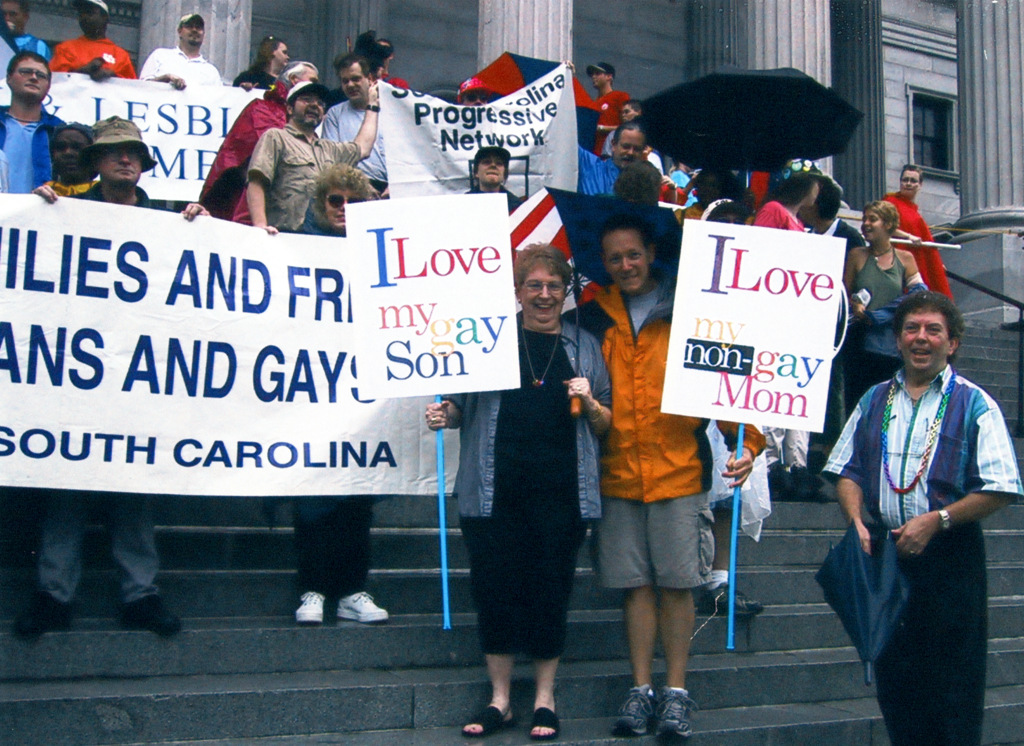
Pride – 2015 – our history belongs to you now
Candace Chellew-Hodge, Harriet Hancock, Deborah Hawkins, Linda Ketner, Nekki Shutt, Carole Stoneking — these are a few of my wonder women, southern style who began a fight for themselves and for those who will come after them and sought to honor those who came before them. The fight took place in a conservative, sometimes hostile, environment but these women persevered in their own battlefields to win some of the fights, lose others, but know that the fight was a virtuous thing. We do, indeed, have more battles ahead, but I also predict we will win. Onward.
Happy Women’s History Month!
Stay tuned.


 I'll Call It Like I See It
You must be logged in to post a comment.