Tag: Harriet Hancock

  • Southern Perspectives on the Queer Movement: Committed to Home (Happy Pride!)


    In June, 2017 I shared my excitement about the upcoming publication of Southern Perspectives – the cover was all I had back then – but I could see the finish line of a very long journey. Two years later I am still excited about this collection of intimate personal stories that reminds all of us to never give up on our potential to change the world for good.  Onward.

    Coming this December – a Must Read!

    Read the intimate personal essays of 21 native or adopted South Carolinians who contributed significantly to the organizing of the queer community in our state from the AIDS crisis in 1984 to marriage equality in 2014.

    http://www.sc.edu/uscpress/books/2017/7813.html.

    Jim Blanton, Candace Chellew-Hodge, Matt Chisling, Michael Haigler, Harriet Hancock, Deborah Hawkins, Dick Hubbard, Linda Ketner, Ed Madden and Bert Easter, Alvin McEwen, Sheila Morris, Pat Patterson, Jim and Warren Redman-Gress, Nekki Shutt, Tony Snell, Carole Stoneking (deceased), Tom Summers, Matt Tischler and Teresa Williams answer the questions surrounding the reasons for their activism in a conservative state in the South during a tumultuous time in American politics when many people assumed the only activists in the queer community lived in San Francisco or New York City. These folks chose to remain committed to home instead of fleeing South Carolina. Why?

    Although the book isn’t scheduled for release by the USC Press until December, I couldn’t let the Pride month of June (or the Obergefell Supreme Court decision two-year anniversary this week) go by without sharing my excitement over this book which has been in the making for the past 4 years. Harriet Hancock was my original creative impulse for undertaking the project and has been with me every step of the way toward the ultimate goal of collecting and sharing these stories.

    I am grateful to all contributors for their unwavering willingness to participate, to Harlan Greene for a wonderful foreword and to the USC Press for their commitment to “home” authors.

    Happy Pride!

    Stay tuned.

    Please contact me at smortex@aol.com if you are interested in obtaining a signed copy of Southern Perspectives.


  • wonder women – southern style (part II)


    A politician/philanthropist from Faith, North Carolina who settled in Charleston; an attorney who moved to Columbia from Key West, Florida; a midlands YWCA executive director from Detroit, Michigan — three women whose different, yet similar, stories were chronicled in Southern Perspectives on the Queer Movement: Committed to Home. I celebrate these women today during Women’s History Month because they all  overcame a youthful sense of isolation and fear of discovery to become leaders of the LGBTQ movement in South Carolina. Regardless of their diverse backgrounds that brought them to our state or the different motivations that inspired them, these women stood on the battleground of equality and refused to surrender.

    Linda Ketner was the first openly gay candidate for federal office in South Carolina. As the 2008 Democratic nominee for the US Congress, District 1, she won more than 48% of the vote, narrowly losing to a four-term incumbent in a district held by Republicans since 1980.  Linda’s fearless leadership in forming organizations such as the Alliance for Full Acceptance and South Carolina Equality plus her generous financial support of individuals and other organizations within the LGBTQ community have cemented her place in our history.

    In Southern Perspectives Linda wrote about her own spiritual journey: “It was at this time [having found a religious community in an all-black church] that it became essential to both my mental health and my soul to ‘take all of me with me everywhere I went’ – to come all the way out to everyone I knew. The decision to do that for me was like jumping off a cliff where you didn’t know if the ground was eight inches below or eight thousand feet. It was an act of faith. What I hadn’t expected was that rather than falling, I soared. My heart soared with a freedom, integrity, and peace I had never known. I was living my life with integrity and congruence. I was living authentically. Secrets kill. Secrets produce a life of shame and a shameful life. And I have never known an LGBTQ person who regretted coming out, no matter what the consequences.”

    Linda Ketner at a Pride Parade in 2013

    Nekki Shutt was born in Honolulu, Hawaii into a military family that traveled in eight states before she graduated from Key West High School in Florida. She moved to South Carolina in 1986 to finish her undergraduate degree at the University of South Carolina where she also finished law school in 1995. Nekki served on the national board of the Gay and Lesbian Victory Fund and co-chaired the board from 1998 – 2000. She helped to found South Carolina Equality, served as its first board chair and was involved in leadership roles in a number of other community organizations. She was, and continues to be, a warrior woman.

    Nekki was one of the lead attorneys in the Condon v. Haley case that resulted in South Carolina’s becoming the thirty-fifth state to recognize marriage equality in November of 2014. She wrote in Southern Perspectives: “That case was the highlight of my legal career, because it brought my passions for both practicing law and civil rights together in one place at one time…This was not an accident, and it is not a result of Will and Grace or Ellen. It is the result of people coming out to their friends and families and neighbors and coworkers because they felt it was a safe environment. The people and organizations of the LGBTQ community have created that environment by their actions during the past thirty years. I am proud of our state and proud to have been a part of this movement. To whom great things are given, great responsibility comes. I had incredible role models in my family as a child and in the larger world as an adult. What I do as an activist is my way to give back and follow in very big footsteps. We have more battles ahead in the war for equal rights, but I predict we will win…”

    Nekki Shutt (l.) at 2015 Pride Parade with her law partner Malissa Burnette

    Carole Stoneking (1937 – 2016) was born and raised in Michigan with an undergraduate degree from Wayne State University in Detroit. She worked for twenty-seven years for the YWCA and came to Columbia as its executive director. Following her career in the YWCA, Carole took a new path as the owner of the Stress Management Institute of Therapeutic Massage in Columbia for the next twenty-three years before her retirement. Carole was a social justice activist throughout her life; she was president of the Columbia chapter of the National Organization for Women, board member of the South Carolina Gay and Lesbian Business Guild, a past delegate for South Carolina Equality, a board member for the South Carolina Council on Aging, a board member for Old Lesbians Organizing for Change, and a member of that organization’s national steering committee.

    In Southern Perspectives Carole says: “I came out of the closet in 1956. That was thirteen years before StonewallI came out in a tumultuous time when it was taboo…there were no organizations helping gays or lesbians. No agencies were trying to help people from feeling shame. Only the bartenders were there to help people keep from starving or to provide space for people to sleep for the night. There were no colleges or universities offering places for lesbians to study about the effects of shame or suicide. I faced a great deal of hardship and criticism from everyone, including my own mother who told me ‘I would rather have seen you be a prostitute.’ At that moment I felt all the shame of a lifetime…However, I am glad that I did not hold it in; being out and fighting for an equal right is a virtuous thing.”

    Carole Stoneking and OLOC banner in Pride Parade in Columbia

    I met Carole shortly after she moved to South Carolina and watched her grow older but continue to show up for meetings and parades for the next thirty years. I always admired her for that. She never quit believing that the fight for an equal right was a virtuous thing. In July, 2008 (at age 71) she gave a speech at a regional Older Lesbians Organizing for Change meeting. That speech has much more meaning for me now  – luckily the talking points are preserved in Southern Perspectives. This is talking point #8:

    “Is this ageism I am feeling? Is this the time in my life when I need to be focusing on the reason I am here on earth? Or maybe a new reason I am here? B.B. Copper says’Unless old lesbians are remembered as sexual, attractive, useful, integral parts of the women-loving world, then current lesbian identity is a temporary mirage, not a new social statement of female empowerment.’”

    Pride – 2015 – our history belongs to you now

    Candace Chellew-Hodge, Harriet Hancock, Deborah Hawkins, Linda Ketner, Nekki Shutt, Carole Stoneking — these are a few of my wonder women, southern style who began a fight for themselves and for those who will come after them and sought to honor those who came before them. The fight took place in a conservative, sometimes hostile, environment but these women persevered in their own battlefields to win some of the fights, lose others, but know that the fight was a virtuous thing. We do, indeed, have more battles ahead, but I also predict we will win. Onward.

    Happy Women’s History Month!

    Stay tuned.



  • wonder women – southern style (Part I)


    Don’t get me wrong. The men whose stories were included in Southern Perspectives on the Queer Movement: Committed to Home are just as important as these women I celebrate today, but it is Women’s History Month after all. As I wrote in the Prologue of the book: “The narratives in this collection tell the stories of ordinary people who became extraordinary in our struggles for equality in a place and time that made change seemingly impossible.”Ordinary women and men became extraordinary as they organized the LGBTQ grass roots movement in a hostile environment from the HIV/AIDS pandemic in the 1980s to marriage equality in 2014….and beyond. The fight continues.

    Candace Chellew-Hodge, the current pastor of Jubilee! Circle and one of the co-hosts of the first LGBTQ radio show in South Carolina which began in 2005, Rainbow Radio, had this to say about that experience in Southern Perspectives: “[On Rainbow Radio] for the first time, a long-silenced group of citizens was granted access to the microphone, and their stories of hiding, living in shame, and feeling condemned by their God and their family were at once heartbreaking and revolutionary. They were stories of hardship, trial, tears, laughter, triumph, and joy, even in the mist of oppression and despair.”

    Candace Chellew-Hodge co-hosted Rainbow Radio

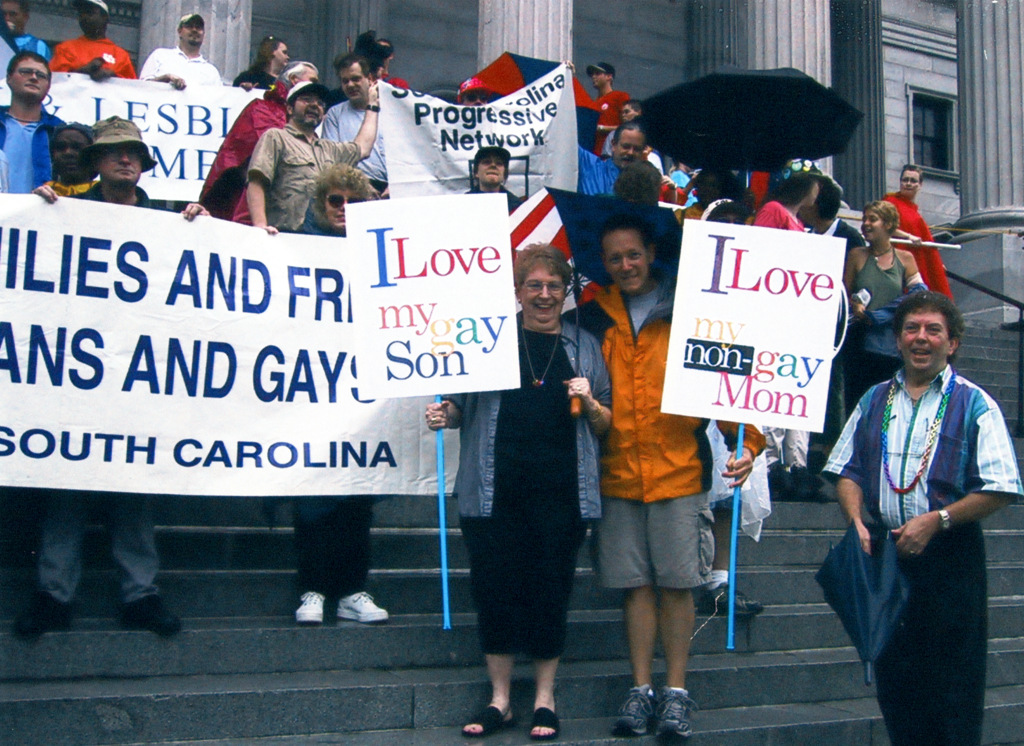
    In the fall of 1980, according to Harriet Hancock’s essay in Southern Perspectives, her son Greg came out to her with the support of Harriet’s sister Diane who was very close to her nephew. With the words Mom, I’m gay, Harriet’s life changed forever. Greg was the middle child of her three children. He was enrolled at the University of South Carolina – along with Harriet who at 44 had decided to go back to college to become an attorney.

    “My heart broke for him, but somehow I managed to keep my composure. I sat down, and with a sigh of relief, I said, “Is that all?’…I don’t think we consider the struggle that many gays and lesbians have in overcoming their own internalized homophobia. Unfortunately some never make it.”

    Now known in South Carolina as the Mother of Pride for her activism in organizing the first Pride Marches in Columbia in the early 1990s and countless other outrageous acts and everyday rebellions against social injustice during the next 30 years, the Harriet Hancock LGBT Community Center was named to honor her commitment to the queer community and continues to be a beacon of enlightenment for youth and adults in all segments of the population.

    Harriet and her son Greg at an early Pride March on State House steps

    “My phone rang at midnight…[An older gay man] told me I was a troublemaker for organizing the march and how it would make more trouble for gay people…The last thing he said to me was ‘There will be blood running down Main Street tomorrow, and it will be on your hands.’” – Harriet Hancock in Southern Perspectives

    Thankfully, the caller was wrong, and those empowered standard bearers became the catalysts for change in South Carolina and kept marching every year –  all the way to the nation’s capitol a few years later.

    “In 1993 I went to Washington, DC, for the national march….I stayed outside the city and took the subway to the Mall. I heard people getting excited on the train on the way to the mall, and it sounded like a symphony orchestra to me. By the time I walked up the stairs from the train and stepped out in the sunlight, it was as if the drums and tympani were exploding.” – Deborah Hawkins in Southern Perspectives

    Deborah Hawkins, owner of lesbian bar Traxx

    By the time Deborah marched in DC in 1993, she had owned and operated a lesbian bar near the railroad tracks in Columbia since March, 1984. “I was thinking we needed a place where women could gather. We needed a country club, a place where we could get together for more reasons than just beer and such. I felt like it was my home, and I wanted people to come in and be happy. I was the hostess. I wanted the women to have somewhere to go, because a lot of them were lacking someone in their life to let them know they were loved. I could see…they were different and felt the difference, and I wanted them to know that I cared about them and loved them. That was my goal for opening Traxx.” — Southern Perspectives

    Candace once thought of South Carolina as a place you went through when you were driving someplace else. Nevertheless, she moved from Atlanta to Sumter in 2003 in search of a new family life that led her to become a reluctant apostle to the LGBTQ people of faith in the midlands for the next 15 years. Harriet was born in 1936 and raised in Columbia in a house built on land deeded to her family in 1784. A disastrous 25-year marriage to a troubled man led her away from the state but her determination to make a better life for herself and her children brought her home in 1978 to her larger family in Columbia that loved and supported her. Deborah’s family lived in the same house in West Columbia from the time she was born until the day she left for college. As a young adult in the 1970s, she hitchhiked around Europe for six weeks with three friends, all planning to never come back home. Riding around in a van through the Transylvania forest at a hundred miles an hour on the Autobahn,  the group of four travelers realized they’d gotten in the wrong vehicle. It was time to go home.

    These women were ordinary women who became extraordinary  – their stories are remarkable.  They heard voices crying for help in a wilderness of needs in a state smothered by conservative rural  leadership. Here are we, they answered. We won’t leave you, but we will work for change.

    Stay tuned for the conclusion.


  • holy moly – it’s a podcast!


    https://libraryvoices.podbean.com/e/sheila-morris-episode-74/

    Thanks so very much to Dr. Curtis Rogers, Communications Director for the South Carolina State Library, for inviting me to participate on his podcast – the opportunity was the icing on the cake following the fun panel presentation at the Center for the Book hosted by Andersen Cook on January 17th.

    Southern Perspectives on the Queer Movement: Committed to Home was our book featured at the Center for the Book – thanks to USC Press Publicity Manager Mackenzie Collier for bringing books to sell. I just love to sell a book!

    My forever gratitude goes to Harriet Hancock and Teresa Williams (better known to my followers as Pretty) for serving on the panel with me. They’ve traveled with me to almost every presentation on our book for the past year, and I’ve loved hearing their stories whenever they speak. They’re simply the best.

    Please check out the podcast this weekend when you have a few minutes – Curtis asked me a number of questions including some personal ones about my blogging. Tune in the podcast and…

    Stay tuned.


  • HAPPY PRIDE!


    Thanks to my Wells Fargo ATM machine for wishing me a Happy Pride Month when I stopped by today to make a cash withdrawal. My first thought was to wonder how the machine knew I was a lesbian? Seriously. I stared at the screen for a few seconds in disbelief.

    I mean, I knew technology now did wondrous things, but had “gaydar” been installed in ATM machines…then I noticed instructions to hit Print if I wanted to see more information on the subject after my transaction receipt was printed. So, of course I did, and this is what rolled out.

    Standing together with the LGBTQ community

    It’s a commitment we made 30 years ago. Since then we’ve contributed over $50 million and countless team member volunteer hours to organizations that are making a difference…

    …including the important work done by GLSEN, Point Foundation, SAGE and The Trevor Project…

    Naturally my cynical self said well, this bank has had so much negative press in recent years they are grasping at straws to attract and keep customers.

    But, then my old lesbian activist juices kicked in and I broke into my imaginary version of a Happy Dance which shouted Hallelujah! I just witnessed an ATM of a major financial institution recognizing Pride Month in 2018 and I couldn’t wait to get home to tell Pretty about it. She was equally impressed.

    Please know that I share this with my cyberspace friends not as an endorsement of Wells Fargo or any of its various services – I’m simply “paying” it forward to wish all of you a Joyous June as you reflect on the progress we’ve made in our quest for equality during the past 50 years notwithstanding the setbacks in recent months of the policies of a new administration in the executive branch of the federal government, the apathy of the legislative branch for social justice as evidenced by a Congress mired in a bog of disputes unrelated to those issues and the judicial decision this week by the Supreme Court that will encourage the No Gays Allowed signs like the one posted in a hardware store outside of Knoxville, Tennessee following that decision (which must have been printed in advance with high hopes of the chance to place it in the window asap).

    Harriet Hancock ended her essay in Committed to Home with a blessing that I love. I wish I’d written it.

    May you be blessed with discomfort at easy answers, half-truths, and superficial relationships, so that you may live deep in your heart. May you be blessed with anger at injustice, oppression, and exploitation of people and the earth so that you will work for justice, equality, and peace. May you be blessed with tears to shed for those who suffer so that you will reach out to comfort them and change their pain to joy. And may you be blessed with the foolishness to think that you can make a difference in the world, so you will do the things others say cannot be done.

    Happy Pride!

    Nothing says PRIDE like a PARADE!

    (SC Pride March in October, 2015)