It’s surprisingly easy to drive a thousand miles from Montgomery, Texas to Columbia, South Carolina. Two days on the road with a nine-hour break in a comfy motel bed. The roads are good but we share them with many travelers who join us in driving from here to there to wherever. Truck drivers pulling heavy loads remind me of the burdens I’ve carried for many years so I like to see the eighteen-wheelers as they struggle to make a hill but cruise on down the road once they reach the crest. I feel I’ve reached the top of an incredibly high hill in my life at this moment and can finally begin to coast on the other side. The responsibilities and pressures I’ve owned for so long are pieces falling from my truck bed into ditches along the way. They fly out and float and vanish as they hit the ground.
For any who want more, complete list of all posts by month since 2011
- October 2026 (1)
- September 2026 (1)
- July 2026 (3)
- June 2026 (9)
- May 2026 (5)
- April 2026 (4)
- March 2026 (5)
- February 2026 (7)
- January 2026 (8)
- December 2025 (5)
- November 2025 (7)
- October 2025 (6)
- September 2025 (7)
- August 2025 (3)
- July 2025 (7)
- June 2025 (8)
- May 2025 (6)
- April 2025 (6)
- March 2025 (7)
- February 2025 (11)
- January 2025 (8)
- December 2024 (11)
- November 2024 (6)
- October 2024 (8)
- September 2024 (4)
- August 2024 (9)
- July 2024 (6)
- June 2024 (9)
- May 2024 (7)
- April 2024 (12)
- March 2024 (11)
- February 2024 (10)
- January 2024 (9)
- December 2023 (18)
- November 2023 (12)
- October 2023 (16)
- September 2023 (13)
- August 2023 (16)
- July 2023 (22)
- June 2023 (24)
- May 2023 (12)
- April 2023 (6)
- March 2023 (9)
- February 2023 (8)
- January 2023 (11)
- December 2022 (7)
- November 2022 (7)
- October 2022 (8)
- September 2022 (5)
- August 2022 (8)
- July 2022 (5)
- June 2022 (9)
- May 2022 (5)
- April 2022 (6)
- March 2022 (8)
- February 2022 (5)
- January 2022 (9)
- December 2021 (9)
- November 2021 (12)
- October 2021 (12)
- September 2021 (9)
- August 2021 (19)
- July 2021 (4)
- June 2021 (4)
- May 2021 (3)
- April 2021 (5)
- March 2021 (7)
- February 2021 (4)
- January 2021 (5)
- December 2020 (5)
- November 2020 (7)
- October 2020 (6)
- September 2020 (5)
- August 2020 (5)
- July 2020 (6)
- June 2020 (9)
- May 2020 (9)
- April 2020 (20)
- March 2020 (16)
- February 2020 (6)
- January 2020 (7)
- December 2019 (8)
- November 2019 (4)
- October 2019 (5)
- September 2019 (5)
- August 2019 (4)
- July 2019 (5)
- June 2019 (5)
- May 2019 (3)
- April 2019 (6)
- March 2019 (9)
- February 2019 (4)
- January 2019 (6)
- December 2018 (7)
- November 2018 (5)
- October 2018 (8)
- September 2018 (1)
- August 2018 (5)
- July 2018 (11)
- June 2018 (13)
- May 2018 (8)
- April 2018 (9)
- March 2018 (10)
- February 2018 (7)
- January 2018 (8)
- December 2017 (8)
- November 2017 (7)
- October 2017 (11)
- September 2017 (9)
- August 2017 (10)
- July 2017 (9)
- June 2017 (9)
- May 2017 (11)
- April 2017 (10)
- March 2017 (19)
- February 2017 (10)
- January 2017 (9)
- December 2016 (14)
- November 2016 (13)
- October 2016 (12)
- September 2016 (10)
- August 2016 (2)
- July 2016 (4)
- June 2016 (3)
- May 2016 (2)
- April 2016 (4)
- March 2016 (1)
- February 2016 (2)
- January 2016 (1)
- December 2015 (2)
- November 2015 (2)
- October 2015 (1)
- September 2015 (5)
- August 2015 (3)
- July 2015 (3)
- June 2015 (4)
- May 2015 (3)
- April 2015 (2)
- March 2015 (3)
- February 2015 (2)
- January 2015 (3)
- December 2014 (3)
- November 2014 (3)
- October 2014 (2)
- September 2014 (3)
- August 2014 (1)
- July 2014 (4)
- June 2014 (3)
- May 2014 (3)
- April 2014 (2)
- March 2014 (2)
- February 2014 (4)
- January 2014 (3)
- December 2013 (2)
- November 2013 (2)
- October 2013 (2)
- September 2013 (5)
- August 2013 (2)
- July 2013 (2)
- June 2013 (2)
- May 2013 (3)
- April 2013 (4)
- March 2013 (3)
- February 2013 (2)
- January 2013 (2)
- December 2012 (3)
- November 2012 (2)
- October 2012 (3)
- September 2012 (2)
- August 2012 (2)
- July 2012 (4)
- June 2012 (3)
- May 2012 (2)
- April 2012 (3)
- March 2012 (3)
- February 2012 (3)
- January 2012 (5)
- December 2011 (2)
- November 2011 (1)
- October 2011 (2)
- September 2011 (5)
- August 2011 (5)
-
Post Cards From The Heart – Lucia Leaves Home. The End.
First comes love, then comes marriage. Then comes Luke and Bessie pushing a baby carriage. Lucia Catherine was the occupant of this particular baby carriage and she was the only child of their marriage. Expectations for a Luke, Jr., turned happily into a Lucia somewhere between 1908 and 1916, the date of the first post card addressed to Miss Lucia Moore in our collection.

Date Unknown
Aunt Sadie give me this to send to your baby. This is me and Little Snookie on front.
from G (?)

Date Unknown
To Lucia Moore from Dorothy Parker

December 21, 1922
I hope Old Santa will be good to you this Xmas and that you have a Merry Xmas and a Happy New Year, Allen & M.M.
November 24, 1919
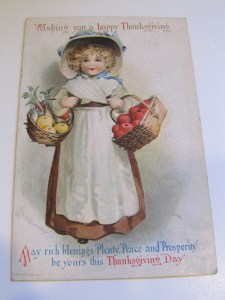
Dear Little Lucia Catherine, I rec’d your pictures yesterday and they are as sweet and pretty as can be. I am sure you are a fine little girl and your Mother and Papa are awfully proud you came to live with them. My little Edna Mae is on the Mexican border with her Papa & Mother. I’ll send her the picture and know she will think it is sweet. Tell Mother I’ll write her a letter some day. Miss Florence
Among the cards kept by Bessie was a Thanksgiving post card sent from China, Texas in 1919 to her daughter Lucia. The handwriting was tiny so all the words could fit the reverse of the holiday card, but Bessie recognized immediately the precise distinctive script of her special friend Florence. After thirteen years of sporadic correspondence via the penny cards, Bessie would have known that writing even if the card had been unsigned. China, Texas sounded a world away from Atlanta, Georgia. Would she ever see her friend again? If not, she wanted Florence to see pictures of Lucia. Everyone said Lucia looked just like Bessie had looked when she was a little girl and Florence had told Bessie many years ago how beautiful she was.
Miss Florence hadn’t married evidently and Bessie thought it was good she had a neice she loved. Tell Mother I’ll write her a letter some day was a lifetime away from Florence’s Will write you soon message to Bessie in 1907 and Bessie understood the different destinies their lives had followed with a touch of…what? Regret? Relief? Remorse? Did she even know herself?

The End As Of Today
For the faithful readers who have followed the odyssey of the Moore family for almost three months now on the blog, I thank you for your patience as I took this blip on my personal radar writing screen for an experiment with historical fiction. When my partner Teresa brought the picture post card album home from an estate sale at the end of February this year, I was fascinated with the pictures from the turn-of-the-century (twentieth, that is!) cards but had not a clue about the treasures I’d find in the words. For me, words are worth a thousand pictures and these have not disappointed. I wish I could share more of them with you, but I have literally hundreds of post cards and fear I have become too attached to them.
The estate sale took place at a home in Columbia and I tagged along with Teresa when she went for a second look. The house was a modest one in an older middle-class neighborhood not very far from our own home. I could have walked there if I’d wanted to – which I didn’t. While Teresa chatted away with her friend Shelley who was in charge of the estate sale, I wandered through the house to see what I could find without spending any money – which I didn’t. I found an old Bible in a bedroom and opened it to the family section. From your father, Luke P. Moore read the inscription. At the time I didn’t realize how close I would be to Mr. Moore and his family through their post cards in the next few months.
I asked Shelley that night if she knew anything about the family who was leaving this home. She said she didn’t know much except that it was an elderly woman in her late nineties who was moving into a nursing home because she couldn’t live alone any longer. Not an uncommon occurrence these days, I thought, as I met Teresa in the kitchen. She was making her final rounds and asked Shelley to hold several items for her before the sale actually started the following day.
I remember seeing a little navy blue magnet in the shape of a sailing ship on the refrigerator that night as I left the kitchen. I wish now I’d paid the 25 cents for it. A tiny white flag had the name Lucia on it. Lucia Catherine Moon, daughter of Luke and Bessie, was leaving her home and most of her possessions behind, including her mother’s treasured post card album entitled Greetings from Jamestown. That’s okay, though. Teresa brought it home to me.
-
Post Cards From The Heart – Luke Writes Bessie
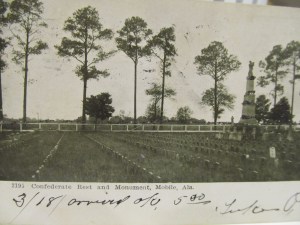
Confederate Rest and Monument, Mobile Ala.
March 18, 1906
3/18 arrived ok. 5.00, Luke P.
First comes love, then comes marriage. On March 18, 1906 our lothario Luke began a flurry of post cards to Miss Bessie Bogan who lived in Alabama City, Alabama. Alabama City was an unremarkable small town six miles from Gadsden in Etowah County – north of Birmingham and west of Atlanta – and a long, long way from Luke’s home in Fort Morgan at the southernmost point of the state beyond Mobile. The distance measured 350 miles to be exact and it begged the question of their meeting. While one in five relationships in March, 2012 begins through match.com, according to match.com, and distance is a Skype away today, finding the love of your life a hundred years ago wasn’t done on a computer dating site.
How did Luke and Bessie meet? Maybe it was the old-fashioned way. A friend of a friend. Or maybe it was a friend’s second cousin who came to Alabama City for Christmas and they met at a Christmas Eve service in a small church. When Luke came to see his cousin and saw Bessie again the following March, sparks flew in all directions. Let the games begin.
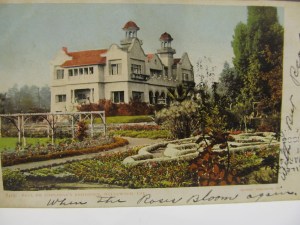
Paul de Longprae’s Residence, Hollywood, Cal.
March 24, 1906
When the roses bloom again. with best reg.
Luke’s interest in architecture was evident from the earliest post cards he sent to Bessie. The Confederate Monument in Mobile was a local landmark for him, but the card itself has a subtle layer of still visible glitter lightly sprinkled on the black and white images. The barely twinkling glitter outlines a line of trees in the background and what appears to be a wreath wrapped around the monument. Classy… and sure to impress a country girl from Alabama City. The second card was more colorful and not from around those parts. It was a picture of Paul de Longprae’s home in Hollywood which at that time had achieved some notoriety. The successful French flower painter built the mansion in 1901 and the house was magnificent with gardens to match that gave him ready subjects for his work year round. The cryptic message When the roses bloom again was a hint of romance from Luke and most likely a reference to a shared moment from his recent visit.
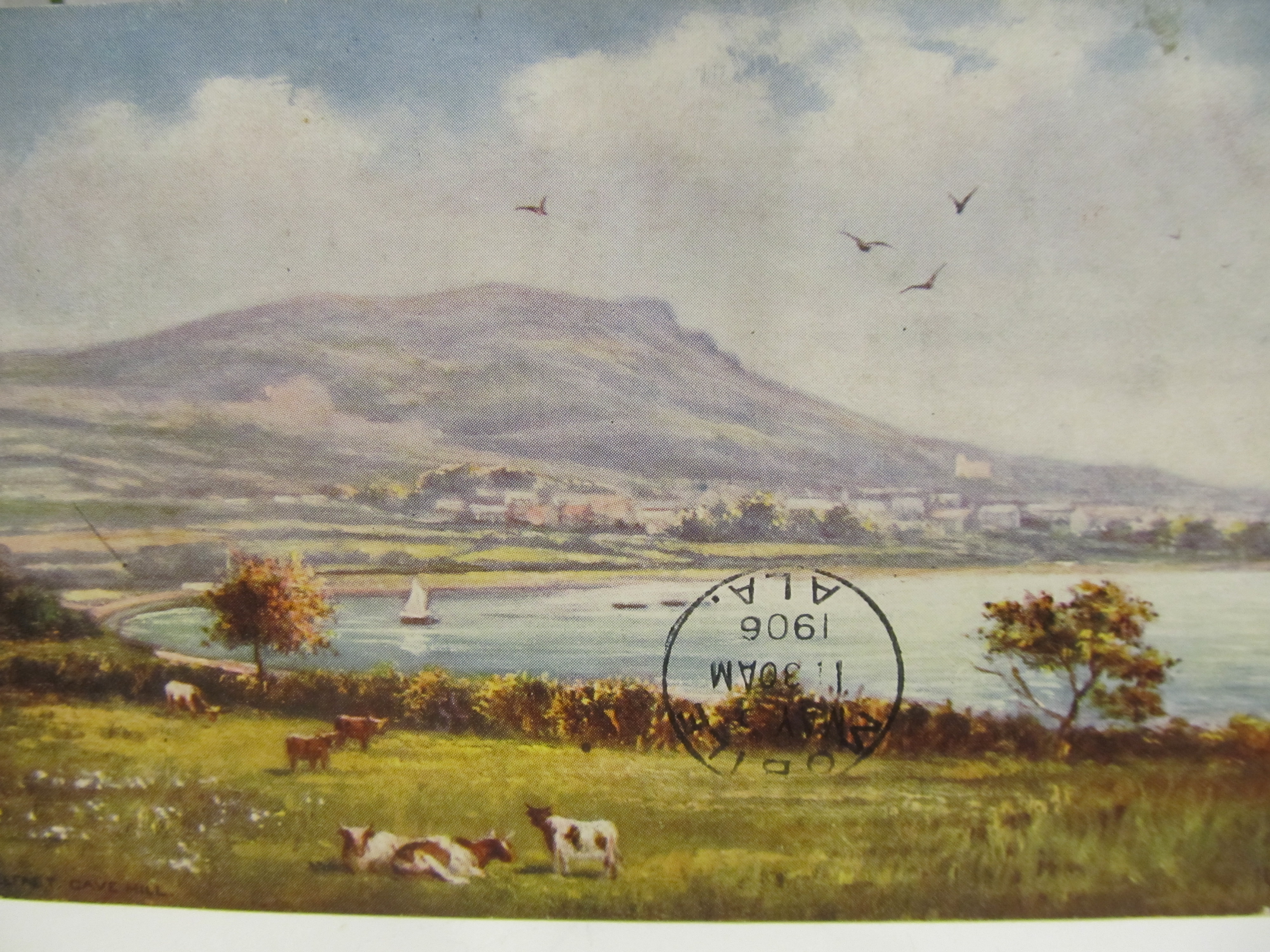
The next two cards Luke sent to Bessie were from the “Oilette” series of post cards produced by Raphael Tuck & Sons and printed in England beginning in 1903. The Tuck cards were among the most popular post cards during the late 1800s and early 1900s during the picture penny card boom years. In small print on the address side of these cards were the words Art Publishers to Their Majesties The King & Queen.

Belfast Cave Hill
May 05, 2906
With best Reg. L.P.M.
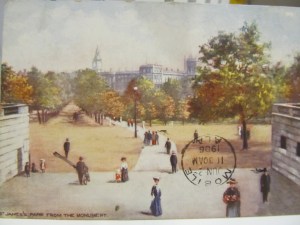
St. James Park From The Monument
June 02, 1906
In July, 1906 Luke sends another “local” post card from Mobile with a message saying he is leaving soon for another place that Bessie clearly already knows about. Not surprisingly, his last card from Mobile is a street with imposing architecture.
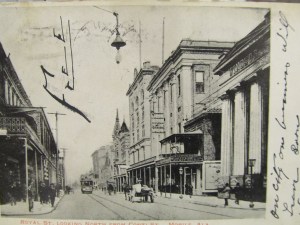
Royal St. Looking North From Conti St., Mobile, Ala.
July 10, 1906
In city on business. will leave soon. With Best Regards from Yours Truly.
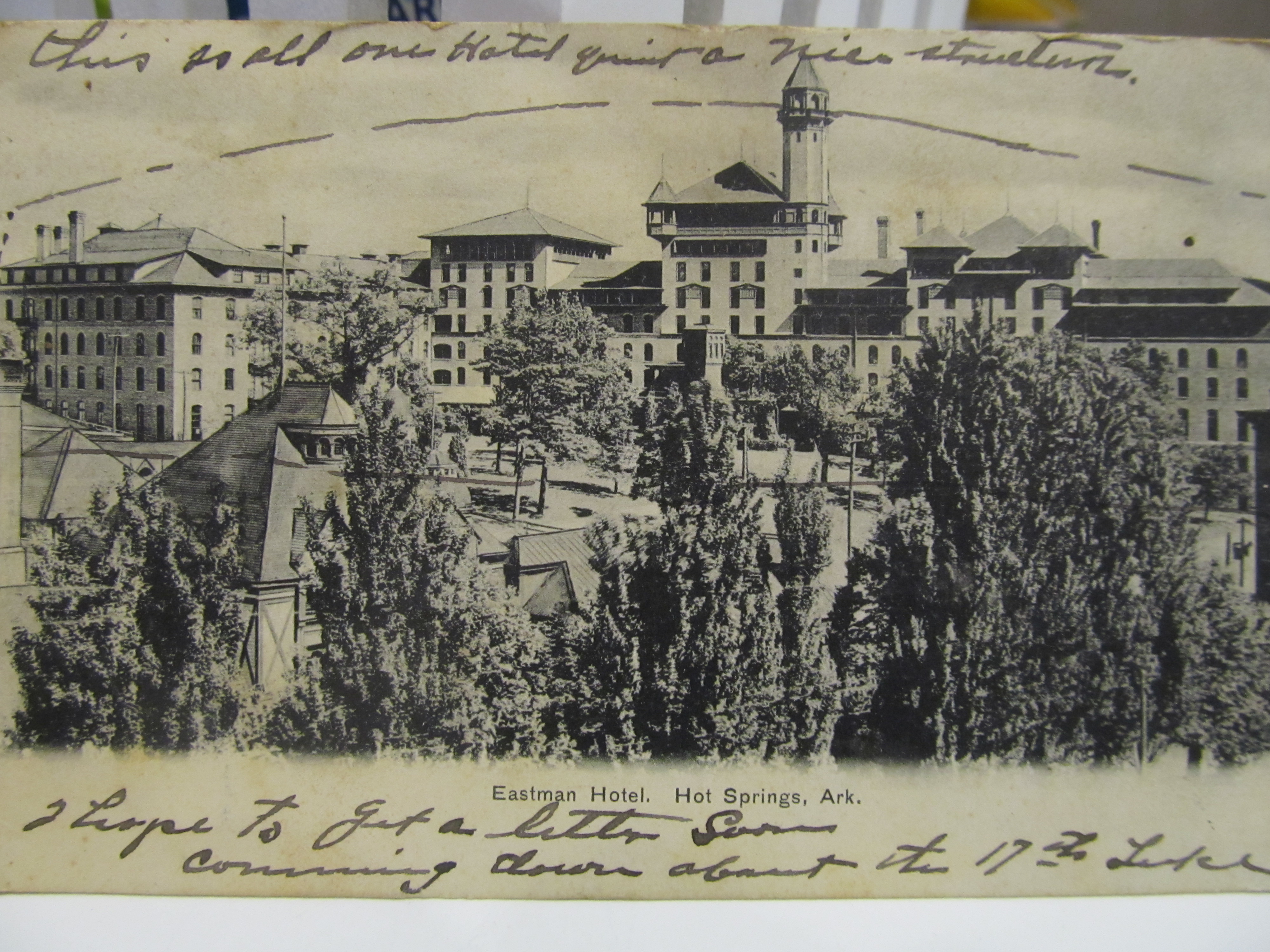
Indeed, the following two post cards sent by Luke to Bessie in August, 1906 were postmarked Hot Springs, Arkansas. Why the trip to Arkansas? Perhaps job related? Perhaps to visit other family?
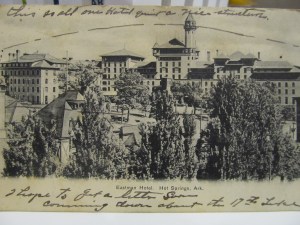
Eastman Hotel. Hot Springs, Ark.
August 11, 1906
This is all one hotel quite a nice structure.
I hope to get a letter soon. Coming down about the 17th., Luke
By August of 1906 the young couple must’ve been hot and heavy in their correspondence because Luke was in the stage of racing to the mailbox to look for a letter from Bessie. When one wasn’t there, his high spirits sank and he had to let Bessie know his disappointment with the passive aggressive tone I hope to get a letter soon. Hah. Translation: Please write to me or I will kill myself.
The Eastman Hotel had over 500 rooms and was one of the largest in Hot Springs at the turn of the twentieth century. The town was home to several major league baseball training camps and it wouldn’t have been unusual for Luke to see Babe Ruth walking from the hotel to the racetrack after practice. He might not have noticed if he were on the way to the post office, though.
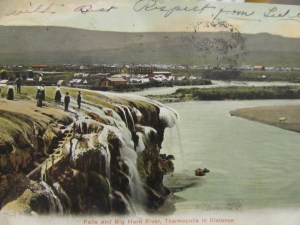
Falls and Big Horn River, Thermopolis in Distance
August 16, 1906
With Best Respect from Luke
The final post card postmarked in Hot Springs was a breathtaking view of the falls pouring into the Big Horn River in Hot Springs County, Wyoming with the town of Thermopolis snuggled in the valley next to the river. Quite a different tune in this card as if to halfway apologize for the brusqueness of the previous one. With best respect from Luke. Sweet.
Next stop: College!

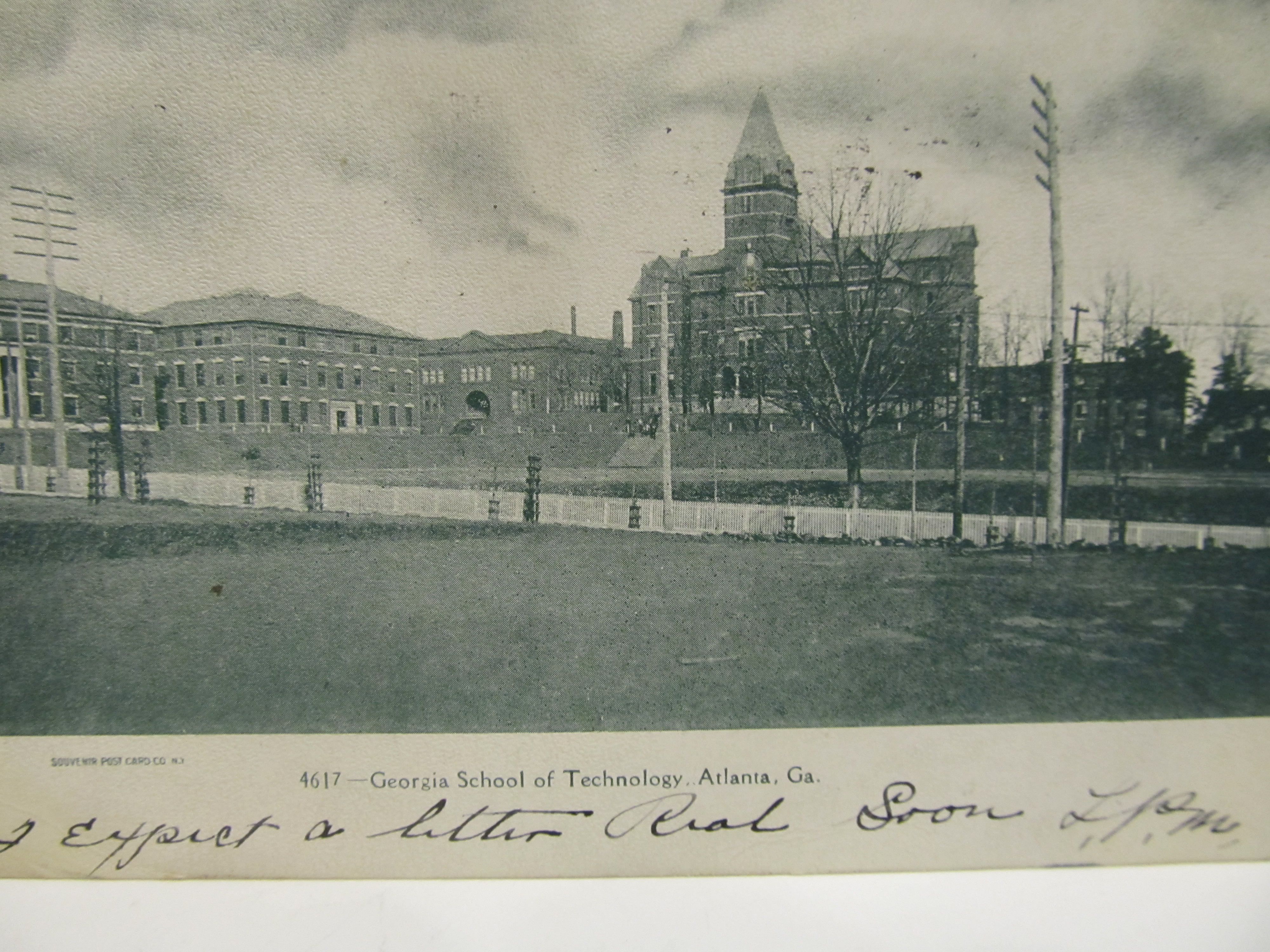
Georgia School of Technology, Atlanta, Ga.
August 31, 1906
I expect a letter Real Soon, L.P.M.
The Georgia School of Technology which later came to be known as the Georgia Institute of Technology or Georgia Tech was started in 1885 and offered one degree in mechanical engineering. By the time Luke enrolled in the fall of 1906, degrees in civil, electrical and chemical engineering had been added to the curriculum. Going to school in Atlanta meant being closer to Miss Bessie Bogan of Alabama City, but letters and post cards were still the only ways to keep in touch. Passive aggressive I hope to get a letter at the first of August was now a much bolder I expect a letter Real Soon by the end of the month.
What a difference six months makes in the lives of young love and lovers! Bessie kept these picture post cards from Luke to remember their early stories, and I can feel his passion growing with each picture for these are not random post cards but ones carefully chosen to send a message to his beloved. He wanted her to know that beauty and art and freshness and flowers and flowing rivers reminded him of her and how much he cared for her.
I think I’ll leave him at school today. He needs to study this week so he can make the trip to Alabama City this weekend.
-
Post Cards From The Heart – It’s Been Quite A Pleasure Trip To Me
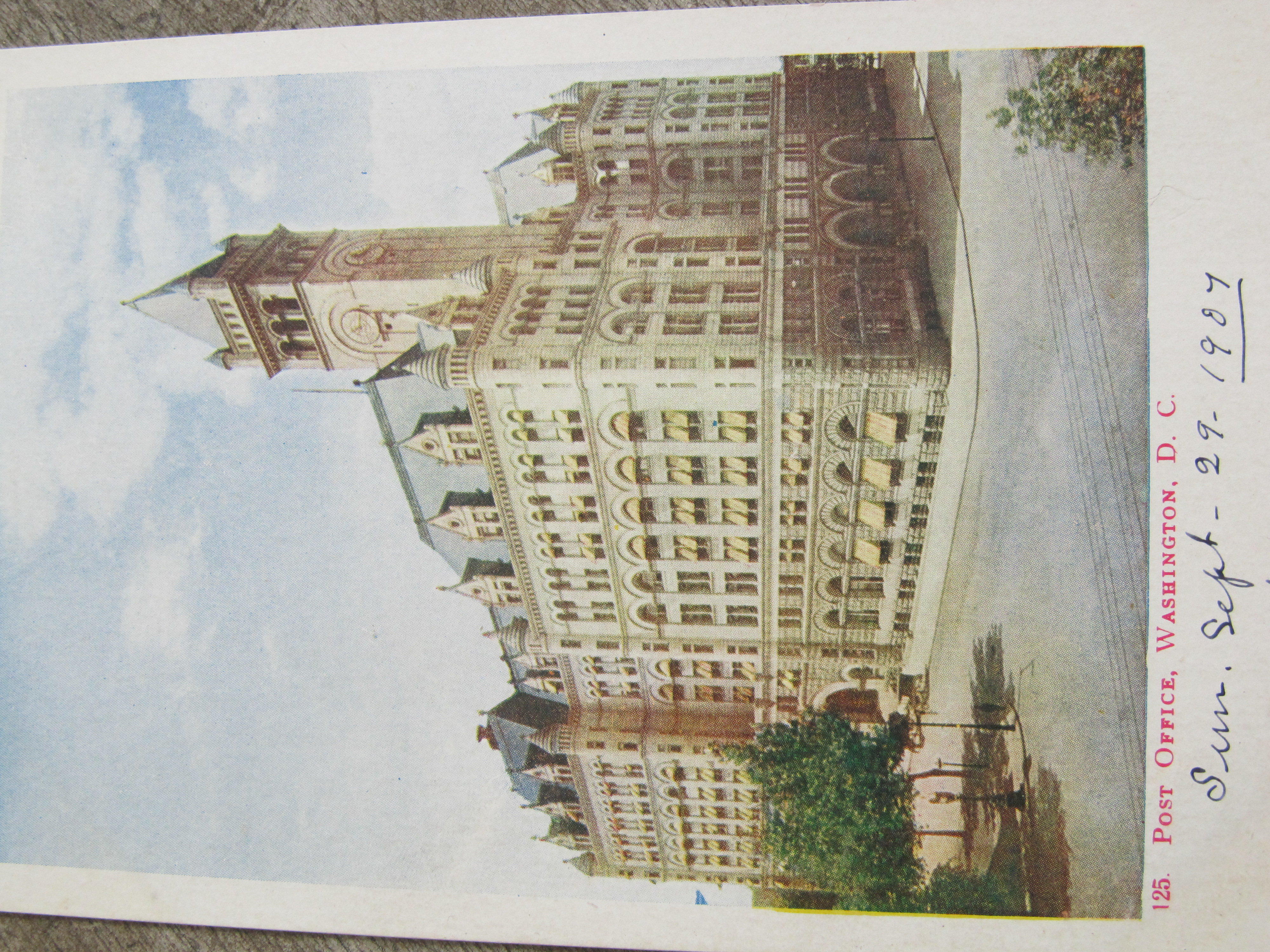
Bessie loved the sights she’d seen on her honeymoon trip and wrote her longest comments on a post card of Thomas Circle dated Sunday, September 29, 1907. Was she writing to one of her sisters or someone in Luke’s family or maybe just a note to remind herself of the awesome experience she’d had on her stay or maybe even to her dear friend Florence? You be the judge.
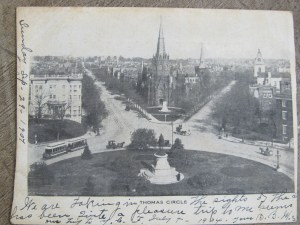
We are taking in the sights of the city. It has been quite a pleasure trip to me. Seems like our trip to Y.C.F. July 4th., 1904. Yours, B.B. M. Sunday, Sep 29, 1907

Of course, Bessie wanted to visit the Post Office and make sure she had a post card from the Home of All Post Cards! The building didn’t disappoint her and Luke was entertained by her enthusiasm for a site he considered to be of lesser importance in the overall scheme of D. C.
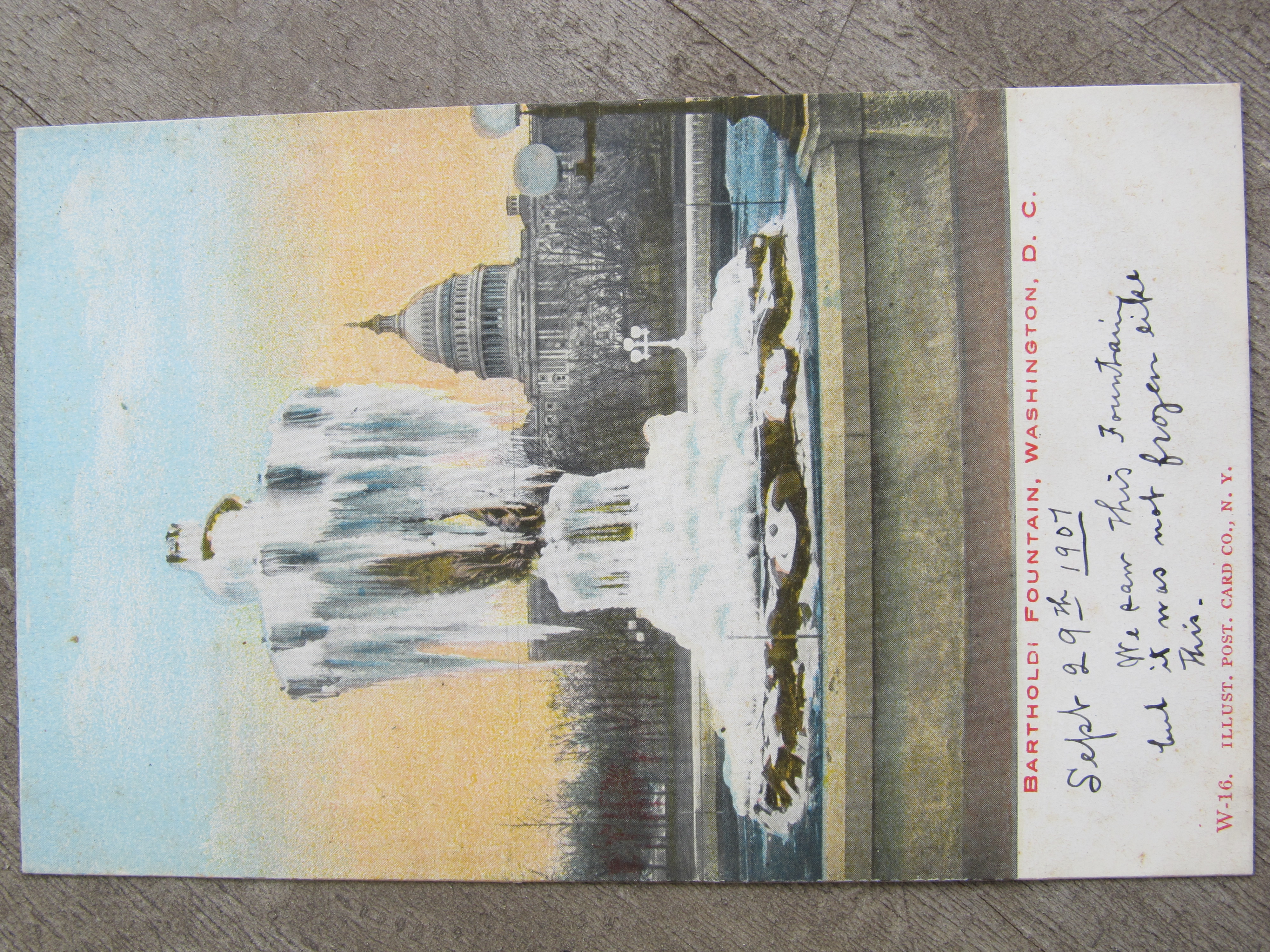
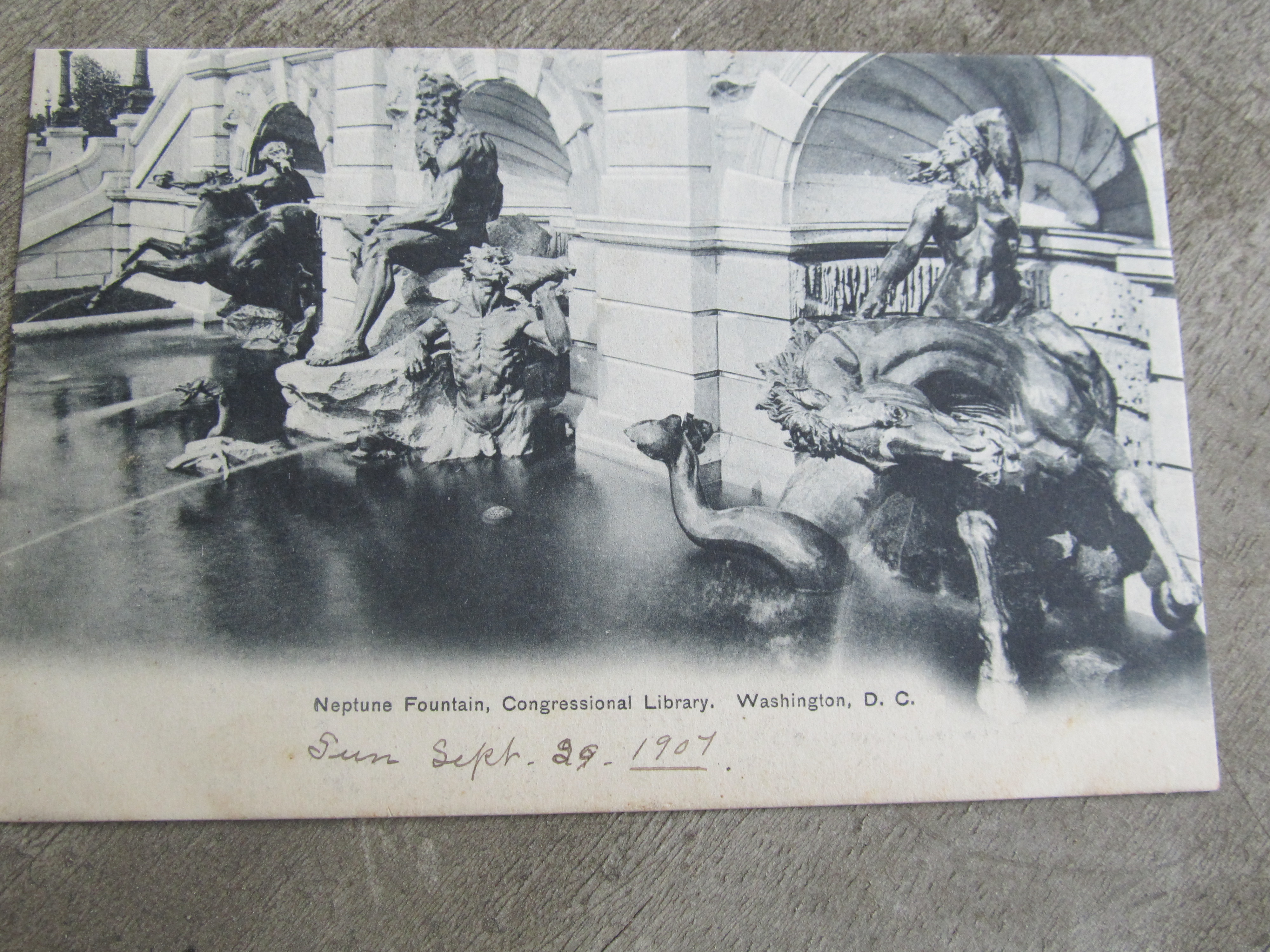
They both must have enjoyed the fountains on their Sunday walk through the Capitol. Bessie had two interesting pictures of fountains she saw on this day in September of 1907.

Batholdi Fountain
Sept 29, 1907 We saw this fountain but it was not frozen like this.

The Neptune Fountain at The Congressional Library made an impression on the couple as they began their tour of the Library. No tour guides today as they decided to wing it on their own and Bessie concluded this library was “The finest in America…”
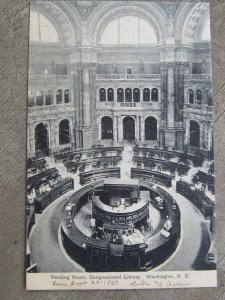
Reading Room, Congressional Library
Sunday, Sept 29 – 1907 Luke and Bessie

In the midst of the post cards Bessie kept from her trip, I didn’t find a single one of the hotel where they stayed, but I think it must have been near F. Street N. W. because her final post card from the weekend was of that street.
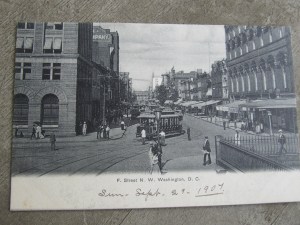
The scene shifts to Arlington, Virginia tomorrow as the honeymooners head south to Lee’s mansion and then further south to Washington’s Mount Vernon, but for this last day in Washington we’ll watch them holding hands as they leisurely stroll down F. Street in the midst of the trolleys and tourists. Their D. C. days have passed quickly, but Bessie has the post cards that will keep her “pleasure trip” in safekeeping.
-
Post Cards From The Heart – Pennsylvania Avenue Washington’s Favorite

Pennsylvania Avenue, Washington, D. C.
Washington’s Favorite, Sept. 28 – 29 1907
B. and L.
Horse-drawn carriages and trolley cars mingled with the newfangled motor cars that made Pennsylvania Avenue a noisy busy scene for our honeymooners Bessie and Luke as they toured Washington, D. C. over the weekend. Bessie called the street Washington’s Favorite to indicate the importance she felt it had for the city in 1907 and, indeed, it remains the most famous avenue in the city a century later.
Saturday morning was cool and crisp as the couple continued their adventures with a visit to The Smithsonian Institute where they were immersed in the museum of American history and its most recent significant addition, the flag known as The Star-Spangled Banner. The flag was loaned to the Smithsonian in 1907 by a Maryland family that had owned it since it flew proudly at the Baltimore garrison which successfully resisted the British naval bombardment in the War of 1812. An American lawyer named Francis Scott Key had watched the cannons fire during the night from a boat a short distance away and when he saw the ragged American flag raised as the light of dawn bathed the scene, he wrote the words to what would be recognized as our national anthem by President Herbert Hoover in 1931. When Luke and Bessie saw it in the Institute almost a hundered after the War of 1812, they were moved by the careful preservation of the tattered faded stars and stripes. What a country!

Smithsonian Institute, Washington, D. C.
Sat Sept 28, 1907
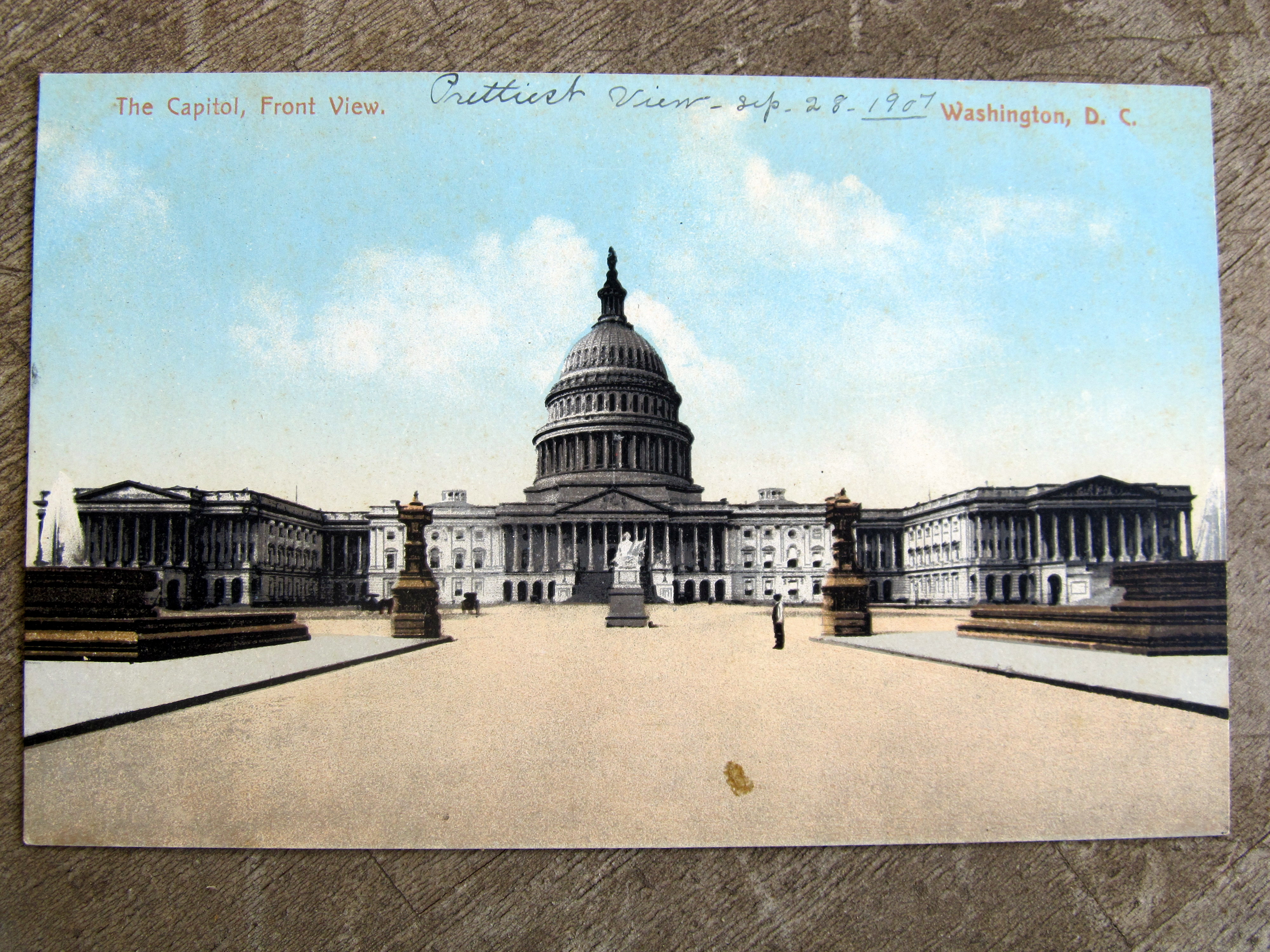
No time to linger here, though, as they needed to grab a quick lunch before the afternoon’s excitement of a tour of The Capitol…food required for stamina.

The Capitol, Front View Washington, D. C.
Prettiest View, Sep 28 – 1907
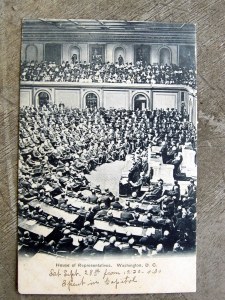
House of Representatives, Washington, D.C.
Sat Sept. 28th from 12:30 – 4:30
Spent in Capitol

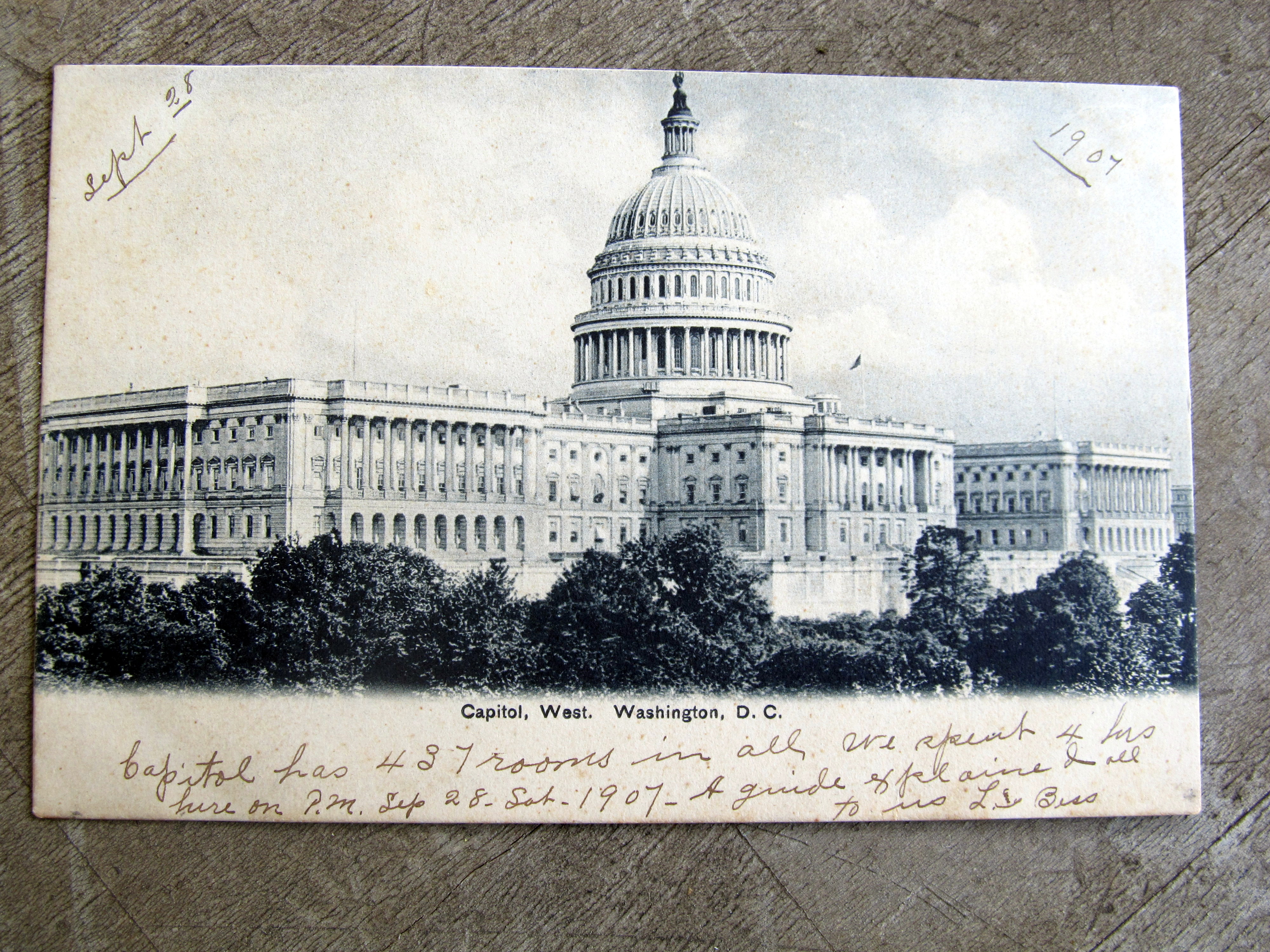
Capitol, West. Washington, D. C.
Capitol has 437 rooms in all. We spent 4 hrs here on p.m. Sep 28. Sat. 1907- A guide explained all to us.
L and Bess
Although the tour of The Capitol ended at 4:30, Luke and Bessie decided to save the rest of their D. C. sightseeing for Sunday. The Smithsonian and The Capitol in one day had been overwhelming – an overload of facts and hard on the feet in pre-tennis shoe days. Luke’s leather boots and Bessie’s honeymoon heels weren’t designed for comfortable wear and their adrenalin sagged in the late afternoon. Get to the hotel and lie down, they decided…have a late dinner and a little night music.
And that’s where we’ll leave them until tomorrow…











You must be logged in to post a comment.