
Category: Random

  • Equal Pay Day 2023

    Equal Pay Day 2023


    AAUW Equal Pay Calendar

    2023 Equal Pay Days

    • Equal Pay Day—representing all women—is March 14. Women working full-time, year-round are paid 84 cents and all earners (including part-time and seasonal) are paid 77 cents for every dollar paid to men. 
    • LGBTQIA+ Equal Pay Awareness Day is June 15. Without enough data to make calculations, this day raises awareness about the wage gap experienced by LGBTQIA+ folks. 
    • Black Women’s Equal Pay Day is July 27. Black women working full-time, year-round are paid 67 cents and all earners (including part-time and seasonal) are paid 64 cents for every dollar paid to non-Hispanic white men. 
    • Moms’ Equal Pay Day is August 15. Moms working full-time, year-round are paid 74 cents and all earners (including part-time and seasonal) are paid 62 cents for every dollar paid to dads. 
    • Latina’s Equal Pay Day is October 5. Latinas women working full-time, year-round
    • are paid 57 cents and all earners (including part-time and seasonal) are paid 54 cents for every dollar paid to non-Hispanic white men. 
    • Native Women’s Equal Pay Day is November 30. Native women working full-time, year-round are paid 57 cents and all earners (including part-time and seasonal) are paid 51 cents for every dollar paid to non-Hispanic white men. 
    • Asian American, Native Hawaiian and Pacific Islander Women’s Equal Pay Day is TBD. Asian American, Native Hawaiian and Pacific Islander women working full-time, year-round are paid 92 cents and all earners (including part-time and seasonal) are paid 80 cents for every dollar paid to non-Hispanic white men.

    Thanks so much to the American Association of University Women for the above images and information they provided on this significant component of Women’s History Month in 2023.

    And thanks to Brazilian illustrator Camila Pinheiro for designing the 2023 US Open Tennis Tournament poster celebrating 50 years of equal prize money for men and women, featuring one of the leaders associated with that seismic achievement in 1973: Billie Jean King. A mere twenty-eight years later the Australian Open awarded equal prize money for men and women beginning in 2001, another six years passed before Wimbledon followed suit in February, 2007; Roland-Garros quickly followed Wimbledon in March, 2007 – thirty-four years after the US Open adopted the equal prize money policy for women and men in the sport all four Majors participated in the policy that became the first Grand Slam of pay equity for all players.

    “UnEqual” pay was the powder keg that ignited my activism in the women’s movement of the 1970s. From a nontraditional career for women in the accounting profession that began in 1967 with the shocking discovery that my compensation of $650 monthly at the Houston office of Arthur Andersen & Co., one of the most prestigious international accounting firms at the time, was $250 less than a work buddy making $900 a month for the same job. Only difference according to the partner in charge of personnel at the firm when I confronted him: my friend was a guy who might have a family to support one day. The risk for me, according to Mr. Terrell, was the need for maternity leave.

    I wasn’t bold enough at the time to tell him why that was an unlikely scenario; I was, however, angry enough to leave the firm. This was my first job in the real world following graduation from the University of Texas at Austin, my first personal introduction to discrimination by men in power who had no respect for women in the workplaces they controlled, my first feelings of being lesser than despite high academic achievements and even higher work ethics. At twenty-two years of age, I was born again – this time as an activist for equal pay.

    **********************

    Slava Ukraini. For the women.

  • everything, everywhere all at once – Cardinal style

    everything, everywhere all at once – Cardinal style


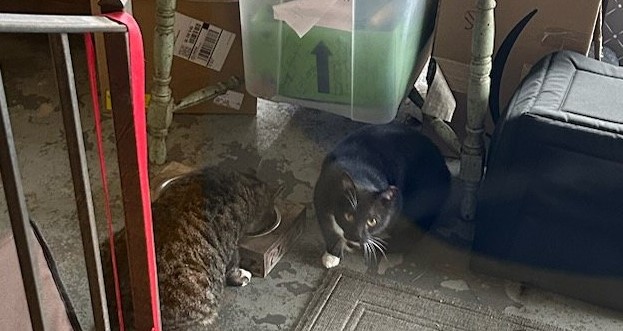
    the two OG cats post Carport Kitty

    neighbor cat visits regularly

    Charly getting white hair, too – but still always at my side

    Carl’s life is as blurry as this picture with loss of hearing, vision –

    but his smell for treats as healthy as ever

    loyal old man Spike at his guard post: no retreat, no surrender

    photo by mother Caroline

    our granddaughters three year old Ella holds year old Molly

    Okay, so I shamelessly stole the 2023 Oscar winner title for this little Monday morning personal multiverse that Pretty and I inhabit every day. Mea culpa. Enjoy – no goggles required.

    Thankfully, all quiet on the Cardinal front today.

    Stay tuned.

    *************************

    Slava Ukraini. Lest we forget the war rages on.

  • ode to the Old Woman in the Shoe

    ode to the Old Woman in the Shoe


    There once was an old woman who lived in a shoe. She had so many health issues she didn’t know what to do.

    From the white hair on her head to the arthritic joints in her swollen toes that bent in odd overlapping shapes like desperate prisoners trying to climb over each other seeking escape from their confinement of pain, arthritic joints that were mysteriously connected to a right foot whose contour she barely recognized anymore.

    From the small red knobs poking out the top of aching disfigured fingers in both hands she once thought to be beautiful like her father’s hands had been, to the true personification of the legendary Achilles heel connecting that same strange right foot to one of two legs held together with artificial knees easily identified by long scars.

    From the ugly shades of brown, crusty, smelly skin patches under her sagging breasts that retreated in different directions following their loss of the Battle of the Bras, to the deep wrinkles now covering both sides of her face just like the trenches on her grandmother’s face had done.

    From taking an inordinate amount of time in a public restroom because of kidneys not interested in competing with younger bladders to being overlooked by adolescent pharmacists who preferred serving younger customers first regardless of their place in line.

    From the perpetually tearing eyes now struggling to discern shapes, colors, depths, and distances to the earring resistant ears engaged in a similar scuffle over distinguishing conversations in noisy restaurants, loud indoor arenas, small family gatherings, even cell phones.

    From icy hands and feet at night that could easily be used for injury first aid treatment or be equally effective for use in a Yeti cooler in the summertime to prevent melting chocolate caramel candies…to the gradual loss of the teeth necessary for eating any chewy sweets or, more importantly, popcorn. 

    Behold the old woman who still lives in a shoe, but now the shoe is a Croc of shoe.

    *********************

    Slava Ukraini. For the old people.

  • why I called it like I see it – yes, but are you still lazy?

    why I called it like I see it – yes, but are you still lazy?


    Six-year-old Finn came inside the house from the pool and ran dripping wet past me on his way to the kitchen to get a bag of chips. I was sitting in my antiquated deep blue velvety cloth recliner in the den watching TV when he zipped by.

    “Every time I come to your home, you’re always sitting in the same chair watching TV,” Finn commented as he raced past me.

    “Hey,” I said to his back. “Why do you think I do that?”

    He barely turned and said with a tone of dismissal in his voice, “I guess it’s because you’re lazy.” Point taken.

     Six years later I continue to hover in my recliner in front of the same TV but with a different new brown leather comfy chair that includes a remote for adjusting my sitting positions. Ah, technology at its finest thanks to the generosity of our best friends Francie and Nekki.

    Sometimes I feel I’ve earned my laziness as reparations for the forty-five frantic years I labored with numbers in the work force, at other times I worry I inherited the right to laziness through the hard work of my ancestors whose sacrifices for family shouldn’t be disrespected by my inability to be productive; but today, I cast laziness to the winds, muted the TV, sat in an upright position and committed anew to this project of recapturing images of the people and places that shaped my solitary journey from playing outside on the dusty red dirt roads of a tiny town in rural southeast Texas as a child to living seven decades later inside a middle-class suburban home in South Carolina facing a blank computer screen screaming give me words.

    I will be seven and seventy years old this year with a life expectancy of fourteen more according to reputable statistics – a sobering thought to see numbers like these in print. Nothing is available to predict quality of life for those fourteen years, however, but laziness is not recommended by any of the experts on aging I have read. 

    One of the great bonuses of getting older is the freedom to own your truth, to reclaim the unfiltered mind of the child you were before the onslaught of the certainties from the adults in your rooms created doubts about who you were and what you believed. Today I get a free pass on words with my white hair, arthritic hands and feet, wrinkled sagging skin, watery eyes.  Oh, ignore her, they laugh. She is old.

    And so, I continue to tell it like I see it as I have done for the past fifteen years. For sure I’m closer to the end of my life than to the beginning, but maybe the words I own will resonate, rejuvenate, even cause us to celebrate our shared humanity which is relevant regardless of age.

    Onward.

  • in the beginning was the Tower

    in the beginning was the Tower


    On August 01, 1966 twenty-five-year-old Charles Whitman drove from his house on Jewell Street in Austin, Texas to the University of Texas campus where he arrived between 11:25 a.m. and 11:30 a.m.. He drove directly to the Tower that was the focal point of the campus, a building completed in 1937 that was Austin’s tallest building at 913 feet with twenty-eight floors and a public observation deck on the top floor. Whitman entered the Tower between 11:30 a.m. and 11:35 a.m.; he wore overalls that gave him the appearance of a workman with dolly and equipment (in reality a footlocker filled with guns and ammunition) which allowed him to take an elevator to the twenty-seventh floor where he exited the elevator to drag the dolly up three half flights of stairs and a short narrow hallway to a landing that led to the observation deck. The first person he shot and murdered in the building was the receptionist who would normally have had the day off.

    Ninety-six minutes later, following a meticulously planned attack that resulted in the deaths of fifteen people and thirty-one others injured, Charles Whitman was dead, shot and killed at the top of the Tower by two city of Austin policemen on the same deck his reign of terror had been carried out.

    “It took Charles Whitman an hour and a half to turn the symbol of a premier university into a monument to madness and terror. With deadly efficiency he introduced America to public mass murder, and in the process forever changed our notions of safety in open spaces. Arguably, he introduced America to domestic terrorism, but it was terrorism without a cause.” (A Sniper in the Tower, Gary Lavergne, 1997)

    This past weekend three funerals were held for the latest victims of another horrific attack at a university, this one at Michigan State University on February 13th. I had followed the coverage of those students whose lives were lost, whose families’ dreams for their children were destroyed by random violence at a place that should have been safe. On the very next day, Valentine’s Day, here in South Carolina at a grocery story fifteen minutes from our home two women had an exchange of hateful words that resulted in one of the women shooting the other woman, killing her in front of her two year old child and infant.

    So I already was troubled by these unrelated tragedies when Pretty casually handed me a paperback copy of A Sniper in the Tower, the Charles Whitman Murders. She found the book on one of her treasure hunts and gave it to me because she knew I had been a student at the University of Texas when the Tower killings took place. Normally when Pretty hands me a book I scan the contents but don’t follow through with actually reading, but the memory of the Tower massacre is as shocking today as it was when I first heard of what happened during summer school at UT. I had a job in Rosenberg, Texas and was living with my parents when Whitman rode the elevator to annihilate as many people as he could. I read every word of this 300+ pages account by Gary Lavergne that explored not only the lives of Charlie Whitman and his family but also the situations of the victims that led them to the Tower area on that fateful day. I was mesmerizd by these stories and finished the book in two days.

    In August, 1977 author Harry Crewes wrote an article in Esquire about his visit to the University of Texas where his host gave an unsolicited tour of the Tower massacre site. “What I know is that all over the surface of the earth where humankind exists men and women are resisting climbing the Tower. All of us have a Tower to climb. Some are worse than others, but to deny that you have your Tower to climb and that you must resist it or succumb to the temptation to do it, to deny that is done at the peril of your heart and mind.”

    When I returned to UT for the fall semester following the Tower shootings, I saw visible reminders of the events of that day. Nearly sixty years later today I remember seeing bullet holes left in buildings where I attended classes, heard first hand accounts from summer school friends that made me shiver as I felt their fear, and for a while dreaded the Tower chimes on the quarter hour that I had loved when I first enrolled in summer school after graduating from high school in 1964. My last year of classes at UT was always overshadowed by the Tower that had been my beacon of orange light like a lighthouse when I drove my old Nash Rambler over a particular hill on Highway 71 on the way back to school from Rosenberg, the Tower lit orange by a football team victory on the Saturday before.

    Lavergne closes his introduction with these haunting words:

    “Periodic attempts to understand what happened and why are worthy; since 1 August 1966 there have been other Charles Whitmans, and there will certainly be more. Potential mass-murderers live among us; some of them are nice young men who climb their towers. It is no longer enough to look upon the University of Texas Tower and sigh, ‘This is where the bodies began to fall,’ because the story is larger than that. It is a story of how a nation discovered mass murder, and that nation’s vulnerability to the destructive power of a determined individual.”

    In the beginning was the Tower, and sadly, the Tower lives on.

    ****************************

    Slava Ukraini. For the children.