Category: Reflections

  • The Impact of Dreams: Connecting with Loved Ones

    The Impact of Dreams: Connecting with Loved Ones


    Detours with Daddy is the title of the third section of my third book I’ll Call It Like I See It  because it’s a mixture of facts and fantasy about my dad who was my best friend and favorite person in the world while I was growing up.   My earlier memoirs Deep in the Heart – A Memoir of Love and Longing and Not Quite the Same describe my adoration of my daddy who died when I was thirty years old.   His impact on my life was incalculable and I often wonder what he would have thought about my adult life as a lesbian activist.

    DADDY DREAMS

                When I woke up, the dream was still in my consciousness, and I had a strange sensation of crossing a threshold through time into another world.  I tried to remember…

    I see the car stop in front of a small building that looks vaguely familiar.  My grandmother, my aunt, and I get out of the car.  We’re not in a hurry as we climb the steps that lead to the door.  I notice that my grandmother and my aunt are very young and beautiful.  My grandmother’s hair is short and wavy and dark.  She looks like she just left the beauty parlor.  My aunt’s body shows no sign of the osteoporosis that plagued her in later years.  Her back is straight, and her walk strong and sure.  The two of them laugh and talk together, and I want to say something, but they ignore me.

    The little building has no windows and no sign.  I know that I belong inside, and I’m anxious to open the door.  My grandmother turns an ancient glass knob, and my aunt and I follow her into the room.

    The room is dimly lit with a single bulb attached to the ceiling.  My eyes struggle to make an adjustment that allows me to gaze at my surroundings.  At that moment the brightness changes like a dimmer switch has been turned up a notch.  I can see clearly.

    “We thought you’d never get here,” my dad says.  “You must’ve taken the long way.  You didn’t run out of gas, did you?”  He laughs and winks at me.  “I told you when you first started driving to always check the gasoline gauge, didn’t I?  Remember that?  You wouldn’t get far without gas, and you always had somewhere to go.”

    My father wears his World War II army air corps uniform with the wings on his collar and insignia on the sleeve.  The knot on his tie is perfectly tied.  He is handsome, and I am happy to see him.  His blonde hair has a military cut, and he, too, looks incredibly youthful.  He sits on a wooden bench in the room.  He looks comfortable and very much at ease.

    “Which way did you come?” he asks.

    “I came…” I start to answer.  “I’m not sure.  I had to pick up your mother and sister, so I left early.  I didn’t want to be late, and they wouldn’t tell me exactly where we were going.  Now here we are.  I’ve missed talking to you so much.”

    “We talk all the time,” he says and smiles.  “It’s a different kind of language, but it’s as real as the King’s English.”  He beckons me to sit next to him on the bench.

    “I’m so glad you have on your uniform,” I say as I sit down.  “I love that uniform.  When I found it in the cedar chest, I thought I could wear it, but it was too big.  Daddy, why didn’t you ever talk about the war?”

    “What’s there to say about war?”  He fingers one of the wings on his collar.  He has the prettiest hands, I think.  “What do you want to hear?”  He looks directly at me.

    “I don’t know, but I want you to tell me something.  Anything, I guess.  I saw the pictures, so I know it was real.”

    “Of course, you saw the pictures and played with the uniform.  That makes it real.  And now you’ve found the letters that I wrote to your mother and the other family members, haven’t you?  Isn’t that enough?”

    “Yes, I found the letters; and no, I don’t think it’s enough.”

    My father opens a box on the bench beside him and removes a piece of paper.  He closes his eyes and begins to recite from memory.

    December 28, 1944

    Dearest Darling,

                 I’ve often wondered if you couldn’t guess just how much I miss you at different times.  You know, sometimes you are the only thing that makes me want to be back there.  I could go on forever telling you that I see you everywhere I go, etc., but you’d enjoy that too much.  In not so long a time I’ll be back with you.  It already seems like ages to me.  Do you ever sort of forget about me, unconsciously, I mean, just forget?  That is one of the most horrible things I can think of.  Well, enough of that.

                Tonight some of the guys wanted me to play on the Field team, but I had a rather hard day so, for once, I refused a basketball game.

                Well, Baby, I must go to sleep, for I am very tired, but not too tired to say goodnight to the one I love.

    Yours forever,

    My dad opens his eyes and returns the paper to the box. He looks at me again.

    “That was the war,” he says.  “The day I wrote that letter I flew my first bombing mission over Germany.  I was nineteen years old and the navigator for my crew.  I was responsible for locating a town that we could blow up, and then for finding our way back to England.  Before that day I had been in training with my buddies.  We waited for orders that would allow us to prove our manhood.  We bragged to each other about what we would do.

    “When we touched the runway coming in from that mission, though, I felt sick, and it wasn’t from the altitude or lack of oxygen.  The smell of gun powder made my eyes burn.  The sounds of machine guns reverberated in my ears.  But, it was the sight of smoke and fire and devastation and death that made me write to your mother that night.  And fear.  Not the fear of dying, but the fear of being forgotten.”

    A dog runs past me and jumps into my father’s lap.  I don’t recognize the dog.

    “Dad, is this your dog?”

    “If it is, make sure it stays outside,” my grandmother says from behind me.  I stand and move away from the bench to see my grandmother sitting at her sewing machine.  She looks up from the contraption’s hammering needle and frowns at me.

    “How many times do I have to tell you that dogs belong out of doors?” she asks.  I have no reply because I can’t count that high.

    “Why do you live so far away?” she continues.  “You never come to see us.  Your grandfather isn’t well, and he wants to know if you’re going to be here for Father’s Day.  I told him you wouldn’t.  Then, I wondered why you wouldn’t.  Well, Miss Busybody who has so many questions for her daddy, I’m requesting an answer from you.”

    “I didn’t know he’s sick,” I say.

    “Who?  Who’s sick?” she responds with irritation.

    “You said my grandfather’s sick,” I remind her.  She shakes her head and pushes the pedal of the sewing machine.  The yammering noises resume.

    “I have a good job,” I say to her back.

    “You had a good job less than two hours away from us.  Now it takes days to visit you, if we can even find your house.  Are you telling me there are no good jobs any closer than a thousand miles from here?”  The machine whirrs faster.

    “You never come to see me,” I say.  “None of my family ever comes to my house for Thanksgiving or Christmas or my birthday, either.  It’s not fair for me to be the only one who travels every holiday.  One night I had to spend the entire night in an airport by myself.  I slept on a sofa in the security guard’s office, for heaven’s sake.”

    The sewing machine stops.  My grandmother stands up and faces me.

    “I didn’t move.  You moved.  You moved a long time ago, and a thousand miles away.  I’m young and stubborn.  You’re old and obstinate.  You get that from your mother’s side of the family.”  She laughs at her own joke.  I laugh with her because I’m glad that she loves me enough to miss me.

    “Thank God you can drive me home today.  Tell your aunt I’m ready to go,” she says.  She gestures toward the machine.  “That material was too flimsy and couldn’t hold the thread.  I’m leaving it for the next fool who’s willing to pay a ridiculous amount of money for thin fabric.”

    “Oh, Mama,” my aunt says.  “You’re such a mess.  Let’s not worry or fuss about something as silly as material.  You’ll get too upset over nothing.  I’m sure we can stop along the way and find you a different kind.”

    We walk to the door in front of us.  My aunt turns the ancient glass knob, and we cross through the portal together.

    The car is gone.

    **********************

    I published this piece here in February, 2012, two months before my mother’s death. I recall I was staying at our home on Worsham Street in Montgomery, Texas; my father, his mother, and sister were not strangers to my dreams. My father died in 1976, my grandmother in 1983, and my Aunt Lucille in 2013. I am thankful for them, would love to visit them – even on a zoom call.

  • Test Your Knowledge: Female Icons of the 80s

    Test Your Knowledge: Female Icons of the 80s


    I am all over the place with this piece because I’ve gone down one too many rabbit holes doing my research on two of my favorite female musicians. Honestly, y’all, is there anything sacred – anything at all unavailable to a persistent person if you keep searching into people’s pasts?

    Pop Quiz on Three Musical Ladies from the 80s

    1. One of these women was born in Arkansas but called Houston, Texas, her home. Was it: a. Cynthia Clawson b. me c. K.T. Oslin
    2. Two of these women graduated from Milby High School in Houston, Texas. Were they: a. Cynthia Clawson and me b. K.T. Oslin and me c. Cynthia Clawson and K.T. Oslin
    3. One of these women attended Lon Morris College in Jacksonville, Texas. Was it: a. K.T. Oslin b. Cynthia Clawson c. me
    4. Other notables from Lon Morris College include the following: a. Margo Martindale b. Tommy Tune c. Johnny Horton d. All of the above
    5. One of these women had a father who coached football at Louisiana College in Pineville, Louisiana. He died in Lufkin, Texas, at the age of 39 when this little girl was 5: a. me b. Cynthia Clawson c. K.T. Oslin
    6. One of these women had a mother who taught her how to sing and play the piano. She also taught her music class at elementary school in the seventh grade: a. K.T. Oslin b. me c. Cynthia Clawson
    7. Who signed her first major recording contract at 45 years of age? a. Cynthia Clawson b. K.T. Oslin c. me
    8. Which woman and/or women never married? a. me b. K.T. Oslin c. Cynthia Clawson
    9. Who died from Covid-19 with an underlying condition of Parkinson’s and heart disease in December, 2020, at the age of 78? a. K. T. Oslin b. Cynthia Clawson c. me
    10. Whose daddy was a Baptist preacher? a. mine b. Cynthia Clawson’s c. K.T. Oslin’s

    *************************

    Answers

    1. K. T. Oslin was born in Crossett, Arkansas, on May 15, 1942, but moved to Texas with her brother and mother who had family there. She went to high school in Houston, graduated from Milby High in 1960, took music from Mrs. Claire Patterson who herself had graduated Milby in 1949.
    2. Cynthia Clawson was born on October 11, 1948, in Austin, Texas, and also graduated from Milby High in Houston, studying music from the same teacher, Mrs. Claire Patterson. Cynthia finished high school in 1966. (I didn’t go to Milby High in Houston – Columbia High in West Columbia, Texas – born in Navasota, Texas on April 21, 1946, high school diploma in 1964, really shouldn’t be mentioned in the same breath with the other two women)
    3. K.T. Oslin studied drama/theater at Lon Morris College, a two-year Methodist college in Texas near the oil fields of Kilgore. She also formed a folk music trio with David Jones and singer-songwriter Guy Clark while she was at Lon Morris. The three sang in a variety of venues around Texas during her college years.
    4. All of the above.
    5. c. K.T. Oslin. Her father played football in high school and then coached at Louisiana College for two years before resigning to return to his home town of Crossett, Arkansas, to work in the paper industry.
    6. b. That would be me. My mother insisted I practice the piano for 30 minutes every day after school from the time I was in the first grade. When I was in the seventh grade, she took me for private lessons to Sam Houston College in Huntsville once a week. I studied music in high school, sang tenor in the choir and then graduate work to become a minister of music at Southwestern Baptist Theological Seminary from 1969-1971. Unfortunately, my voice teacher advised me to return to my original career path with my CPA certificate and undergraduate business degree from UT in Austin. There was no place for me in Southern Baptist Churches, she said.(Meanwhile, Cynthia Clawson graduated from another Baptist College, Howard Payne University, in 1970 and won the Arthur Godfrey Talent Show on TV her senior year of college. She was off and running on her impressive musical career.)
    7. K.T. Oslin signed her first major contract in 1986 at 45 years of age. In April, 1987, RCA produced a song Oslin had penned herself, 80s Ladies, which became a major hit. The song won the Grammy Award for Best Female Country Vocal Performance and Song of the Year at the Country Music Association Awards. Oslin became the first female to win Song of the Year recognition.
    8. Cynthia Clawson married Ragan Courtney in 1973. They had collaborated on the religious musical Celebrate Life in the early 1970s when she recorded the songs that became the inspiration for renewed interest in gospel music for youth choirs across the country. In Addition to her Grammy Award in 1981 for Best Gospel Performance, she has received numerous other accolades in the genre. In 1985, Clawson’s rendition of the hymn Softly and Tenderly became part of the soundtrack of the Academy Award winning movie A Trip to Bountiful. I married Pretty as soon as I legally could in 2016 after living with her for fifteen years. K.T. Oslin never married.
    9. On December 21, 2020, K.T. Oslin died from Covid-19 with underlying causes of Parkinson’s and heart disease. She was living in an assisted-living facility in Nashville, Tennessee, where she had lived when her Parkinson’s dictated the move. She was buried in Woodlawn Memorial Park next to another country music legend, Tammy Wynette.
    10. Cynthia Clawson’s dad was a Baptist preacher known as “Brother Tom” Clawson. He died November 3, 2015, at the age of 91 from natural causes in his home in Conroe, Texas.

    80s Ladies by K.T. Oslin

    We were three little girls from school
    One was pretty, one was smart
    And one was a borderline fool
    Well, she’s still good lookin’
    That woman hadn’t slipped a bit
    The smart one used her head
    She made her fortune
    And me, I cross the border every chance I get

    We were the girls of the 50’s
    Stoned rock and rollers in the 60’s
    And more than our names got changed
    As the 70’s slipped on by
    Now we’re 80’s ladies
    There ain’t been much these ladies ain’t tried

    We’ve been educated
    We got liberated

    And had complicating matters with men
    Oh, we’ve said “I do”
    And we’ve signed “I don’t”
    And we’ve sworn we’d never do that again
    Oh, we burned our bras
    And we burned our dinners
    And we burned our candles at both ends
    And we’ve had some children
    Who look just like the way we did back then

    Oh, but we’re all grown up now
    All grown up
    But none of us could tell you quite how

    We were the girls of the 50’s
    Stoned rock and rollers in the 60’s
    Honey, more than our names got changed
    As the 70’s slipped on by
    Now we’re 80’s ladies
    There ain’t been much these ladies ain’t tried

    80s Ladies is one of my favorite songs, written by one of my favorite singer-songwriters, and I wanted to say I am thankful for her music that spoke powerfully to me in the years leading me to the 1990s revolution beginning with the 1993 March on Washington that was my personal introduction to activism in my queer community. Cynthia Clawson carried me musically through my gospel music experiences in the 1970s. I listen to both of these women faithfully on my playlist as long as Alexa lets me.

    I encourage you to look up old YouTube videos, or try to catch an interview like the one I’m including below. K.T. had quadruple bypass surgery in 1995. King asked her about it when he interviewed her in 1996.

    Larry King Interview on CNN with K.T. Oslin

    No, I was really close to it. I just started feeling terrible. I mean, when you hindsight and look back, you can see your steady decline of energy over a period of years. But last summer was the thing. I’d get out there and try to mow this little lawn that’s about the size of this table. And I’d get about half way through it, and oh my chest would be hurting. And I’d go, girlfriend, you are just really out of shape. And it got worse, and worse. And finally the third time I mowed the lawn in the summer, I just got about two feet done, and I said that’s it. There is something really wrong.

    And I had the classic chest pain running down the arm. And I thought, oh, it’s your heart, don’t think about it. I just didn’t want to think about that. And so we tested it, and yes I had sky-high blood pressure, sky-high cholesterol. I was just falling apart. And so, tested me, we did the angiogram. And they said, they got very quiet. Everybody was chatting, love your album, love your song, love everything. And then the pictures came up on the screen, and they all got quiet. And I thought, oh my God. They said, well we’re going to do the operation. I said, when? They said, tomorrow. So, bam, you make out wills, you’re crying, weeping.

    ********************

    RIP, K.T. I hope you’re singing with the angels.

  • Life Lessons from Canterbury Road: A Personal Reflection

    Life Lessons from Canterbury Road: A Personal Reflection


    If you remember this one, you’ve been with me from the earliest moments in August, 2011, when our adventures began…

    CANTERBURY ROAD

                My first impression of the house at 2501 Canterbury Road was of a Tara set from the movie Gone With the Wind.  The four very tall, thin, and grayish-white wooden columns on the front of the two-story brick façade reached from the bottom of the narrow front porch to the equally dingy triangular portico beneath the roof.  Dark green English ivy crept across the brick in irregular patterns that almost covered the front, but not quite.  Lighter strands of the plant made their way to the columns and clung to them for dear life.  The house sat back from the street, and several ancient oak and pine trees vied for my attention in the front yard, but I confess I barely noticed them.  All I saw were those columns.  I halfway expected to see Scarlett O’Hara  swoop down the steps, grab the black wrought iron railing with one hand and, placing the other hand across her forehead, proclaim that the South would rise again.

                Dear God, I thought, may I please not ever have to live in this house.

                God must, indeed, have a wonderful sense of divine comedy because my partner Teresa and I moved into the house on Canterbury Road one year after she bought it as an investment property.  She’s a residential real estate agent and thought it had potential.  I was sixty-three years old and cranky about change.  Circumstances, situations, timing—the vicissitudes of life, as my Daddy used to say—conspired against me and aligned the planets of my universe in a perfect storm that compelled me to Canterbury in 2009.  The move went as well as moves can go, and I attributed this to our successful downsizing a mere eight months earlier when we relocated to a little house on Woodrow Street in downtown Columbia from a larger home in suburban Spring Valley.  I didn’t realize how much I’d miss the privacy of our large lot in suburbia, but I’d gradually come to accept the proximity of the neighbors on Woodrow Street.  Our four dogs weren’t so flexible, however, and made life miserable for the unsuspecting neighbors who dared to venture into their own back yards.  Thank goodness we hadn’t bothered to unpack all of those boxes.  Procrastination has its own rewards.

                Unfortunately, the house was not as prepared to receive our family as we were to move in.  Teresa’s twenty-four-year-old son and an assortment of his friends had lived in it for the past year, and, while the columns on the front porch still stood, they did seem to breathe a sigh of relief when the boys left.  Or maybe that was us.  Regardless, we began an interior renovation to restore and renew our new home.  In addition to the steady stream of workers on a daily basis, specialty deliveries required schedules and arrangements (i.e., making sure our four dogs didn’t escape or imperil anyone’s safety).  Several security lapses occurred during the process, and Red, our Welsh terrier-turned-Houdini, managed to break free twice.  Both times he was apprehended and returned unharmed.  On one of his adventures, he was spotted riding by our house in a flashy convertible with the top down.  He apparently considered it an upwardly mobile moment because he pretended not to recognize us and our frantic gestures to flag down the driver, who appeared relieved to find Red’s owners.

                The one room in the house that was completely finished was my office, thanks to an understanding spouse who knew my need for peace, space, and family pictures.  I found comfort in the pictures of my mother and father when they were young and innocent in a time before I was born.  And the picture of me as a child standing behind my mother’s grandparents, with my mother and her mother beside me, reminded me of our connection from generation to generation.  The eyes of my great-grandparents asked me to honor their strength and respect their vulnerability.  My grandmother’s smile in that picture evoked memories of her as the center of warmth for me in my childhood home.  My mother was a mystery to me in the picture, as she has been in life.  I recently heard a character in the movie Up in the Air say, “Pictures are for people who have no memory.”  That startled me, waking me from my usual movie-watching trance.  For me, pictures preserve people and places and points in time, and I want them in my line of sight for as long as I have the vision to see them.  Maybe the movie character just needed better memories.

                So, in the midst of screaming saws, pounding hammers, new paint smells, barking dogs, people coming and going—I settled into my oasis on the second floor.  In my opinion, it’s the best room in the house on Canterbury Road, and it is both teacher and muse for me.  The crisp white trim stands out from the cool gray walls, and the colors soothe and calm me when I hear the turbulence beyond my sanctuary.  The size is perfect for my desk and all-important computer work area.  But, it is the windows that give the room life and character.  From my desk I have two large windows on my right and another one of equal size behind me and to my left.  I don’t have Edith Wharton’s view of her lovely gardens at The Mount or Herman Melville’s vision of the humpbacked Berkshires, which he eyed from his tiny writing desk while he penned Moby Dick, but what I see from my windows is remarkable.

                I moved to Columbia, South Carolina, in the early 1970s.  Columbia is the state capital, and with a population of more than 125,000, it is the largest city in a Carolina state that no one remembers unless it achieves notoriety through an embarrassing public scandal.  When that happens, as it frequently does, the rest of the world miraculously makes the distinction between North and South Carolina.  Otherwise, the only Carolina that has any memorable features is our sister to the north.  Now, after considering the “lesser” Carolina my permanent residence for more than thirty-five years, I’ve simply learned to smile and nod or shake my head and shrug when someone in my travels asks me questions like, “Where is it that you live?  Some place in North Carolina?” or, more recently, “Don’t you live in a town in South Carolina?  Isn’t your governor the one that ran off to Argentina and said he was hiking the Appalachian Trail?  And, then, didn’t he come home to his wife and announce on national television that his one true love was the woman in Argentina?  Isn’t that where you’re from?”

                The heritage of this city is, well, complicated.  Formed in the late eighteenth century as a substantial settlement in colonial America, Columbia is a city that survived the devastation of the Civil War to become number twenty-two on CNNMoney.com’s top twenty-five places to retire in the United States in 2009.  I have friends who are historians, and I trust them to weave the threads of the past into a tapestry that differentiates truth from fiction far better than I can.  My history lessons come from the windows of the house on Canterbury Road and are vignettes that raise troubling issues for me.

                Actually, our house sits on a corner lot, which means we live on two streets.  We face Canterbury, and when I look out the windows to my right, I see similar two-story, older brick homes built on lots like ours, replete with immaculate grassy lawns, beautiful oak trees, driveways for parking newer models of European or Japanese sports utility vehicles, and labrador retrievers who are never pleased to see anyone on our narrow street.  We are one of the houses that form the boundary for our neighborhood association, Forest Hills, which was created in 1925 and named by its developer for a New York City suburb.  We have our own motto prominently displayed on a plaque in a yard near ours: Forest Hills – Historic Homes – Treasured Trees.  Our association is active, and committees represent almost three hundred homes to coordinate Christmas outdoor decorations, community picnics, and historical preservation.

                Our Canterbury neighbors could not be nicer to Teresa and me.  The couple across the street are my age and have an empty nest except for two handsome golden retrievers that behave as well as they look.  The young couple next door has an adorable baby girl who is learning to talk and calls all four of our dogs Daisy—the name of her sweet golden retriever.  If any of them are disappointed in having a lesbian couple move into the house that resembles Tara, they hide it well.  Regardless, during our first Christmas season, we participated in the association’s annual Lights of Christmas, and our outdoor spruce tree with white lights looked just like everyone else’s.

                When I peer through the window to my left, the contrast is a tale not only of two cities but of two worlds.  The intersecting street is Manning Avenue, which is the dividing line for the Lyon Street Community, an area of slightly more than a quarter mile and a population of 1,654 people, according to data published in 2008 by Columbia City-data.com.  But what I see from this window are two small, white, wooden houses with aging roofs and tiny, neat front yards.  Cars parked in these driveways are American sedans—older models soon to be considered “vintage.”  Both houses have front porches, and in the summer, I often see people gathered on those porches to visit.

               Occasionally, I talk with Dorothy, the ninety-something-year-old African American woman who lives in the first house on the left.  Dorothy’s age and failing senses have no impact on her warm-hearted spirit and concern for the neighborhood.  Whenever we talk, she never fails to greet me with a hug and tell me how happy she is to see me.  She confides her worries about the people who live behind her and their lack of interest in taking care of their home.  She doesn’t understand people who have no pride in what they own, she says.  Dorothy walks with difficulty, but feels with ease.

               Less frequently I chat with Mr. Scott, an older African American man who lives in the house next door to Dorothy’s.  Mr. Monroe Scott is a very handsome tall man who lost patience with us when we moved in because we didn’t remove our construction trash in a timely manner.  We admitted our guilt, apologized profusely, and he kindly forgave us.  He has an adult son, Anthony, who lives with him.  They are less likely to begin a conversation with either Teresa or me, but they are equally friendly when we see them.  They even brought us a lovely poinsettia for Christmas.

                It’s our first winter in the house, and I can’t remember a colder time in Columbia than the last couple of months.  So much for the warm and sunny South.  The scene from my second floor office has changed with the weather.  Workers came and taped large sheets of plastic across every window in Dorothy’s house several weeks ago.  At first, I wondered what happened.  Then, it dawned on me that she must be too cold in her home.  When I connected the dots, I walked over to see her.  She wasn’t there, and her car was gone, too.  One light inside the little house stayed on day and night, keeping a vigil of hope for her return.  Teresa and I waited for her, too, and were happy to see her come back recently.  She had, indeed, stayed with family who had a warmer house.

                The median household income for the Lyon Street Community in 2008 according to Columbia City-data.com was $9,542, which means that 41.6% of my neighbors live below the national poverty line.  The crime index is nearly twice the national average.  When my insomnia isn’t deterred by prescription medications, I hear gunshots from time to time behind our house.  Police sirens and blue lights at odd times during the day and night heighten my awareness of trouble in the lives of people in my community.  Education levels, unemployment, households with single parents—by almost any measurement, the world of the Lyon Street Community is vastly different from Forest Hills.  They are as different as black and white.

                However, to make sure the uninitiated driver on Manning Avenue understands that difference, the City of Columbia placed a sign on our street corner that prohibits a left turn from Manning to Canterbury.  No left turn.  It’s the law.  Brick walls further separate Forest Hills and the Lyon Street Community.  The walls are seven feet tall, and the color of the brick used in the walls matches each Forest Hills house along Manning Avenue perfectly.  Our wall color is the same red brick as our house.  It is conceivable that we would never see the daily lives of our Manning neighbors, except for my office window.

                I remember the words of a hymn from my childhood’s faith: Open my eyes that I may see—glimpses of truth Thou hast for me…  That’s what I see from these windows every day—glimpses of truth.  I understand it isn’t the whole truth, but it is my history lesson from a house I now call home.  Scarlett O’Hara doesn’t live here, and our home isn’t Tara, but it is a teacher whose lessons define the American people, and I am a student who struggles to make sense of the complexities.  Manning Avenue.  Canterbury Road.  It’s the same location and the same house.  It faces different directions on a complicated compass.


  • Timeless Bonds: Els, Carl, and The Value of Friendship

    Timeless Bonds: Els, Carl, and The Value of Friendship


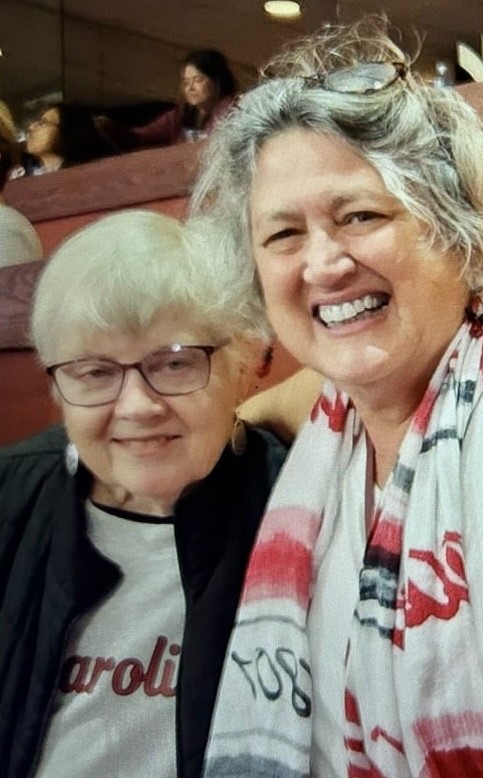
    sharing fun with our dear friend Saskia’s mother, Els, yesterday

    Els and her husband, Carl, are our Dutch friends from The Netherlands and have been on an extended rare visit to see her daughter and grandson, Finn, the youngest grandchild (but who will unbelievably be 15 this month!). Carl, Pretty, and Saskia graciously allowed Els and me to exchange family news, personal health issues, the deliciousness of American tomatoes, and generally enjoy each other’s company for a couple of hours as Els and I both near eighty years of age in 2026.

    Our shared friendship across the Pond through the years is a reminder that love has no boundaries, there are no obstacles too difficult for kindness and respect to overcome, and that Time waits for no one. Thanks to Saskia for the special photo of her mother and me.

    We talked about the possibility of this being our last visit, but we pledged to hope together it is not.

    Safe travels, Els and Carl. Until we meet again.

  • Reflections on Disney, America’s Shutdown and No Kings Day

    Reflections on Disney, America’s Shutdown and No Kings Day


    Jumbled words. Fragmented phrases. Images of Disney World still swirling in my mind. It’s a small world after all, isn’t it. Is it?

    While we frolicked with thousands of people from around the “small world” of Disney in Florida two weeks ago, the United States began what has become the 4th. longest shutdown in American history. As of October 17th. approximately 900,000 federal employees have been furloughed, and many of those who remain have not been paid. Many will be laid off, permanently. The shutdown began on our granddaughter Ella’s sixth birthday, the 1st. day of October.

    As we rode the rides in Disney World for Ella’s special day, federal forces and members of the Tennessee National Guard were deployed in Memphis, Tennessee, as part of the Trump administration’s overall plan to send federal troops to American cities including Los Angeles, Washington, D. C., Portland, Oregon, Chicago, and the southwestern border.

    Jumbled words. Fragmented phrases. Images of Disney World still swirling in my mind. It’s a small world after all, isn’t it. Getting smaller, I fear, for my little granddaughters.

    In a telephone call with one of my favorite first cousins earlier this week, I mentioned I had the overwhelming feeling I was “winding down” in my life to which he responded, you’re not winding down anywhere, you’re cruising. The thought gave me pause because I do feel the inclination to let it all go, as three-year-old Molly loudly sings with her hero Queen Elsa in Frozen; sorry, Sweet, too soon to cruise past your future without protest.

    Tomorrow is another No Kings Day of Protest. Remember the words of Congressman John Lewis about the purpose and power of our protests. Protest is an act of love, not one of anger.

    Share the love. Equality is for everyone.

    ******************************

    Slava Ukraini. For the children.