Category: Reflections

  • O say can you TELL by the dawn’s early light?


    I find I have been quick to judge our American swimmer Ryan Lochte for his behavior away from the pool in Rio de Janeiro during the Olympic games, and I had a few minutes to sit in my favorite chair this morning to ponder his trials and tribulations while I was waiting for T’s physical therapist to arrive. I love to ponder – particularly when the house is quiet, and today was no exception.

    I read moments ago that Speedo and Ralph Lauren  severed their endorsement relationships with Mr. Lochte which led me down the meandering  pondering  quite smug path of See there, I told you so. When you play, you pay…an ounce of prevention is worth a pound of cure. Why didn’t you stick to pool parties…I went on and on with this conversation in my mind because it’s a replay of how I’ve felt since the bizarre incident occurred in Rio. Really, Ryan, how stupid could you be. You’re thirty-two years old, for crying out loud. You’re old enough to know better.

    Whoa, Nellie…hold your horses. Old enough to know better – that stopped me in my instant replay.  Hm.  Now what was I doing when I was thirty-two years old…that would have been 1978. Hm….meander, meander some more… I was living in Columbia by then and had met the person that would become my lifelong friend but was at the time my best drinking buddy Millie Miller who was happy to spend many evenings with me at local bars until they closed in the wee hours of the morning.  We weren’t always in the best shape when they closed, either. Really, then, people who live in glass houses shouldn’t cast stones, although admittedly my glass house wasn’t part of an international Olympic Games and I wasn’t representing my country at the time. Not to split hairs, of course. The two similarities of this story were thirty-two years old and intoxicated, as I rambled along in my mind. Don’t try to make more of it than that.

    So it wasn’t the drunken public exhibition by a member of Team USA in a foreign country that continued to nag at me in the Lochte saga although that would have been enough to keep the story churning. I could finagle that around in my mind to somehow relate to his wanting to celebrate with his teammates after the medals were handed out. Something to be ashamed of when he sobered up, but mistakes are surely made by us all – usually not in front of a gazillion people but hey, nobody’s perfect.

    No, that wasn’t the nagging current flowing through my stream of consciousness this morning. It was the lying – an amazingly creative lie to be sure – but a lie nonetheless… followed by his inability to say Hey, I lied about it, and I’m sorry.  Instead, the lie became his “over-exaggeration” of the truth which sounds strangely similar to the acceptable “little white lie.” Ding, ding, ding goes the alarm bell. Don’t tell that to the Brazilians.

    Somewhere in my mind there is a disconnect between what used to be known as the truth and what now has become an inability on a grand scale to define. Lying is a way of life in our family relationships, business dealings, political discourse, religious institutions, collegiate locker rooms, football weights, beauty pageants and just about anything else you can think of. You name it – we can lie about it with gusto and embellishment.

    I am beyond weary of lies and liars.

    But this is clearly not a new problem of the 21st. century.  The major religions of today have all weighed in against lying thousands of years ago via stone tablets and whatever else they could find to write on plus probably on cave walls before that. The universal consensus was that lying is fundamentally wrong but truth is subject to interpretation. My truth might not be your truth, and vice versa.  Clearly Ryan Lochte subscribed to that theory when he invented his own elaborate version of the truth and then tried to redefine it.

    I should never have gotten started on this mind meandering today. I feel like I’m digging myself deeper and deeper into a meaningless hole and I hear the voices of my Texas heroines Molly Ivins and Ann Richards hollering from their graves to admonish me that when I find myself in a hole this big, I need to stop digging.

    And so I shall. Team USA won forty-seven gold medals at the 2016 Olympics in Rio;T and I heard the Star-Spangled Banner played for many of those medal ceremonies from her hospital room following her successful knee replacement surgery last week and from our bedroom where she continues to recover this week.  Each time we heard it was special with the expressions of the champions ranging from smiles of happiness to tears of joy to thoughtful reflections of awe and wonder…they were moments of truth we shared with them. At least, that’s how my mind meanderings like to think about it. Somebody stop me.

  • I Give Up


    Big “D”, little “a”, double “L”  – a – s. Dallas, Dallas, Dallas, another notch in your gun belt this week; more snipers take a shot at our ability to wage peaceful parades and protests  while the face of violence lights up within your city limits. Shades of 1963 when you were the harbinger of our national nightmares to come.

    I am outraged at the environment of fear and desperation that leads men to believe that shooting each other with guns or blowing up each other with bombs is the only solution to our problems within our borders and across the pond. Prejudices over skin color and religious practices cross oceans, span continents and land right at our doorsteps. And since we have the right to bear arms, we also have the right to shoot them – at each other.

    Policemen who are sworn to protect us become caught up in a kind of madness that makes them so suspicious and fearful of  people of color that even routine traffic violations can turn into scenes of degradation and death.  Lives are changed forever – death is permanent – there is no taking back the gunfire that kills an innocent man or woman: no do-overs. And it’s not just that one life taken. The ripple effect in the lives of families and friends is also never-ending.

    Take Back the Night? Hardly bold enough. Give Back the Light, I say. Give back the light of acceptance of citizens regardless of race or who they love or where they worship, but without apathy toward those who struggle with less. Acceptance without apathy – do we have leaders capable of recognizing the reality of the feelings of Powerlessness that drive men to fire gunshots against the Powerful…I wonder. And can the Powerful be changed to look beyond the obvious to the pain below the surface…I wonder.

    Blessed are the peacemakers, for they shall be called the children of God, Jesus said in his sermon on the mount. I am looking for the peacemakers, I am waiting for the peacemakers, I am hoping that they find their way to Dallas, Texas tonight.

    Otherwise, I give up.


  • Franciscan Peace Prayer


    Lord, make me an instrument of Thy peace;

    Where there is hatred, let me sow love;
    Where there is injury, pardon;
    Where there is error, the truth;
    Where there is doubt, the faith;
    Where there is despair, hope;
    Where there is darkness, light;
    And where there is sadness, joy.

    O Divine Master,
    Grant that I may not so much seek
    To be consoled, as to console;
    To be understood, as to understand;
    To be loved as to love.

    For it is in giving that we receive;
    It is in pardoning that we are pardoned;
    And it is in dying that we are born to eternal life. Amen.

  • Please Pardon this Interruption from the 2016 Campaign Trails


    The summer of 1960 was a hot one in Texas, as most summers are, but the temperatures at my grandmother’s little round kitchen table where I had eaten for fourteen years were even hotter – and the cause wasn’t just the heat from the frying pan on the stove that held the delicious fried pineapple pies she’d fixed for dessert. Nope. Presidential politics was the fire-starter that summer at our kitchen table and many others around the country. Democratic  nominee John F. Kennedy versus Republican standard-bearer Richard Nixon was a hot topic for us.

    My family that gathered around the kitchen table had always voted Democratic. They were the quintessential yellow dog Democrats and lovers of Franklin Delano Roosevelt who, they believed, was responsible for putting an end to the Great Depression of the 1930s and bringing a successful ending to WWII. After all, both of their sons had crossed the Pond to place their very young lives in harm’s way for their country, but President Roosevelt had brought them home without a visible scratch. Democrats were “for the people,” as my grandfather never failed to remind me whenever he had an opportunity. He rarely had any opportunity since my grandmother held court in most of our family discussions – which made any remarks from my grandfather more memorable to me.

    In addition to their faith in the Democratic Party, however, all of us at the kitchen table – and beyond were members of a small Southern Baptist church in our town. My paternal grandmother, Ma, was very proud of her church attendance and the Christian heritage that went with it. Her faith itself was a mixed bag since she couldn’t keep herself from poking fun at the minister’s sermons every Sunday, but she had very definite opinions on every religious topic including her suspicions regarding the Catholic Church, the Pope and her Polish neighbors who went to the Catholic Church ten miles away in Anderson. My grandmother was prejudiced against Catholics, among other groups.

    Here was her dilemma in that hot summer of 1960. The Democratic nominee, Senator John F. Kennedy, was a Catholic. Not just a little bit Catholic, but a whole lot Catholic. He was a card-carrying Catholic, and his family had been Catholics as long as hers had been Baptists and Methodists. Mr. Nixon was not a Catholic. He was a Quaker, of all things, and that really didn’t suit her, either; but she knew Quakers didn’t have a Pope.

    My daddy and grandfather argued for JFK at that little table and in other, more public places, and said the idea that he would be taking orders from the Pope in Rome was ridiculous. For one thing, he would be so busy with the Russians that he wouldn’t have time to talk to the Pope about every little matter that came up and plus, with Lyndon Johnson as Vice-President to keep him in check, no Pope could get past him. Lyndon was a Texan who was also a savvy politician in the Democratic Party and hadn’t Senator Kennedy made a wise choice in choosing a man who could move things along up there in Washington without any help from a Pope.

    My little kitchen table was a microcosm of the larger anti-Catholic sentiment that was one of the major campaign issues in 1960 and a cause for one of the slimmest margins of victory in American presidential elections . In fact, Senator Kennedy made a swing through Texas with Senator Johnson on September 12, 1960 to give one of his most famous speeches to the Greater Houston Ministerial Association at the Rice Hotel in Houston, Texas. In that speech he emphasized the “far more critical issues to face in the 1960 election; the spread of Communist influence…; the humiliating treatment of our President and Vice-President by those who no longer respect our power – the hungry children I saw in West Virginia, the old people who cannot pay their doctor bills, the families forced to give up their farms – an America with too many slums, with too few schools, and too late to the moon and outer space. These are the real issues which should decide this campaign. And they are not religious issues – for war and hunger and ignorance and despair know no religious barriers.

    But because I am a Catholic, and no Catholic has ever been elected President, the real issues in this campaign have been obscured – perhaps deliberately, in some quarters less responsible than this. So it is apparently necessary for me to state once again not what kind of church I believe in, for that should be important only to me – but what kind of America I believe in.”

    And this is what he talked about in the speech in Houston that evening, an America where separation of church was “absolute” and an America where he wouldn’t be “accepting instructions on public policy from the Pope, the National Council of churches or any other ecclesiastical source…”

    Two years later on September 12, 1962, after John Fitzgerald Kennedy squeaked out his victory over Richard Nixon,  President Kennedy returned to Houston to address a crowd of 35,000 in Rice University’s football stadium. I was sixteen years old, just beginning my junior year of high school, and I was there. My dad took me. He said it was a once-in-a-lifetime opportunity to hear a great President speak in person, and he wanted us to go. There must have been something special about Houston for JFK – that speech became one of the cornerstones of the President’s space program.

    “We set sail on this new sea because there is new knowledge to be gained, and new rights to be won, and they must be won and used for the progress of all people…” I was mesmerized by the President’s words, his delivery and I was in awe of being a part of such an amazing crowd. It was a memory maker, as Granny Selma would say.

    The very next year in November, 1963 President Kennedy made a final trip to Texas, this time to Dallas, and was fatally shot while riding in his motorcade. I mourned with the rest of the nation.

    Fast forward to the Presidential Election of 2008. On November 04, 2008, President-Elect Barack Obama, the first African-American man to be elected President, gave one of his most famous speeches in Grant Park in Chicago, Illinois, his home town. I shared that moment with Oprah – she was there in person while I watched with Rachel Maddow from my living room. I was in love with another American President just like Annette Bening. Heady stuff.

    “If there is anyone out there who still doubts that America is a place where all things are possible, who still wonders if the dream of our founders is alive in our time, who still questions the power of our democracy, tonight is your answer.” he began and his message of “Yes we can” reverberated around the world to give hope that race should not be a barrier to leadership or equality.

    Finally this week, there is a presumptive Democratic presidential nominee in the person of former Secretary of State, former New York Senator and former First Lady of the United States and now the first woman ever to be nominated by a major political party: Hillary Rodham Clinton.  Another barrier comes tumbling down as all of us who are the survivors of the feminist movement of the 1970s are fortunate enough to witness the fruits of our labors. The bitter feelings of defeat after the Equal Rights Amendment failed to pass in South Carolina in the 1980s have been replaced by the fulfillment of the promises and dreams I first had when I watched the National Women’s Conference in Houston in 1977. Thank you, Shirley Chisholm, Barbara Jordan and Ann Richards. Thank you, Gloria Steinem, for the inspiration to do outrageous acts and everyday rebellions. Thank you, Hillary Clinton, for the massive undertaking of running for President. I admire your resilience and your abilities. Onward.

    Remarkably, in my seventy years, I have hit the trifecta! I have personally observed the prejudices of religion , race and gender be revealed to the world for what they are – excuses to exclude and divide people from each other – to build walls instead of bridges. By the dawn’s early light I’ve seen what so proudly we hail at the twilight’s last gleaming…a glimmer of hope for a level playing field for every citizen in our currently great country. Greatness does not mean flawless, but we can – and will –  continue to strive for the right.

    As for my grandmother and JFK, I will never know what happened when she voted in 1960 because she refused to tell despite the pleadings of my daddy. In the 1968 Presidential election when I was finally old enough to vote, I cast my first vote for Republican and Quaker Richard Nixon.

    My family was horrified.


  • Memorial Day Matters


    Last Sunday afternoon Teresa and Spike and I took advantage of the low humidity and spring-like weather that lasts about a minute in Columbia before we hit the days that make you feel like you could melt any second and drove over to St. Peter’s Cemetery downtown just off I-126. Remarkably, this was a cemetery we had overlooked in our graveyard tours in the past because of its proximity to the much larger Elmwood Cemetery which goes on forever.  (No pun intended.)

    What impressed me first was the large number of little American flags standing guard over the graves. It’s a common occurrence for soldiers’ markers to have the small red, white and blue colored flags flying above the veterans’ graves but usually only one or two families bother. Clearly, this was a concerted effort by someone or some group or perhaps St. Peter’s themselves to honor every fallen soldier. Luckily Teresa had her cell phone with her and was able to take pictures.

    Memorial Day Pictures from St. Peter's 7

    I was taken with the names of the veterans and wondered about their stories from the wars.

    Memorial Day Pictures from St. Peter's 9

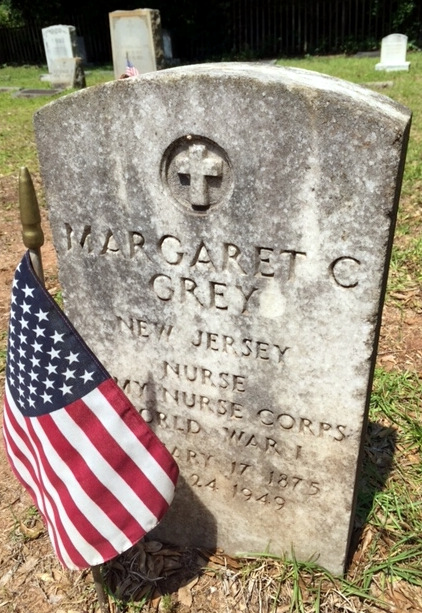
    What was a World War I army nurse from New Jersey doing in a Columbia, South Carolina cemetery, I wondered.  She was born just ten years after the Civil War and somehow ended up as an Army nurse in World War I.  Now she rests here with an American flag that acknowledges her service to her country and two visitors who would like to know how she came to be in this place.

    Memorial Day Pictures from St. Peter's 3

    James Riley was born in New York  in 1837 and actually served in the Civil War as a Confederate soldier; he died in Columbia in 1924. He is buried here draped with a flag that is the symbol of a country he tried to destroy. Yet, here he is – a survivor of one of the bloodiest wars in American history.

    Then there’s Sergeant Charles Edward Timmons, Jr. who served in World War I and was killed in action. His body is buried in France, but his family has honored him with a beautiful marker and  stone flag that flies every day so boldly it practically reaches out for your attention.

    Memorial Day Pictures from St. Peter's 6

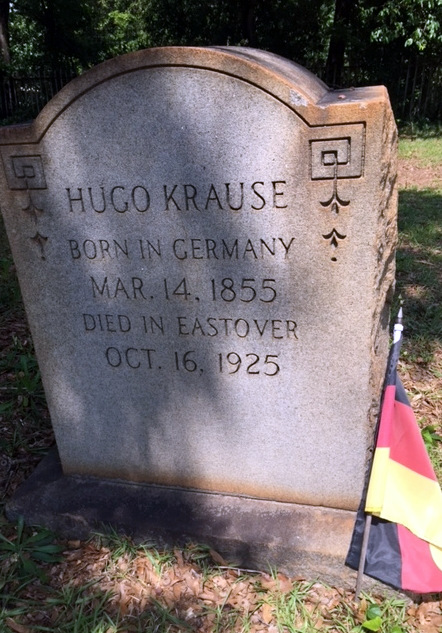
    We also saw one different flag – a German one – lying against a grave in St. Peter’s. Memorial Day Pictures from St. Peter's 8

    Hugo Krause was born in Germany in 1855 and died in 1925 in Eastover, South Carolina, which is a small town south of Columbia. Apparently Mr. Krause was also a soldier but served a different country in World War I. Someone is still proud of his German heritage.

    So the stones tell short stories of a few of the soldiers we honor this Memorial Day which is a day of remembrance for those who cared enough for what they believed in to offer up their lives to preserve those beliefs. I admire and respect these soldiers for their sacrifices.

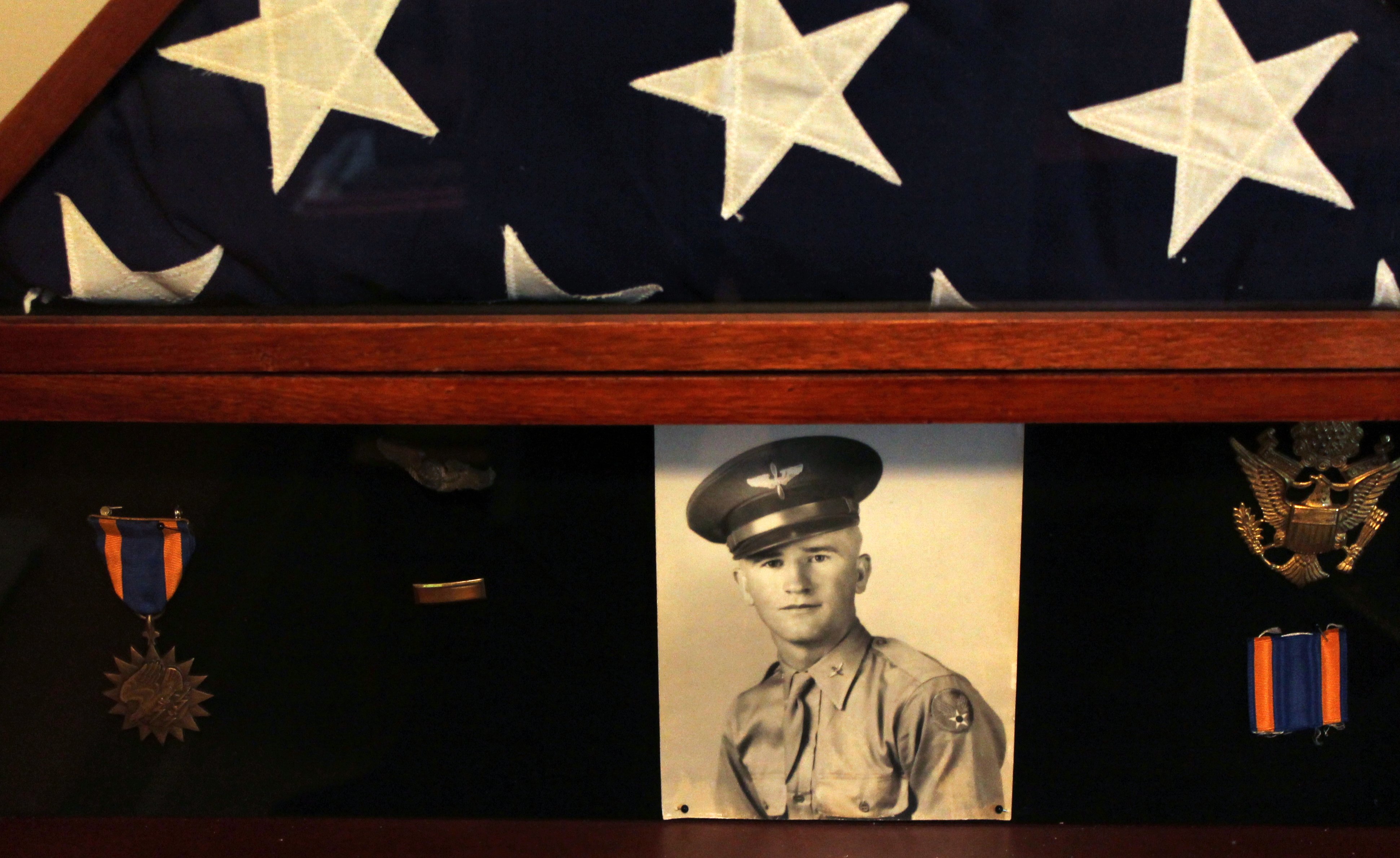
    My family had members who served in World War I and World War II as well as ancestors who served on both sides of the Civil War and some who date to the Revolutionary War for Independence in 1776. I obviously didn’t know many of them, but I did know my father who was a navigator in the Army Air Corps in 1944-45. He was nineteen years old when he enlisted and sent to officer training school in San Antonio.

    He served with the Eighth Air Force in England and flew thirty-two missions over Germany in the short time he was over the Pond. He was never proud of his assignments – the only thing he ever said to me about it was he felt he did his duty.

    002

    I am proud of the teenager who left his small rural Grimes County, Texas home town, family and friends to do what he thought was right. His country was proud of his service, too, and awarded him the Medal of Honor when he was discharged. On this Memorial Day I will once again respectfully remember  the young man who became the father I loved and all the daughters and sons, mothers and fathers who served in past years and those who serve today who will not be with their own families because they have a reason that puts them in harm’s way every day.

    Memorial Day matters.