For any who want more, complete list of all posts by month since 2011
  • valor above and beyond the call of duty


    I posted this originally on November 11, 2015 for Veterans Day  – I think it’s equally appropriate for Women’s History month in 2020. Be prepared.

    The Medal of Honor is the highest military honor awarded for “personal acts of valor above and beyond the call of duty.” It is awarded by the President of the United States in the name of the US Congress and so it is often known as the Congressional Medal of Honor.  The Navy began the award in 1861 during the American Civil War with the Army following suit a year later. Since the establishment of the award, more than 3,500 have been presented – 1,523 to honorees of the Civil War.

    One Medal of Honor recipient is a woman. One. Out of more than 2.2 million women veterans since the creation of the Medal of Honor, the solo female recipient is Dr. Mary Edwards Walker, a physician from New York,  who volunteered for and served in the Union Army as an Army Surgeon during many battles of the Civil War from the First Battle of Bull Run in 1862  to the Battle of Atlanta in 1864.

    Dr. Walker was captured by Confederate forces in April of 1864 after crossing enemy lines to treat wounded civilians in areas her fellow male surgeons refused to go. She was arrested as a spy and sent as a prisoner of war to a Confederate prison in Richmond, Virginia.  When she was released in a prisoner exchange in August, 1864, she suffered from partial muscle atrophy that disabled her for the rest of her life. At the end of the War in 1865, President Andrew Johnson presented her with the newly created Medal of Honor.

    Dr. Walker became a writer and lecturer following her service in the Army.  She wrote two books that discussed women’s rights including their right to dress as they chose, a cause she embraced personally as she was frequently arrested for wearing men’s clothing. She had grown up working on her family’s farm and had little use for the skirts and corsets women wore routinely in the late nineteenth century.

    In 1871 she registered to vote along with many other women who believed they  had the right to vote already guaranteed in the Constitution. This was the prevailing strategy for suffragettes initially in this country. Later on in the Suffragette Movement, the strategy changed to push for a Constitutional Amendment which would irrevocably provide women the right to vote. Dr. Walker didn’t embrace the new strategy and distanced herself from this new wave of feminists which was ultimately successful in helping to secure the passage of the Nineteenth Amendment that granted women the right to vote in 1918.

    In 1917 the Medal of Honor Board deleted 910 awards, including Dr. Walker’s, and the recipients were ordered to return their medals. Dr. Walker refused to return hers and continued to wear it every day as she had since the day she received it. She wore it until the day of her death on February 21, 1919 at the age of 87 – one year after the passage of the 19th. Amendment.

    On this Veteran’s Day in 2015, I salute Dr. Mary Edwards Walker, a soldier who showed personal acts of  valor above and beyond the call of duty in both her military service as a doctor during the Civil War which has been called one of the bloodiest wars in history and as a civilian who displayed the same courage in the battles for equal rights for women in the country she helped to unite.

    I also salute the more than 2 million women veterans who have served – and are serving in the US military today. The personal sacrifices you make – and have made- are acts of valor and deserve recognition above and beyond what you receive.  I find it shameful that only one of you has been awarded the Medal of Honor. Surely history will rectify this oversight at some point. Until then, you have my admiration, respect and gratitude.

    P.S. President Jimmy Carter restored the Medal of Honor to Dr. Mary Edwards Walker in 1977.  As of this March, 2020 no other woman has received the Medal of Honor.


  • lessons in survival: the unsinkable Violet Jessop


    Twenty-four-year-old Violet Jessop, the daughter of Irish immigrants who lived in Argentina when she was born in 1887, worked as a steward on board RMS Olympic, the largest civilian luxury liner of its day,  when it collided with the British war ship HMS Hawke on September 20, 1911. The ship returned to its port at Southampton in England without sinking and with no fatalities.  Seven months later Jessop was hired to work aboard the RMS Titanic which set sail on April 10, 1912 and famously sank four days later after striking an iceberg in the North Atlantic. Violet escaped via lifeboat in that historic accident which took the lives of more than 1,500 people.

    Despite surviving two dangerous threats to her life at sea, Violet became a stewardess for the British Red Cross during WWI on a hospital ship  HMHS Britannic that had been converted from a commercial liner. On November 21, 1916 the Britannic sank in the Aegean Sea and took 30 lives out of the thousand on board. Again, Violet Jessop survived – this time by jumping from a lifeboat threatened by the ship’s propellers.

    the unsinkable Violet Jessop

    (1887 – 1971)

    (Wikipedia image)

    What drew me to the Wikipedia stories and the piece by Katie Serena in History Science News that were my sources today was the concept of women who survive…whatever life throws at us. Most won’t be on a huge ship about to sink in the Atlantic Ocean like Violet was when she was such a young woman; but all of us face difficulties throughout our lives that threaten to drown, overwhelm, instill fear, panic, the desire to escape. Sometimes our lifeboats hang by ropes of uncertainty amid the shipwrecks that interrupt smooth sailing.

    And yet, the poet Garth Brooks reminds us not to “sit upon the shoreline and say you’re satisfied…choose to chance the rapids and dare to dance that tide.” – The River

    Violet Jessop dared to dance the tide.

    Stay tuned.


  • STRONG IS THE NEW PRETTY: CELEBRATING MARCH MADNESS!


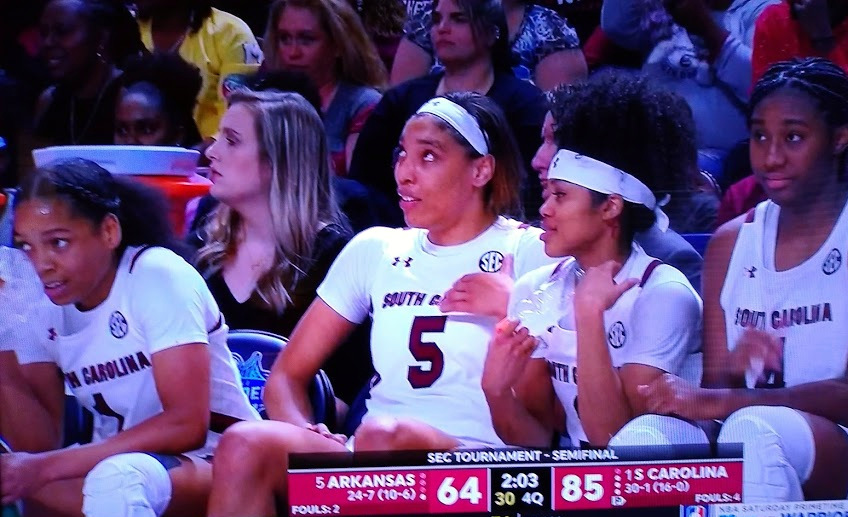
    I’ve never had any doubt about the different strengths of the women in my life, but it sure has been fun watching a team of young women who have proven their physical strength, endurance,  and mental toughness to the many fans who have had the opportunity to see them in person or have watched them on television during the 2019 – 2020 NCAA women’s basketball season. The University of South Carolina women’s basketball team has been rated Number One in the nation for the past 9 weeks. Last week they finished their regular SEC season with a perfect 16 – 0  to place first in the conference. This past weekend at Bon Secours Arena in Greenville, they won the annual SEC tournament championship as well.

    If strong is the new pretty, these young women are gorgeous!

    Senior leadership we will miss next year:

    Kiki Herbert Harrigan and Ty Harris

    Mad Kiki and Chill Ty – you girls have been the best – thanks for your guts and glory!

    Zia Cooke, Victaria Saxton, Destanni Henderson, Aliyah Boston

    They will be back – and they’re fierce!

    Winning is the most fun!

    Slo, Pretty, Gamecock G,

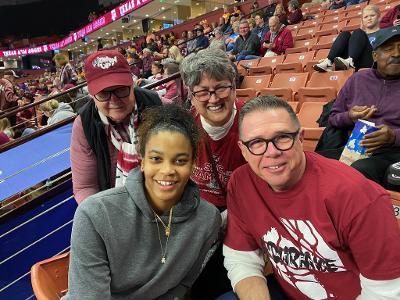
    with outstanding player Lele Grissett who had a great season!

    Hey, Ref, don’t mess with my team!

    The women who make our Gamecock basketball go round:

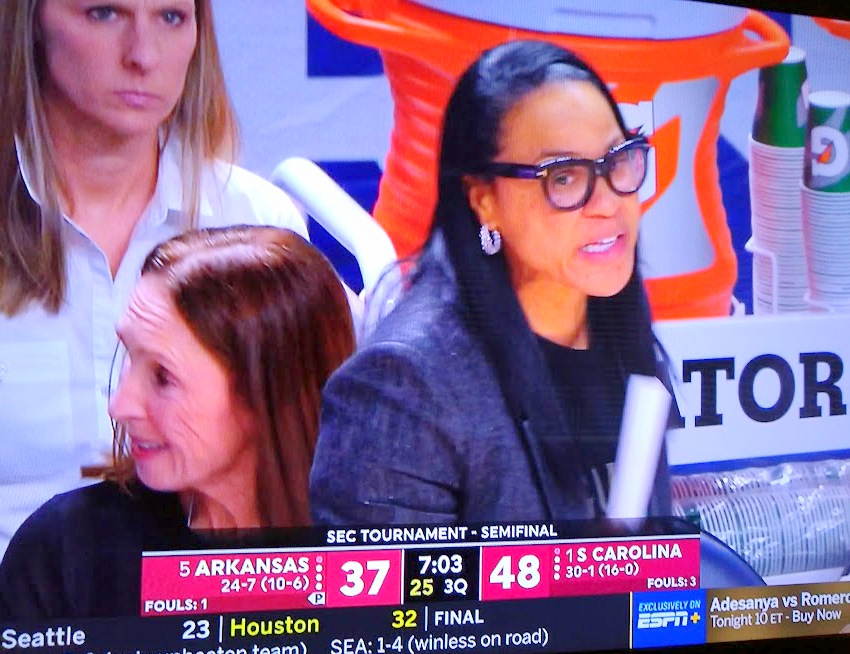
    Head Coach Dawn Staley and Associate Head Coach Lisa Boyer

    Huge congratulations to Coach Staley and the Gamecock women’s basketball program for a wonderful  regular season. As Coach says to her players, don’t flinch now. Onward.

    Stay tuned.

    (Clearly, I lifted most of these pictures from ESPN’s game coverage without their permission, but the picture of Lele Grissett with her fans courtesy Brian Murrell.)


  • remembering The Red Man (December, 2000 – February 22, 2016)


    The good news is the Angel Band played, Big Dawg Bernard came to The Middle to announce promotions and this time when the roll was called up yonder The Red Man’s name was on it. He made it to the Top and joined his running buddies Tennis Ball Obsessed Chelsea, Paw Licker Annie, Smokey Lonesome Ollie and even ran into Sassy the Old One. It was a joyous reunion – everyone was happy to see him…well, maybe not happy…more like glad he made it, if you catch my drift.

    In September, 2010 Red began the rants and raves with his post I’m a Talker which produced the first two “Likes” he ever had: Wayside Artist and Terry1954. They have stayed with us for the whole ride with Red and Pretty and the Old Woman Slow and the rest of the cyberspace folks who gave us 69,666 hits in the past six years while posting 666 posts – a nice number to end with, don’t you think?

    It’s very hard for me to let go of Red’s Rants and Raves but I find it difficult to “edit” for Red when he no longer dictates to me while lying next to my feet as I sit at my desk. I feel I have to let him rest in peace with his brother and sisters.

    I hope all of Red’s 1,649 followers will follow me to my I’ll Call It posts (www.iwillcallit.com.)  – I think many of you already have – and so the writings and photos from Casa de Canterbury will continue on my other site, hopefully with Red’s keen insights and observations serving as my muse when the days lack inspiration otherwise.

    I thank all of you so very much for the “likes” and “comments” and hits through the past six years. Truly Red’s Rants and Raves changed my life.

    Get me outta here, Percy – and he did.

    Red’s favorite spot…in Pretty’s lap getting Pretty pets


    in the beginning was The Red Man…

    and the Old Woman Slow loved him

    (Posted on Red’s Rants and Raves September 02, 2016)

  • celebrating Black History Month with Pearl


    In the tiny Sears Roebuck kit house I grew up in, boundaries were both invisible and highly visible. The home was owned by my maternal grandmother and shared with two of my mother’s adult brothers in addition to my daddy, mother and me. The home was crowded. When I think back on it, I don’t know how we all managed to eat and sleep there – not to mention the scheduling of everyone’s turn in the single bathroom which barely had space to turn around to close the door after entering. That room was tight, and boundaries were tightly defined.

    While the home itself was small, the lot on which it sat was large, a corner lot with an unattached garage (with an attached outhouse that may help explain the bathroom scheduling inside) behind the house. Beyond the garage a small pond which we called a tank in rural Texas lay quietly in an “in-town” pasture that had no fences. My back yard was spacious, vast in a small child’s mind, unique in comparison to the other small frame houses sitting on the few dirt roads that connected them.

    Although the tank wasn’t very big, the fish and frog population that lived there mysteriously thrived, encouraging our relatives from the bigger cities of Houston, Dallas, Rosenberg, et.al., to make regular fishing trips to our place “in the country.” They came with their poles, rods, reels, live and artificial bait to try to land Ol’ Biggie, the name my Uncle Toby gave to the wiser large perch and catfish that proved elusive most of the time. During those early years I preferred running around the banks of the tank with my cousins to dropping a line with a squiggly worm in the water.

    At random times, though, I made an exception to enjoy the company of a full-bodied black woman named Pearl who walked across another invisible line to come fishing in our tank. One paved road we called main street distinctly divided black and white people in my community in those days in the late 1940s and early 1950s;  that street should have been painted blood red. Pearl lived in an area of town on one side of the street I knew simply as The Quarters. I would be much older when I realized the name referenced slave quarters that still separated her world from mine.

    Pearl told me the best stories about all the fish she had caught in the hottest fishing holes around the county. I believed every word she said because I trusted the deep rich voice that spoke. Pearl and my grandmother were good friends who visited together whenever she got ready to leave with her bucket full of fish. Pearl had the best luck catching perch in our tank – never very large – but she bragged that the little ones were better to fry anyway. Made sense to me. My mother also adored Pearl which surprised me since Mama didn’t adore anyone including herself.

    Pearl Harris was the first black person in my life. She was warm, affectionate, funny and always kind to me. I have no idea how she came to be friends with my grandmother. I suspect they met in the general store in town where my grandmother clerked. Whatever the circumstance, I felt their friendship was authentic. They were easy with each other. I now know Pearl’s walk across the invisible racial divide to our fishing tank was not only brave but necessary to put food on the table for her family. My grandmother could relate to that need, too.

    Wanda Sykes says in her Netflix comedy routine that I’ve watched at least four times now, seriously, at least four, that all white people need to have at least one black person who is their friend. Wanda thinks that friendship just might be a starting point to heal the racial divide that is at the center of income inequality and a host of other problems in our country. From a little girl growing up in a Texas town big enough for only one general store but large enough to contain two worlds separated by skin colors of black and white, I say I couldn’t agree more, Wanda. Bravo.

    RIP Pearl Harris (1893 – 1957).

    Stay tuned.